Why Monitoring Center Staffing Models Break Down When Alert Volume Spikes
Fixed human review capacity can't absorb surges, so filtering must come first.
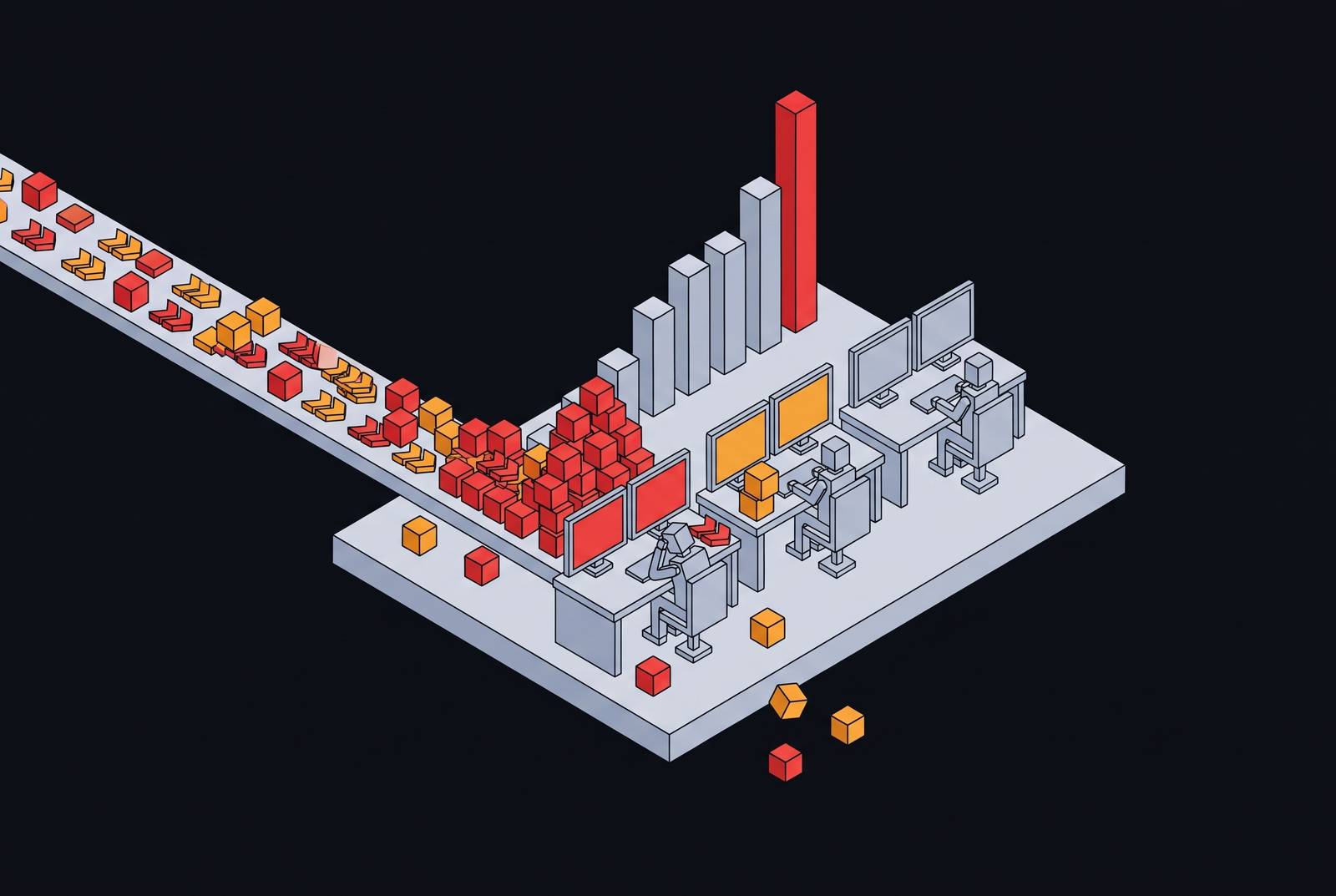
Alarm response time failure in traditional video monitoring centers begins when alerts arrive faster than operators can investigate them. Fixed human review capacity cannot absorb an episodic surge, so genuine threats wait behind noise until the window to act may have closed. Adding staff can increase throughput, but resolving the failure requires an architecture that filters noise before it reaches the human response queue.
Why the spike-staffing assumption is wrong from the start
The intuitive response to an overwhelmed monitoring center is to ask why more operators were not on duty. That question assumes the workload was predictable and the shift was simply understaffed. Traditional monitoring models are built around a relatively steady background rate of alarms, with a fixed operator count reviewing them in sequence. A spike breaks that assumption at its foundation. It compresses work into a short period rather than distributing it across the hours available to process it.
The distinction is between staffing for ordinary demand and absorbing a sudden concentration of alerts. More people can process more work, but that does not mean a linear staffing model can follow nonlinear demand quickly enough to preserve response times. Attendance is not the central issue here. What does the queue actually look like when volume spikes, and why cannot more operators solve it?
Why do monitoring centers fall behind when alert volume surges?
Consider a property where many cameras pick up motion events at the same time after hours. The alerts arrive in the same queue at the same moment, while the operators assigned to review them are already handling other alarms. A single event can fan out across sensors, feeds, and systems, producing several signals that each demand attention. The workload grows faster than the underlying event count. Whether the property is commercial, multifamily, or industrial, the processing problem is the same.
Operators must check those signals before they can tell ordinary activity from a genuine threat. Until that investigation happens, the queue contains unverified alarms rather than a reliable ordering of incidents by urgency. Without real-time context, selecting an alarm for immediate review means making a decision before the evidence needed to support it has been gathered. The real threat may therefore sit behind routine motion events, even when everyone on shift is working without a break.
As incoming volume exceeds review capacity, unfinished work accumulates. The end of the spike does not erase it. New alarms continue to arrive behind earlier ones that have not yet been investigated, so a brief burst can create a much longer period of delayed response. If ordinary arrivals consume the available review capacity, there is no spare capacity with which to clear the backlog. Even with some spare capacity, clearing the backlog takes time, and threats go unresolved while that work is done.
That pressure changes the work as well as its timing. Operators facing an expanding queue must either preserve the time spent investigating each alarm or shorten their reviews to move through more of them. The first choice lengthens the wait for later events, while the second risks weakening the triage decision. Neither choice adds information that the alarm itself does not have. A monitoring center can therefore fall behind without an absent employee or an idle workstation, because the queue demands more timely investigation than its human reviewers can supply.
How cognitive limits accelerate the breakdown during high-volume periods
The queue model becomes more severe when it accounts for the people processing the alarms. Human reviewers do not maintain steady-state accuracy indefinitely while simply taking longer to finish the work. Their attentiveness and accuracy decline as exposure to high alert volume continues. A model based only on ordinary review speed misses the deterioration in decision quality that accompanies a sustained backlog.
Shahroz Tariq and colleagues, in research published in ACM Computing Surveys, identify alert fatigue in security operations as a structural problem driven by four categories of causes. The research describes an environment in which analysts face tens of thousands of daily alerts and only a small fraction correspond to genuine threats. It also cites empirical studies that found false-positive rates of nearly 99% in security operations centers. Those figures measure security operations and do not measure how well video monitoring performs.
Lewandowska et al., in Intensive and Critical Care Nursing, document selective staff responsiveness to alarms as a behavioral consequence of high alarm volume. Staff reported that alarms caused fatigue and negatively affected their work. The shared mechanism is desensitization to a continuous stream of low-actionability signals, which weakens the urgency response when a genuine event appears.
Within a monitoring queue, that adaptation has a dangerous logic. Repeated exposure teaches operators that most alerts are noise, so they begin evaluating new alarms with that expectation. The expectation is understandable but operationally hazardous. A genuine threat entering the same stream can receive the same initial deprioritization as the routine events that preceded it. Under backlog pressure, faster and coarser judgments can then produce missed events, extending the duration of an incident already in progress.
Burnout and turnover follow from this operating condition. When experienced operators leave, knowledge of what normal activity looks like at a particular site leaves with them. That knowledge helps distinguish routine activity from suspicious behavior. Its loss can increase false positives and force more work back into the review queue.
Why conventional staffing adjustments cannot fix a queue math ceiling
Each operator can investigate only a finite number of alarms in the time available, and prolonged overload can reduce the quality of those investigations. Adding colleagues raises aggregate throughput, but it does not remove the time required to assess each event. More capacity is not the same as elasticity. The binding constraint is the relationship between episodic arrivals and the human review capacity available during the response window.
Having enough staff for the worst possible peak would mean keeping people on hand who have no alarms to review during ordinary periods. Yet spikes are episodic and cannot be treated as a dependable shift pattern. A peak may occur once a week, once a month, or in response to an external event, making permanent worst-case staffing economically prohibitive. Shift tuning can redistribute scheduled labor, leaving the review process to absorb the same concentrated demand during an unpredictable burst.
Offshoring changes the labor cost without changing that process. An offshore operator still has to check an unverified alarm, work out its context, and decide whether it needs action. The queue calculation is identical to the domestic one. Lower-cost staffing may make additional seats affordable, but it does not make human investigation instantaneous or immune to fatigue.
Threshold muting takes a different route by reducing the number of alarms entering the system. Silencing noisy cameras or lowering sensitivity can relieve queue pressure by removing coverage while leaving the investigation process unchanged. A muted camera is not being monitored. The apparent improvement in workload therefore comes with a change in what the center is able to detect. Fewer queued alarms are not evidence of better protection when the reduction comes from suppressing the signals themselves.
Overage pricing likewise changes what is paid while leaving the processing architecture in place. Vectra AI’s 2026 report found that 63% of security alerts go unaddressed in security operations. A threat waiting behind fifty uninvestigated alarms remains in that position whether the operator is billed at standard or overage rates. To change that outcome, the architecture must change which alarms people have to review.
What a structurally different architecture does instead
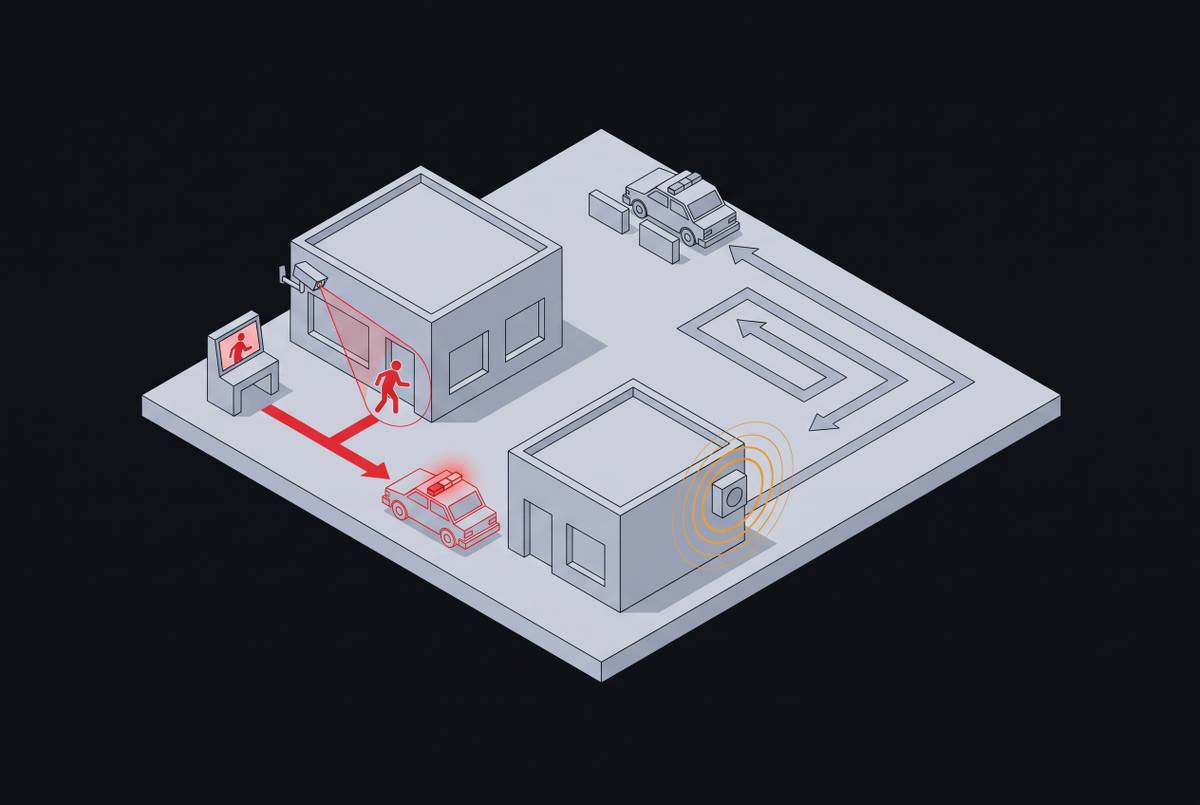
A different architecture separates filtering noise from acting on verified threats. Instead of making human operators investigate the full stream of raw alarms, it assigns the filtering work to a system that does not tire or depend on sequential human review. Trained people remain responsible for the judgment required to respond. Their attention is reserved for a narrower workload. The goal is not to make operators rush through a surge, but to prevent raw surge volume from becoming their investigation queue.
AI agents serve that purpose by reducing the queue before it reaches an operator, rather than merely accelerating the same human-led process. The important distinction is between notification and reasoning. A sensor that fires on motion reports a change, while an agent can classify objects, evaluate site-specific context, and require behavioral thresholds to be met before escalating. An architecture that forwards every motion event to a person has retained the original bottleneck, even if it describes the notification stage as intelligent.
CORTEX research shows how multi-agent architectures can cut false positives by a large amount and improve the quality of investigations compared with single-model approaches in security operations. Specialized agents handle behavior analysis, evidence gathering, and reasoning separately before synthesizing a decision. This divides the investigation into distinct analytical tasks. Its relevance to monitoring architecture is the separation of evidence-based triage from the human response workload. The research supports a design principle but does not guarantee that every system using AI will work well.
An agent that knows a loading dock is active until midnight does not escalate a forklift at 11 PM simply because motion has occurred. Without that context, the same activity can become another false alarm competing for human attention. Context changes how the activity is interpreted. Schedules, authorized activity, and known environmental noise let a behavioral threshold fit the site, so every movement detected need not be treated as equally suspicious.
AI triage can introduce errors, and that objection cannot be dismissed by invoking automation alone. An agent applying a site-specific protocol and behavioral threshold makes a more consistent, auditable decision than a fatigued operator rushing through a surge, but consistency does not itself establish correctness. Calibration still determines which events are escalated. The error mode shifts from variable cognitive fatigue toward systematic calibration, which can be corrected. For the architecture to help, a model placed ahead of the existing queue needs to reason well and have the right context.
For security buyers, the lesson is to ask what happens to alerts during a spike rather than treating operator count as the decisive measure. The answer needs to tell raw notifications apart from verified threats and explain where alerts are filtered before a person needs to review them. It must also distinguish reduced noise from reduced coverage. A real threat needs an available, informed person while action is still possible.
Sources
- Alert Fatigue in Security Operations Centres: Research Challenges and Opportunities
- What Is Alert Fatigue? Causes, Impact & How to Reduce It
- CORTEX: Collaborative LLM Agents for High-Stakes Alert Triage
- Veritas-RPM: Provenance-Guided Multi-Agent False Positive Suppression for Remote Patient Monitoring
- Improving alarm management to reduce alarm fatigue in critical care: a mixed-methods study - ScienceDirect