Verified Alarm vs Unverified Alarm Dispatch Policies
Cities are shifting police response based on whether alarms have corroborating evidence.

If a commercial alarm trips tonight, the question of whether an officer actually shows up depends less on the alarm itself than on a policy decision made somewhere in city hall. Verification status now functions as a gating condition in a growing number of U.S. jurisdictions, so an alarm signal with no corroborating evidence behind it may never generate a dispatch. Seattle made this explicit on October 1, 2024, when the Seattle Police Department implemented a policy of non-response to unverified alarms, closing out years of escalating false-alarm volume with a formal line in the sand. Only a small share of U.S. law enforcement agencies have gone this far, so verified response is still a minority practice. The trend line still points in one direction, and that direction matters more than the current adoption count.
The policy has not gone uncontested. South Salt Lake City, Dallas, Madison, San Jose, and Henderson have all tried verified response at some point and reversed course under political or public pressure. Agencies that walked back non-response still face the same patrol math that pushed them toward it in the first place: officers sent to confirm nothing, over and over, on calls that carry no advance evidence a crime is underway. The policy fight is about who absorbs that cost, not whether the cost exists.
The false-alarm rate that broke the unverified dispatch model
The shift toward verified response did not start because of an ideological position about alarm companies or property owners. It came from arithmetic. When the overwhelming share of incoming alarm activations turn out to be false, every unit sent to confirm one is a unit not available for a call where something is actually happening. San Jose police handled a large volume of alarm calls in 2025, a substantial share of all calls for service that year, and filed reports on 102 of them. Of those 102, only 11 ended in an arrest or criminal citation. That ratio is the pattern departments across the country have been staring at for years, in one form or another.
A federal problem-oriented guide on false burglar alarms lays out the same mechanism nationally: the vast majority of alarm activations police respond to turn out to be false, and each one consumes a significant block of two officers' time. The guide's most-cited cost estimates trace back to 1998 and 2002 data, and no newer authoritative national figure has replaced them since. That dating matters, because it means departments have been managing this problem with decades-old baseline numbers even as alarm volume and technology have both moved on.
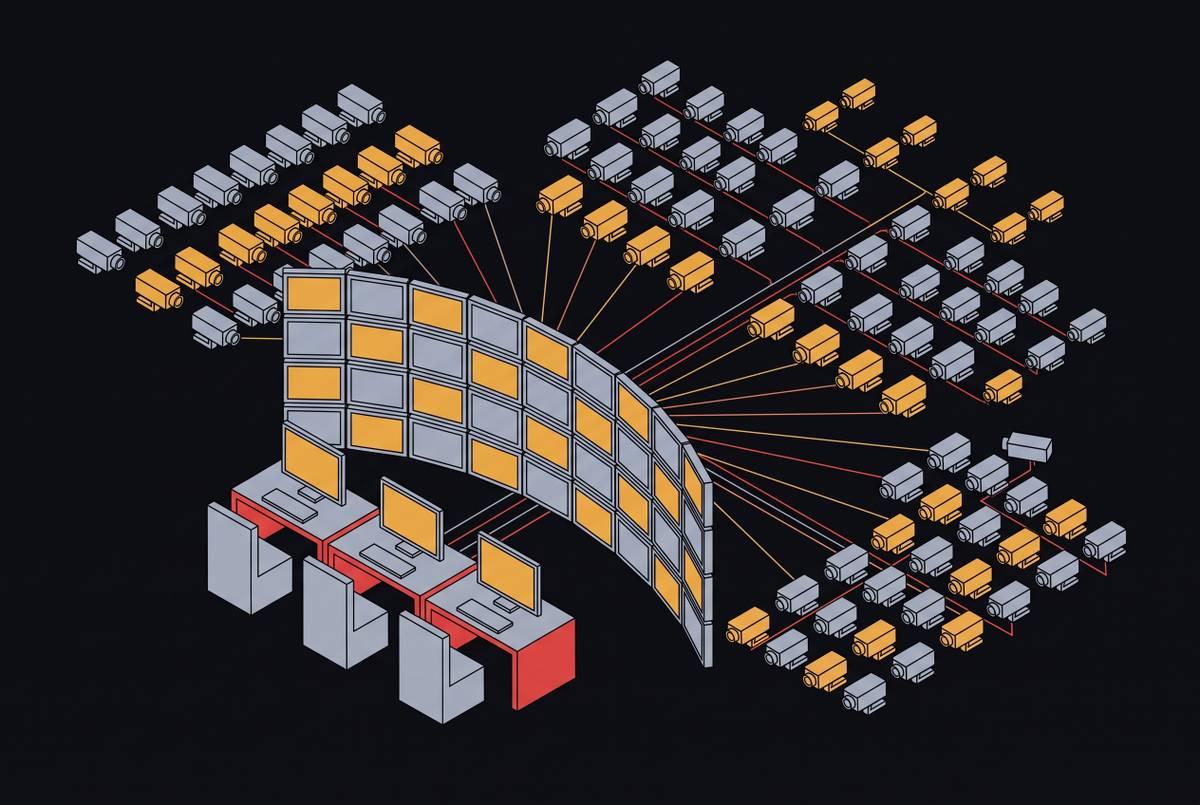
The root causes behind most false activations are almost comically mundane: a door left unsecured, a window not latched, a pet moving through a space the sensor covers, equipment that has started to fail. None of that is crime. An unverified sensor trip, by itself, carries almost no information about whether a crime is occurring, and that is the core failure of the old dispatch model: it treated a signal with no evidentiary content as though it warranted the same response as a confirmed threat. Inside a monitoring center, the effect compounds. When most incoming signals are noise, the queue fills with false positives faster than any operator can sort the real threats out from underneath them, a structural defect in how the signal is generated rather than a staffing shortfall that more hires would fix.
This is not a residential quirk that commercial operators can shrug off. The DOJ data and the San Jose figures cover commercial and residential alarms together, but retail operators show up on their own in false-alarm data as a chronic-offender category. A business running an unverified system is not exempt from the queue it creates; it is often adding to that queue at a higher rate than the house next door.
The priority-tier system dispatchers use for alarm calls
Inside a computer-aided dispatch system, an unverified alarm call is assigned the lowest priority tier. That placement means it waits behind every higher-priority call active on the shift, which, on a busy night, is nearly everything else in the queue. Shots-fired calls, domestic violence in progress, and injury crashes: all of these move ahead of an unverified alarm automatically. When an officer finally does free up, the alarm often rolls without lights or sirens, because nothing in the call justifies it.
A handful of specific conditions can push an alarm up that queue. It counts if the monitoring center hears glass breaking or voices on the premises through audio verification. Video verification, where an operator confirms an unknown person is actually on the property, counts. Cross-zoning, where a second sensor trips in a way that suggests real movement through a space rather than a single stray trigger, counts. Panic or duress signals are treated as Priority 1 almost without exception. Enhanced Call Verification, where the monitoring center has already attempted two contacts with no verified answer, also raises the call's standing. The IACP endorsed Enhanced Call Verification by resolution in 2002 and recommended that alarm companies try at least two calls to two different numbers before requesting dispatch, and cities that adopted it cut needless dispatches by double-digit percentages.
Seattle's own numbers show what happens at the far end of a queue stacked with unverified calls: average police response time to a burglar alarm had stretched to two and a half hours before the city moved to non-response. That is an alarm sitting in a queue long enough that whatever was happening on the property, if anything was, has already concluded by the time an officer arrives.
The emerging standards that encode verification into a scoreable, transmissible format
What used to be a phone call describing a hunch has become something closer to a structured data transaction. ANSI/TMA-AVS-01-2024 prescribes a five-tier scoring ladder that monitoring centers apply to every alarm event before transmitting it to a public-safety agency. The schema is evidence-driven: a higher tier reflects more real-time data, and more diverse real-time data, corroborating that an actual event is underway. In November 2024, the International Association of Chiefs of Police executive committee ratified a resolution encouraging public-safety answering points and emergency communications centers to adopt the AVS-01 framework.
Alongside that scoring standard, APCO International's ASAP-to-PSAP protocol changes how the verified information actually gets to dispatch. Rather than a monitoring center operator calling a PSAP and reading details off a screen, ASAP-to-PSAP delivers the emergency type, address, contact data, and bi-directional status updates digitally, straight into the PSAP's computer-aided dispatch system, over the Nlets law-enforcement network. That digital handoff saves about two minutes per call compared to the legacy voice process. Two minutes sounds small until it is measured against the actual window in which a burglary in progress remains in progress: a faster handoff means a PSAP can start building a priority-appropriate dispatch before a human has finished a phone call that, under the old model, was the first step.
ASAP-to-PSAP is live in a number of states already, though AVS-01 adoption at the PSAP level remains voluntary. The IACP resolution encourages it; no federal mandate requires it. Neither standard changes anything, though, if the underlying signal does not clear the bar it is meant to score. A sensor trip with no video attached does not score high on AVS-01 no matter how quickly it travels over Nlets. The protocol can move evidence fast; it cannot create evidence that was never generated.
The evidentiary limits of an unverified alarm signal
A conventional alarm sensor notifies the moment something trips it, but it cannot say who or what did the tripping. The signal itself carries no contextual information: wind, rain, a temperature swing, an animal moving through a perimeter zone, headlights sweeping across a parking lot, a tree branch swaying, a shadow shifting across a facade. None of these are threats, and a traditional system cannot tell any of them apart from an actual intrusion.
That blindness has a human cost inside monitoring centers. When operators face a stream of signals that is almost entirely noise, alarm fatigue sets in: after enough false events, operators start to distrust the system generating them, response times lengthen, and a genuine threat receives the same sluggish handling as routine static. The weakness of the raw signal becomes a weakness in the people whose job is to interpret it, and that is the hinge point between a sensor problem and an organizational one.
Legacy video monitoring adds its own delay on top of this. Under protocols like the Los Angeles Sheriff's Department's, footage may not reach the department immediately, because the monitoring company first has to review the video, confirm with the property owner whether anyone on screen is authorized to be there, place a call, and then email the footage over. Each of those steps adds time that a verified-response framework was not built to tolerate. A commercial facility running a legacy system without integrated video verification does not just move slowly through this process. It loses police response capability entirely in jurisdictions that have adopted verified response, regardless of whether a real intrusion is actually in progress on the property.
AI-assisted alarm review and the contextual evidence verification policies require
The gap between a raw sensor trip and a verified event is what AI-driven video analytics are built to close. A conventional motion sensor assumes that detected movement equals threat. AI analytics invert that assumption: rather than triggering on every movement, they filter out passing traffic, weather, and scheduled maintenance activity, and flag only the events that actually warrant a human look. Video verification built on that filtering lets an operator catch a burglary while it is still happening, confirming location and relaying details to law enforcement in real time, without tipping off the intruder that anyone is watching.
This matters directly for AVS-01 scoring. A detection event carrying a confidence score above a policy threshold, attached to a live camera frame, is the visual evidence the AVS-01 ladder is built to reward. That output does not just reduce false alarms on the back end of a monitoring center's operation. It produces the specific form of evidence the scoring schema recognizes, which earns the event a higher tier and a correspondingly higher dispatch priority before it ever reaches a PSAP.
Making that filtering work at all requires site-specific context, because a motion event in a common corridor at midday has a different baseline frequency than the same motion event in a parking garage at 3 a.m. AI agents trained on a site's schedules, its authorized personnel, and its delivery windows can suppress the false positives those baselines generate without dulling sensitivity to a genuine threat. The queue-collapse problem that forced police departments to abandon automatic response mirrors what happens inside a monitoring center every day: when most incoming signals are false positives generated by user error, pets, or faulty equipment, human operators cannot isolate the real threats fast enough on their own. AI review positioned before human escalation is what cuts the volume operators have to judge in the first place, preserving their attention for the events that actually need it.
Verdun's architecture and the verification gap for commercial and multifamily operators
Verdun's monitoring architecture is built around a 90-second standard for moving from detection to a decision on a verified threat, a speed figure that sits at the center of what separates its model from legacy signal-then-dispatch monitoring. The second differentiator is equally structural: Verdun's AI agents reason about each site using schedules, authorized personnel, and delivery windows specific to that property, rather than applying a generic detection model across every camera it monitors. Those two elements, speed and site-specific protocol, are what the preceding sections have already established as the requirements for a signal that modern dispatch policy actually rewards.
Verdun's AI agents review every alarm before a human ever sees it, dismissing environmental noise and authorized activity and escalating only the events that have already been contextually classified as real. A human operator's judgment is applied to those pre-classified events rather than to raw sensor output, which means a verified threat reaches a person quickly instead of sitting in a queue behind routine signals. That is precisely the speed gap dispatch priority systems were built to reward: a threat that clears verification fast is a threat that reaches police with the evidence attached to justify a faster response. Site-specific protocol coverage is built into how the AI agents reason about an event rather than bolted on afterward, and that is the contextual classification AVS-01's evidence-based scoring rewards with a higher tier.
Commercial sites such as retail locations, truck yards, and employee parking lots generate different false-alarm patterns than multifamily properties do, which are built around parking garages and shared corridors. Verdun trains its AI agents per site to address those differences directly, so it cuts noise without reducing sensitivity at the properties where an after-hours threat is both consequential and time-sensitive. The alternative, familiar to anyone who has looked at legacy monitoring operations, involves rows of operators managing a high volume of raw signal, muting cameras that generate too much noise, or offshoring review work to absorb cost. None of those adjustments clear the backlog of unverified signals sitting in the queue. They move it somewhere else, and the signal that finally reaches a dispatcher looks exactly as unverified as it did before.
A checklist for commercial and multifamily monitoring setups
An operator can check directly, rather than assume, whether a property's current monitoring setup can produce a verified alarm in the form local dispatch policy and standards like AVS-01 actually recognize.
- Does the monitoring center support real-time video review tied to each alarm event, or does it dispatch on sensor signal alone? A setup that dispatches on signal alone almost certainly enters the CAD queue at the lowest priority tier every time.
- What does the jurisdiction's current policy actually require? Permit-and-fine ordinances, verified-response mandates, and non-response thresholds vary by city. Chicago applies zero tolerance to commercial burglar alarms while giving residential users warnings for their first two violations, and the fine schedules in Los Angeles, Houston, and Dallas differ substantially from Chicago's and from each other. Knowing which framework applies changes what a false alarm actually costs, operationally and financially.
- Does the monitoring center participate in ASAP-to-PSAP digital handoff? Where the jurisdiction supports it, the roughly two-minute savings per call is material in any situation where time-to-dispatch affects whether a response arrives while an intruder is still on site.
- Is video verification integrated so confirmed footage reaches the dispatcher promptly, or does the setup carry the same latency the LASD protocol describes, where footage is delayed while the monitoring company calls the property owner, confirms authorization, and emails the clip after the fact?
Each of these questions traces back to the same underlying fact this piece has laid out from the opening section forward: an alarm signal with no verification attached no longer functions as evidence a dispatcher can act on with urgency. The jurisdictions, the standards, and the technology built to supply that evidence have all moved in the same direction. Operators whose monitoring arrangements have not moved with them are the ones most exposed to a two-and-a-half-hour response time, or no response.