Alarm Fatigue in Security Operations Centers
Structural flaws in alert design, not staffing gaps, create the bottleneck.
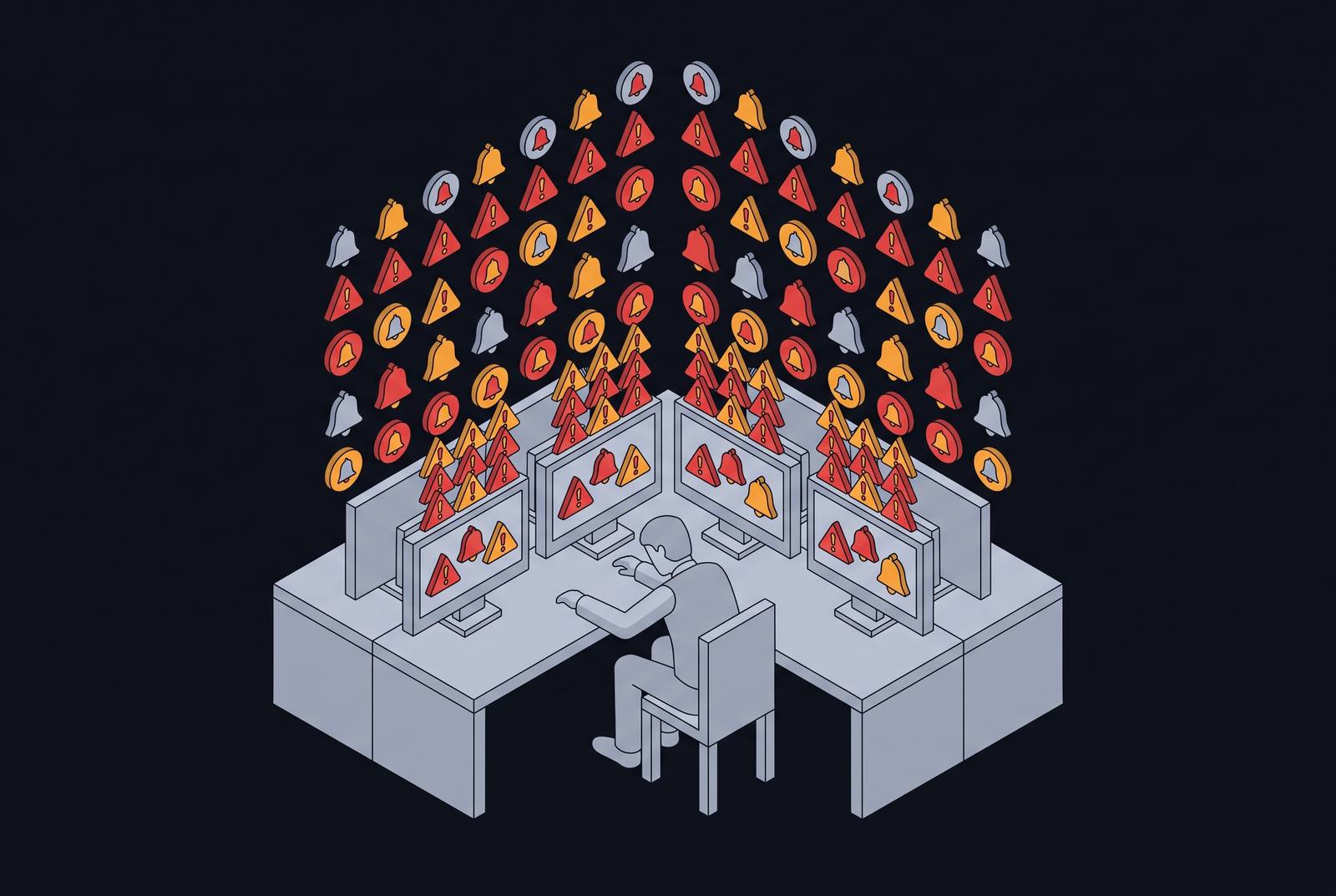
Alarm fatigue is not a staffing problem. It is a structural one. Security operations centers keep adding tools, staff, and budget, yet the alert backlog keeps growing, and the costs of that contradiction now shape both cybersecurity and physical security monitoring.
Why alarm fatigue keeps getting worse despite more investment in monitoring
The paradox is straightforward. More detection tooling produces more alerts, and every alert still lands in the same human queue. Each new layer of instrumentation, whether endpoint, identity, cloud, or network, contributes its own alert stream to a finite pool of analysts. Investment that should improve coverage instead compounds the desensitization. The term itself originated in clinical settings to describe how nurses stopped responding to monitor alarms after sustained exposure to false positives. The security operations center version of that phenomenon is no longer a workplace complaint. It is an architectural fact.
The gap between what organizations intend and what their operations actually deliver is easy to document. Most SOCs maintain 24/7 coverage yet depend heavily on manual reporting, so the coverage exists on paper while the throughput lags behind the volume. Analysts spend a meaningful share of every shift reconciling context across separate consoles rather than investigating threats. Each console represents a different vendor, a different data model, and a different severity scheme. The work of stitching them together is cognitive overhead, not investigation. More tools, in this configuration, can actively reduce investigative time.
This is not a training problem. The analysts responding to these alert streams are not undertrained or inattentive. They are rational actors adapting to an impossible workload, and their adaptations are the system's design outcome, not a personnel failure. That distinction matters because it determines where the fix belongs.
How the architecture of traditional monitoring guarantees a broken queue
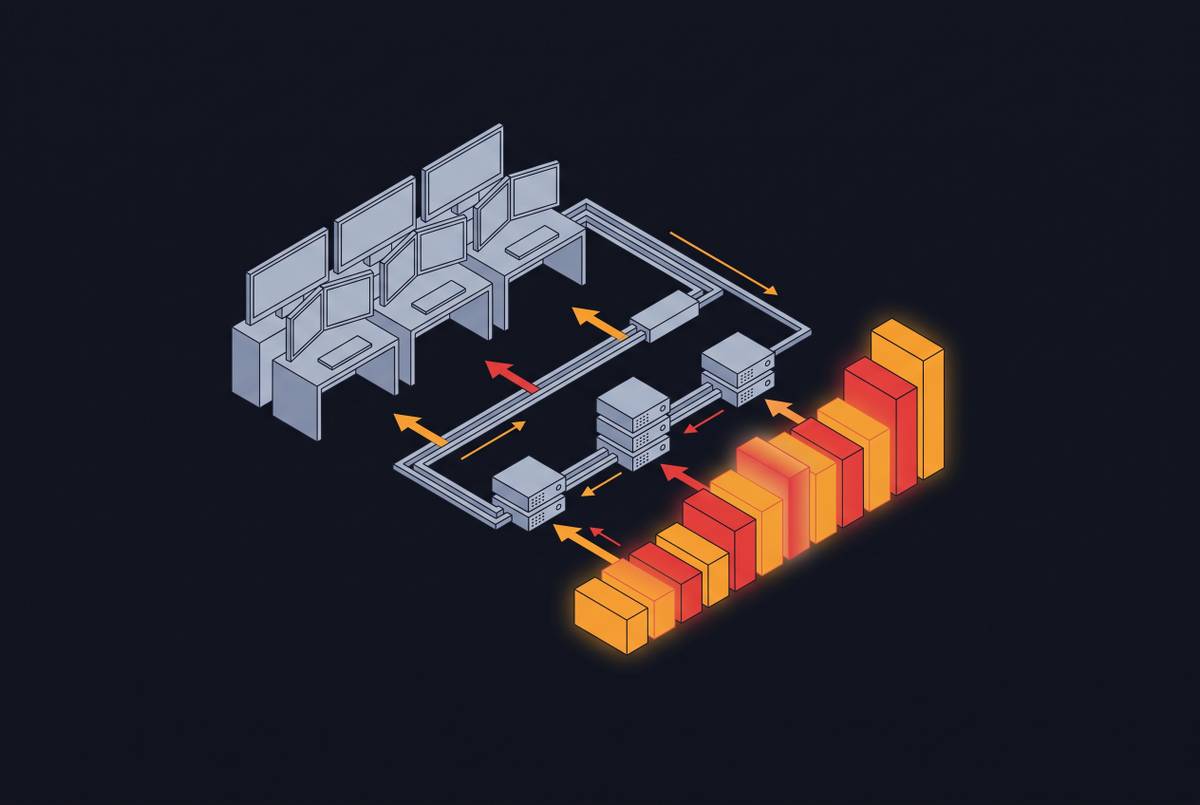
Traditional rule-based detection is tuned for high recall. It is deliberately calibrated to miss as few threats as possible, which means it produces large volumes of false positives by design. In a single tool this trade-off is defensible. Stacked across a dozen tools it becomes catastrophic, because every tool's false positives route into the same triage step. The queue is not broken by bad practice. It is the predictable output of an architecture that sends every signal, real or false, critical or trivial, through a human decision point before any prioritization happens.
Once a SOC hits its throughput ceiling, the only survival mechanism available within that architecture is aggressive deprioritization. Analysts close what looks unimportant and hope the severity label is accurate. That feedback loop then institutionalizes blind spots. The deprioritization is not a failure of discipline. It is the only mathematically possible response to a queue that outpaces processing capacity.
Sophisticated attackers understand this. MITRE ATT&CK formally recognizes spoofing security alerting as a defense evasion technique, classified as T1562.011 under Impair Defenses. The tactic involves generating noise deliberately to bury the activity that matters. The architecture's weakness has therefore become part of the threat model. The queue is not just an operational inconvenience. It is an attack surface.
Physical security monitoring has the same structural flaw. Every sensor trip travels to a central station and enters a human queue, regardless of whether the trip is a verified threat or a delivery driver propping open a door. The operator cannot know which it is until investigating. Services like Verdun address this by inserting an AI filtering layer before the human queue. AI agents review each alarm first, dismiss authorized activity and environmental triggers, and escalate only verified threats to operators, so the human queue processes only signals that warrant human judgment. Without such a layer, verified threats and routine environmental triggers share the same queue, and response time to a genuine intrusion becomes a function of how many trivial events precede it.
What the queue math does to operators over time
Sustained exposure to low-signal alert streams changes how people work. Analysts adopt coping behaviors that the literature documents clearly: blanket suppression rules, severity-based skimming, and over-reliance on tool severity scores. Ndichu et al.'s 2026 survey describes these behaviors as creating blind spots exploitable by sophisticated adversaries. None of these adaptations reflects a skill deficit. Each one is a survival mechanism that becomes a vulnerability.
Burnout in this context is not a soft HR concern. It drives attrition among the people whose institutional knowledge is hardest to replace. An experienced analyst knows what normal looks like for a given environment, and that knowledge cannot be documented into a playbook. When such operators leave, the judgment they carried leaves with them, and the architecture does not store it anywhere. Burnout among experienced operators is particularly costly because their tacit knowledge of what constitutes normal activity in a specific environment cannot be easily replaced or documented. This is precisely where the architecture matters: a monitoring system that reduces alert noise before it reaches human operators preserves the judgment capacity that makes those operators valuable, rather than depleting it through sheer volume.
The night-shift problem makes the consequences concrete. A skeleton crew handles the same alert volume that strains a full-strength day shift. Coverage therefore degrades precisely during the hours when after-hours threats such as burglary, unauthorized access, and theft are most likely to occur. Suppressing detection rules reduces immediate workload but can create permanent blind spots, because low-severity alerts that get systematically ignored do contain genuine threat signals.
The objection that organizations should simply hire more senior analysts runs into two structural limits. The cybersecurity labor market cannot supply analysts fast enough to match alert volume growth. And in physical security, the economics of staffing a 24/7 human monitoring operation are prohibitive at scale. The fix cannot be a hiring problem because the problem was never a headcount problem.
Why adding staff, muting cameras, and offshoring operators do not resolve the queue
The three most common responses to alarm fatigue are hiring more operators, suppressing noisy sources, and offshoring to lower-cost labor. Each addresses a symptom while leaving the queue intact. Adding headcount scales the human layer without reducing alert volume. More engineers reviewing the same noise produces the same outcomes with a larger salary budget. The throughput ceiling moves slightly, but the architecture remains a single-lane road.
Muting cameras or suppressing noisy sensors reduces alert volume immediately, but the reduction is purchased by trading away coverage. A suppressed camera is an unmonitored camera. The nuisance disappears and a blind spot replaces it. The false assurance of having cameras persists while the monitoring value evaporates.
Offshoring addresses unit economics but not queue architecture. A lower-cost operator in a different time zone faces the same cognitive constraints, the same false-positive rate, and the same throughput ceiling as a higher-cost operator. The queue behaves identically wherever the human sits.
Overage pricing is a billing mechanism, not a capacity mechanism. It charges clients for the volume problem rather than solving it, and it incentivizes monitoring centers to tolerate noise rather than reduce it. Threshold tuning in legacy systems carries the same weakness: hand-maintained thresholds drift out of alignment as environments change, so any improvement from tuning degrades without continuous re-engineering effort. Vectra's SOC operations guide describes a cyclical workflow in which lessons from incidents inform better detection rules, and separately documents that alert fatigue leaves 63% of alerts unaddressed. The improvement loop only functions when teams have bandwidth for post-incident reviews, which the alert volume itself prevents.
What it means to fix the architecture rather than patch the queue
An architectural fix moves the filtering and reasoning step upstream of the human queue. What reaches an operator becomes a verified, contextualized event rather than a raw signal competing for attention among thousands. The critical distinction is between flagging and reasoning. A system that flags every motion event has the same architecture as a basic sensor, just faster. A system that reasons about whether the motion is suspicious given time, location, known schedules, and behavioral context produces a fundamentally different signal. Ndichu et al.'s 2026 survey maps four stages of alert screening: filtering, triage, correlation, and generative augmentation. In an architectural fix, the first three stages happen before the event reaches a human, not after.
The capability set for this shift already exists. Machine learning can identify false-positive patterns in historical alert data. Deep learning can correlate multi-source telemetry into multi-stage narratives. Reinforcement learning can adapt prioritization policies based on operator feedback. Each capability moves work out of the human queue.
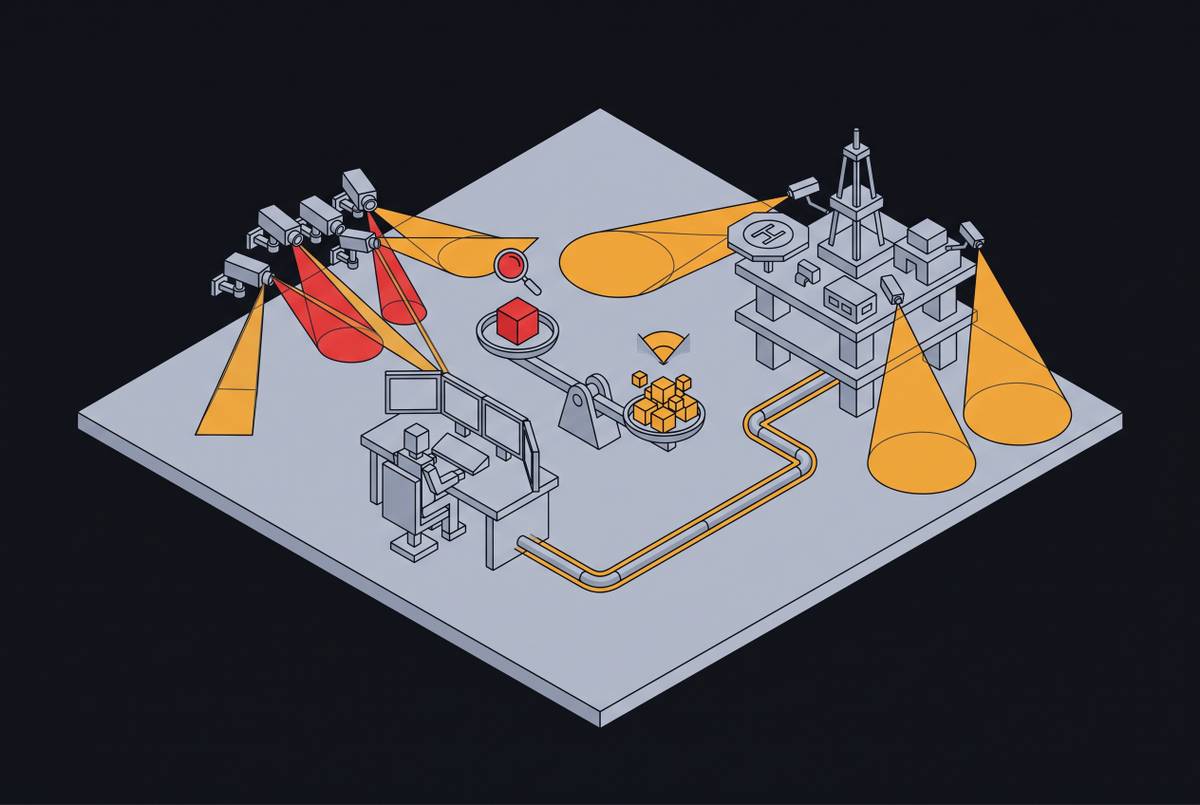
In physical video monitoring, the translation is specific. AI agents that can review camera footage, evaluate behavioral patterns such as loitering or erratic movement, cross-reference known schedules and authorized activity, and dismiss environmental noise before human review are what upstream filtering looks like in this domain. The human role is not diminished by this arrangement. It is clarified. Operators receive verified, high-confidence events and apply trained judgment to response decisions, which is the work they are best positioned to do. Agentic systems make this concrete: AI agents that execute multi-step investigations to retrieve context, query history, correlate signals, and synthesize a summary surface confirmed events to humans rather than raw alerts.
Why site-specific context determines whether AI filtering is meaningful or just faster noise
AI filtering upstream of the human queue only reduces fatigue if the AI has enough site-specific context to distinguish authorized from suspicious activity. Generic detection rules applied without that context reproduce the false-positive problem at higher speed. What triggers a false positive at one site is genuine at another. A delivery truck arriving at 3 a.m. may be routine at a distribution center and alarming at a corporate campus. Employees accessing a restricted zone during a scheduled overtime shift is authorized activity at one facility and a breach indicator at another. A system without site context cannot make that distinction.
Site-specific protocol coverage means encoding the details that make context legible: known schedules, authorized personnel and vehicles, permitted activities by time of day and location, and escalation paths specific to that site's stakeholders. That encoding is what makes an AI agent's decision meaningful rather than mechanical. A motion event at a truck yard at 2 a.m. means something different depending on whether a scheduled night-shift driver is expected, whether the perimeter gate was opened by an authorized credential ten minutes earlier, and whether the vehicle matches known fleet. An AI agent with that context can reason. One without it can only flag.
The verification layer is where context matters most. Under AI-assisted monitoring, what reaches a human operator should be a clip with annotated context: time, location, behavioral classification, and known-schedule cross-reference. A raw motion event that requires the operator to reconstruct that context under time pressure is not a filtered alert. It is the same cognitive burden with a new wrapper.
What faster verified response looks like in practice across commercial, multifamily, and industrial sites
When AI filtering reduces the queue to verified, contextualized events, response time to a genuine threat stops being a function of queue depth and becomes a function of architecture. The difference is measurable in minutes, and those minutes determine whether a threat is deterred, interrupted, or discovered after the fact. Commercial and retail sites face after-hours intrusion and theft as their dominant threat scenarios. The window between a sensor trip and a response that can deter or interrupt an incident is short and directly tied to how quickly a verified event reaches someone who can act. False alarms carry a compounding cost here. In many major US cities, repeated false dispatches trigger permit suspensions that eliminate police response entirely. A high false-alarm rate consequently converts a monitored site into an unmonitored one in the eyes of law enforcement. AI-screened visual verification before dispatch changes that relationship, because verified alarms are treated as higher priority than unverified sensor trips. Employee lots and perimeter coverage present continuous overnight monitoring needs that human-only operations handle poorly during low-staffing hours.
Multifamily residential properties generate high volumes of motion events in parking areas, mail and package rooms, lobbies, elevators, and building perimeters. Most of it is routine resident activity, exactly the false-positive profile that overwhelms a traditional queue. Voice-down deterrence, where an operator or automated system addresses a person directly before an incident escalates, is only possible when the monitoring layer can distinguish a resident returning late from an unauthorized person in a restricted area. The value proposition for property operators is measured in guard hours removed, incidents reduced per unit, and resident-reported safety perception.
Industrial and multi-site operators face a different challenge. Truck yards, manufacturing perimeters, and logistics facilities operate around the clock with scheduled and unscheduled activity that a context-free detection system will consistently misclassify. Cross-site dashboards that consolidate verified events give a security director visibility across a portfolio in a single view, which is structurally impossible with a human-only monitoring model at scale.
How Verdun's AI-and-operator architecture addresses the queue problem at its root
Verdun's model implements the fix this argument points toward. The AI-first layer reviews every alarm, dismisses environmental noise and authorized activity using site-specific context, and escalates only events that a human needs to evaluate. The queue human operators at Verdun receive is not a subset of all alarms ranked by severity. It is a set of verified events, which is a different category entirely.
Human operators in this architecture do what humans are best positioned to do: apply trained judgment to verified, contextualized events and make response decisions. They are not a fallback for AI errors. They are the intentional final layer for events that require human decision-making, which is a deliberate design choice rather than an admission of limitation.
The architecture also addresses the false assurance problem directly. Cameras that generate alarms entering an unmonitored queue provide no security value, no matter how impressive the camera count looks in a proposal. Verdun's model ensures that every camera's output is reviewed, not by a human for every event, but by an agent that can reason about every event and surface the ones that matter.
For buyers who have been burned by legacy monitoring promises, the structural argument matters more than feature comparisons. The question to ask any monitoring vendor is not how many cameras they can monitor. It is what happens to a real threat that arrives during the busiest alert hour. The architecture determines that answer. The headcount does not.