Redeploying Existing Guard Hours Through AI Video Monitoring at Large Freight Facilities
AI monitoring takes over feed-watching so guards can secure gates.
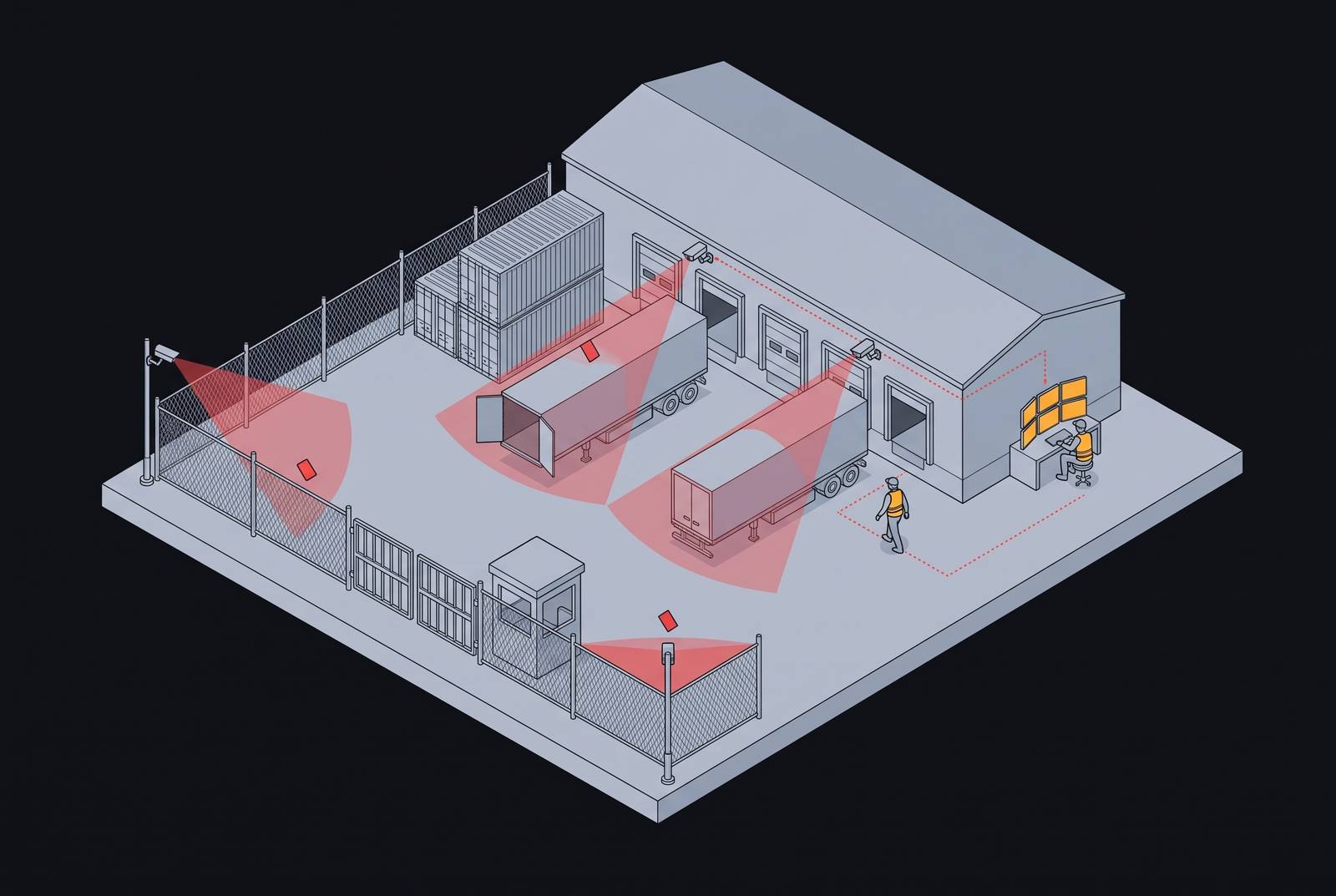
AI-augmented remote video monitoring for truck yards and freight facilities should free existing guards for physical security. AI filtering sorts suspicious activity from routine yard movement, while human operators review events and send guards to respond. Its value depends on whether the same guard hours can move from alarm-watching to access control, escort duties, and active perimeter response without leaving gaps in detection.
Why freight facilities have a guard-hour problem, not a headcount problem
Verisk CargoNet's 2025 analysis shows organized criminal groups targeting high-value loads through planned, coordinated operations. Food and beverage, copper, and enterprise computing hardware are dominant targets, with high resale velocity and established informal-market channels. These are planned operations with buyers behind them. The threat therefore extends beyond an intruder crossing a fence to reconnaissance of shift changes, camera blind spots, and after-hours access windows.
Hours spent watching feeds, reviewing routine alerts, and completing predictable interior rounds leave less time for gate verification and perimeter response. A facility can have guards on duty while the points an organized group intends to exploit remain underserved. Staffing decisions therefore need to consider where existing guards should be as well as whether the facility needs more of them.
What guard time actually goes toward at a large freight facility today
A useful task map separates camera-watchable work from work that requires physical presence. Distribution facilities routinely operate 50 to 100 or more cameras, and watching rotating feeds can consume a substantial part of a shift. Guards also have to pay attention to motion alerts. Most resolve as environmental noise, authorized vehicles, or routine yard activity, but someone still has to distinguish those events from a developing intrusion.
Other duties require a closer look at their purpose. Predictable interior rounds belong in the camera-watchable cluster where their primary function is observation. A record that someone showed a credential does not prove that the pickup matches a scheduled load, though both checks may appear in the same access-control log.
The physical cluster includes checking pickup credentials against scheduled loads, escorting unfamiliar visitors, patrolling perimeter zones, and matching departing drivers, trailers, and loads to outbound manifests. These tasks require more than a camera view. A guard can turn away a mismatched driver before that person reaches a dock or accompany a contractor through a secured yard. The functional distinction provides the basis for deciding which hours can move.
Why human attention cannot scale to cover a large camera array without AI support
Human factors research dating back to radar-operator studies establishes a vigilance decrement, with detection accuracy falling within 20 to 30 minutes on continuous monitoring tasks. Surveillance operator studies show the same pattern. Training and dedication do not remove that physiological constraint over a 12-hour shift.
Large camera arrays compound the problem because attention must cover yards, gates, docks, fence lines, and interior aisles. A single operator or small team cannot maintain meaningful real-time attention across that field. Assigning more feeds to an attentive guard does not make those feeds continuously observed.
Motion-triggered alerts also draw on that limited attention. Wind, animals, authorized vehicles, shift-change foot traffic, and shifting shadows produce a stream in which routine events dominate. When false positives keep coming, operators learn to expect noise. Genuine indicators then enter a queue behind ordinary activity, so a facility may have extensive recording coverage without dependable real-time intervention. The footage can support an investigation even when nobody responds soon enough to interrupt the theft.
What AI filtering actually does in a freight monitoring workflow
Traditional motion detection flags a threshold breach, while AI filtering evaluates scene composition and distinguishes activity that warrants review from activity that fits the site's operating pattern. The difference appears in what reaches the operator. A person repeatedly trying a truck cab door routes immediately for review as a possible vehicle break-in. A forklift operator completing routine yard maintenance at a scheduled hour requires no action when the activity matches the site's baseline. A person lingering near a dock door after authorized activity ends routes for a voice-down or escalation decision.
Those distinctions depend on site-specific context from shift schedules, authorized vehicle lists, expected pickup windows, and zone-specific baselines that help the system tell what an event means at the site. A detection model needs to know that dock 7 closes at 2200, forklift traffic in zone C stops at shift change, and the staging area behind building B has no authorized after-hours activity.
Protocol configuration is a required part of detection because it gives the system that knowledge. Without that knowledge, a system cannot reliably distinguish a routine late pickup from activity inconsistent with the facility's rules. Human judgment remains part of the chain. The operator receives contextualized events, reviews them, and decides whether a voice-down, guard dispatch, or other escalation is warranted instead of sorting a continuous stream of identical motion flags.
How faster, filtered alerting changes what the on-site guard is responding to
A shorter alert queue changes what is still actionable when a guard receives a dispatch. A staged theft in progress or a person at a closed dock door can be intercepted while the situation develops. Delay can turn either into an investigation. Filtering has operational value when it allows a reviewed threat to reach the person who can physically respond before that opportunity closes.
The dispatch also changes in substance. Rather than conducting a general patrol because an ambiguous alarm occurred, the guard receives the zone, camera ID, and nature of the event. That context gives the response a defined destination. It connects continuous remote observation to a specific physical intervention instead of leaving the guard to discover what prompted the alarm.
With that monitoring chain in place, a guard no longer needs to remain at a camera bank to maintain surveillance coverage. Guards can make gate coverage, mobile patrol, and dock-side verification their main duties instead of fitting them in between time spent monitoring. The same distinction applies after hours. AI-augmented remote monitoring can support detection at an unmanned freight yard, but detection is not physical interception. At a staffed facility, the benefit depends on reaching an available guard quickly enough to act.
Mapping current guard hours to identify what can be redeployed
To decide how to move those hours, security directors should review the tasks that recur during a standard shift and sort them into three buckets. The first is camera-watchable work, including feed observation, alert review, and routine event logging that AI can classify. These hours are candidates for redeployment. Their transfer depends on the monitoring service taking over the observation and screening function they currently provide.
The second bucket is irreplaceable physical work, where guard presence supplies the deterrent or verification mechanism. Access control, escort duties, credentialed pickup review, and active perimeter patrol belong here. These hours should be protected and potentially expanded. The third bucket is procedural overhead, including shift handoff, log completion, and incident documentation. Guards still need to do those jobs, but fewer alerts and pre-classified incidents can cut the work involved.
The task map should then be examined by zone and time. Authorized after-hours activity must be identified before a detection model can filter it correctly. Gates and dock doors with the highest credential-verification volume need scrutiny for whether they have physical staffing or camera coverage alone. Patrol intervals need the same examination. An interval based on risk is different from one determined by whatever hours remain after camera duties are covered.
Finally, the audit should compare the timing of theft incidents with the distribution of guard presence. Having more guards at shift handoffs may leave them out of step with the hours when most incidents happen. This comparison makes the audit usable in a staff meeting or site walkthrough. Its output is a map of transferable observation hours and physical duties that need them.
Where redeployed guard hours have the highest deterrence value at freight facilities
The first destination for redeployed hours should be gate access control and pickup credential verification. Organized theft can enter through the front gate using cloned credentials, fictitious pickup documentation, or fraudulent broker paperwork. A camera records the encounter, but a guard still needs to check the pickup against the scheduled load list in person. During after-hours pickup windows, a guard needs to be at the gate to check entry instead of watching cameras elsewhere while people enter on credentials alone.
Escort duties address the reconnaissance that can precede theft. Legitimate-looking visits give individuals opportunities to observe shift changes, camera positions, and dock schedules without intending to collect freight. An escort requirement for drivers absent from the scheduled load list forces contact, creates a record, and removes the opportunity for unobserved reconnaissance. The guard's presence is the control in this case. Watching people alone does less to limit where they can go in secured areas.
Active perimeter patrol should also absorb hours released from monitoring. A documented 30-minute interior round gives a theft group willing to wait a pattern it can predict and work around. Randomized mobile patrol removes that dependable timing cue. When coordinated with AI perimeter alerts, it also directs physical presence toward activity as it develops, rather than leaving the guard on a fixed route regardless of conditions.
Dock-departure verification provides another opportunity to intercept fraudulent pickups. A guard confirms that the departing driver, trailer number, and load match the outbound manifest, including where cloned credentials allowed entry through the gate. The check takes seconds when it is the guard's designated function, but it may not happen when camera monitoring occupies that guard during the departure window.
How to evaluate AI video monitoring that alerts truck-yard guards in time to respond
Before moving guard hours, security directors should check whether a monitoring service can do the work it must take over. The first criterion is alert volume and filter quality, measured by how many alerts reach a human operator per night, per facility. A service that forwards hundreds of unfiltered alerts has transferred the queue rather than resolved it, leaving the same attention problem in another location.
The next criterion is time from a verified threat classification to guard notification. The service needs an auditable account of that interval because the response must arrive while interception remains possible. “Instant” alerting is not a sufficient procurement claim. A fast automated notification and a fast, reviewed dispatch are different outputs, and the latter is what supports the deployment model described here.
The service should configure detection around actual schedules, authorized vehicle lists, zone baselines, and after-hours rules. It should also explain who makes the escalation decision. A trained operator reviewing an event before dispatch provides a judgment step that direct routing of AI classifications to guards omits.
Coverage continuity is the final requirement because organized groups deliberately exploit off-peak windows. Security directors should establish whether AI attention covers every required camera at all hours or thins when activity appears quieter. Each criterion needs an auditable answer before hours are redeployed. Without those answers, moving guards away from camera-watching is a coverage gamble.