Truck Yard and Freight Facility Overnight Security Monitoring
Real-time human judgment backed by AI filtering stops freight theft before trailers leave the yard.
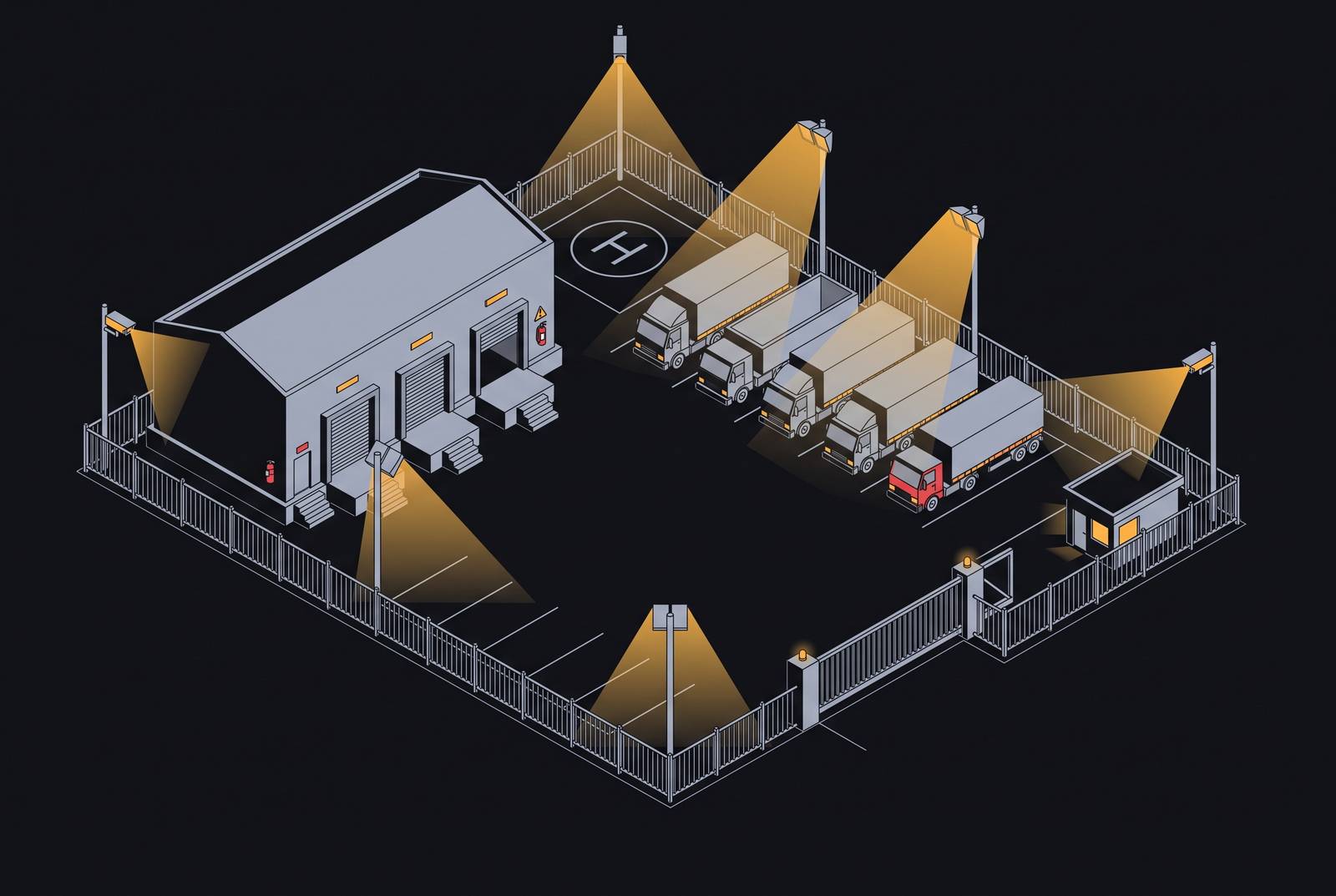
Overnight security monitoring at a truck yard or freight facility needs more than cameras that record parked loads. The decisive security variable is the speed and quality of the response when activity becomes suspicious. To cover the yard well, zone-specific views, AI-assisted alarm review, and site-specific rules must work with trained human operators who can step in or dispatch help before freight leaves the yard.
Why overnight is the highest-risk window for freight facilities
Loaded trailers are designed to sit disconnected from a tractor for hours or days. That dwell time gives thieves a chance to reach the freight while it stays in one place. Federal hours-of-service rules require drivers to rest, often in the yard itself. A driver asleep in a cab is not an active observer of the trailer rows nearby. The exposure therefore comes from normal freight operations.
At the same time, multi-carrier access brings legitimate traffic through the gate throughout the night. A plausible pickup story can blend into that traffic when paperwork is checked under time pressure. Skeleton staffing compounds the problem because a patrol crossing acres of parked freight leaves most rows unobserved. Round-the-clock operations also create perimeter movement that makes unexpected traffic harder to distinguish from ordinary work.
The four problem zones that define freight yard exposure
The gate is the anchor because every tractor and trailer passes through it. License plate recognition creates a searchable, time-stamped movement record, but it cannot establish a driver's identity or authority to collect freight. A fictitious pickup can look like a successful transaction until the load fails to arrive. Closing that gap requires checking driver identity against the day's expected-pickup list, checking the MC number against FMCSA in real time, capturing photo ID, and matching truck and trailer numbers to the rate confirmation. Any exception must be held before a pallet moves.
Beyond the gate, the open lot presents a visibility problem. Closely packed trailer rows have blind spots that shift as units move but fixed cameras stay in place. A cut seal and a hooked trailer can put a load worth well into six figures at risk. Elevated views down the rows help detect movement, while loitering detection distinguishes someone lingering between trailers from a driver moving toward a specific unit.
The fuel and equipment area requires a different angle of observation. Diesel siphoning occurs at saddle or bulk tanks, while catalytic converter cutting takes place beneath parked tractors. Nearby units can hide both activities from a lot camera mounted high up and far away. Lighting aimed at the access point and dedicated low-angle or island-level coverage show it along with the surrounding area.
The fourth zone is temporal. During an after-hours or driver-rest window with no scheduled activity, movement should be treated as anomalous by default. That differs from an overnight receiving period when arrivals remain legitimate. Predictable stillness lets trespassers work slowly unless someone is actively reviewing the scene. This window therefore requires live monitoring with authority to issue a voice-down, contact on-site staff, or escalate to dispatch.
Why cameras across all four zones are not the same as coverage
A camera can show the right place and still support the wrong security process. At the gate, a plate record reviewed after departure documents a fictitious pickup without preventing it. In the rows, a view suited to an earlier trailer arrangement may no longer show the space where someone is working. At the fuel island, general coverage may show a vehicle but miss someone forcing access beneath it. After hours, all those cameras may record an incident without prompting intervention.
Usable footage is therefore necessary, but it is not the same as protection. Blocked sightlines, poor lighting, and overwritten video can leave those who later investigate without footage that shows what happened. A guard shack or foot patrol does not resolve every gap because one observer cannot watch several rows simultaneously. A predictable patrol also leaves intervals that an intruder can exploit. Protection depends on what happens when a camera detects something that warrants action.
The coverage architecture must match these different exposures rather than force them into a generic lot-camera grid. For an industrial monitoring service such as Verdun, that means linking gate verification to dispatch, changing lot surveillance as trailers move, and using views that show what happens in the fuel area. Active review then connects those views to a response.
How the legacy monitoring queue fails freight yards specifically
In traditional monitoring, a human operator is the first to decide what to do with every alarm. The operator acknowledges a signal, reviews the clip, calls the subscriber, and decides whether dispatch is warranted. Each step consumes attention before the next event can receive it. In a freight yard, trucks arriving, equipment moving, and drivers returning to their cabs continually generate signals. A genuine threat enters the same queue as routine activity.
Repetitive, low-priority alarms create cognitive overload during long overnight shifts, while a large camera bank divides attention across sites. As vigilance degrades, response can slow and decisions become harder at precisely the wrong moment. These effects are the predictable consequence of requiring human attention to absorb the full alarm volume before threats have been separated from noise.
Adding operators does not change that sequence. Muting noisy cameras or reducing sensitivity removes signals without reliably distinguishing harmless activity from a developing theft. Offshoring review likewise leaves the underlying mismatch intact. The needed change is earlier discrimination, so a mismatch receives attention before the trailer clears the gate. A process that logs the movement for later review preserves a record of the transaction.
What AI agents actually do differently when reviewing a freight alarm
AI-assisted review changes the work before an operator receives an alarm. Instead of forwarding motion alone, an AI agent assesses whether the event fits the site's schedule, authorized activity windows, expected arrivals, and normal movement patterns. Consider a truck arriving at 2 AM. Its arrival outside the receiving window warrants a different response from the same arrival at a scheduled dock time. Authorization and context distinguish arrivals that warrant action.
The same reasoning applies within trailer rows. Motion may show an authorized driver returning to a cab or someone lingering between units with no clear place to go. Reviewing more than one frame helps show what that movement is. Correlating video, audio, access-control, and environmental data adds context that an isolated trigger lacks. The agent then assesses confidence against defined thresholds and routes a verified threat to an operator within seconds, rather than placing every event in a manual-review queue.
Speed alone does not make this architecture effective. An AI deployment that forwards hundreds of low-confidence alerts per shift recreates the same fatigue under a different label. The filtering must screen out routine dwell-time activity and keep the genuine anomalies. Verdun uses AI agents with trained human operators to review overnight footage as it comes in, without breaks, and deliver verified-threat response in under 90 seconds. Operators receive contextualized events that warrant action.
Why the human operator remains essential after AI filters the queue
Filtering and intervention are different decisions. AI agents handle the volume, but a trained operator decides whether to issue a voice-down, contact law enforcement, or notify on-site staff. That decision requires the full situation, including the site's response rules and the activity visible in the yard. A verified event delivered almost immediately gives the operator a stronger basis for action than an unexplained trigger delivered after a delay. Human judgment becomes more focused because it is no longer spent acknowledging routine movement.
Valley Alarm's East Hollywood incident timeline illustrates the sequence. AI detected activity at the fence line, and the alert reached the operator's screen within seconds. Verification and speaker activation followed, then a live audio warning before the trespassers could move deeper into the property. In a freight yard, the equivalent response decision must account for legitimate drivers and carriers as well as intruders.
A carrier arriving at 3 AM may be authorized under a standing weekend pickup agreement. An operator who knows that protocol can avoid the wrong response and still keep watch over an actual exception. When dispatch is necessary, live video confirmation also gives law enforcement a more credible basis for prioritizing the call than an unverified alarm. Live voice-down and dispatch are therefore essential response capabilities in services including Verdun. AI removes the noise so the human layer can act on what remains.
How site-specific protocols shape what monitoring can actually catch
To judge an event against normal activity, the site must first define what is normal. Scheduled late pickups, driver swaps, fuel stops, and yard hostler moves can resemble theft when stripped of context. Fictitious pickups exploit fraudulent activity that looks operationally correct. A system that treats every truck movement alike will either generate constant alarms or overlook a convincing impersonation. Site-specific protocols provide the reference against which a deviation becomes visible.
Those protocols include expected-carrier lists checked against real-time FMCSA data, dock assignments, receiving windows, authorized forklift routes, and vendor access schedules. Each addresses a concrete ambiguity. A yard scenario in Bloomington, California shows how monitoring set up around forklift routes can tell permitted movement from suspicious activity. However, that scenario is illustrative, with outcomes for theft and false alarms undocumented. Its practical value is the implementation principle, which is to define authorized movement before judging deviations from it.
Response rules also have to reflect local constraints. Where ordinances restrict audible alarms overnight, as at some intermodal yards, protocols must use visual deterrents and covert thermal detection. Otherwise, a technically successful alert can lead to an inappropriate intervention. Defined protocols also make performance measurable through mean time to acknowledge, detection-to-voice-down intervals, and false alarm rates. Unless there is an agreed response path, those measures say little about whether the system did what it should.
What a monitoring architecture built for freight actually requires
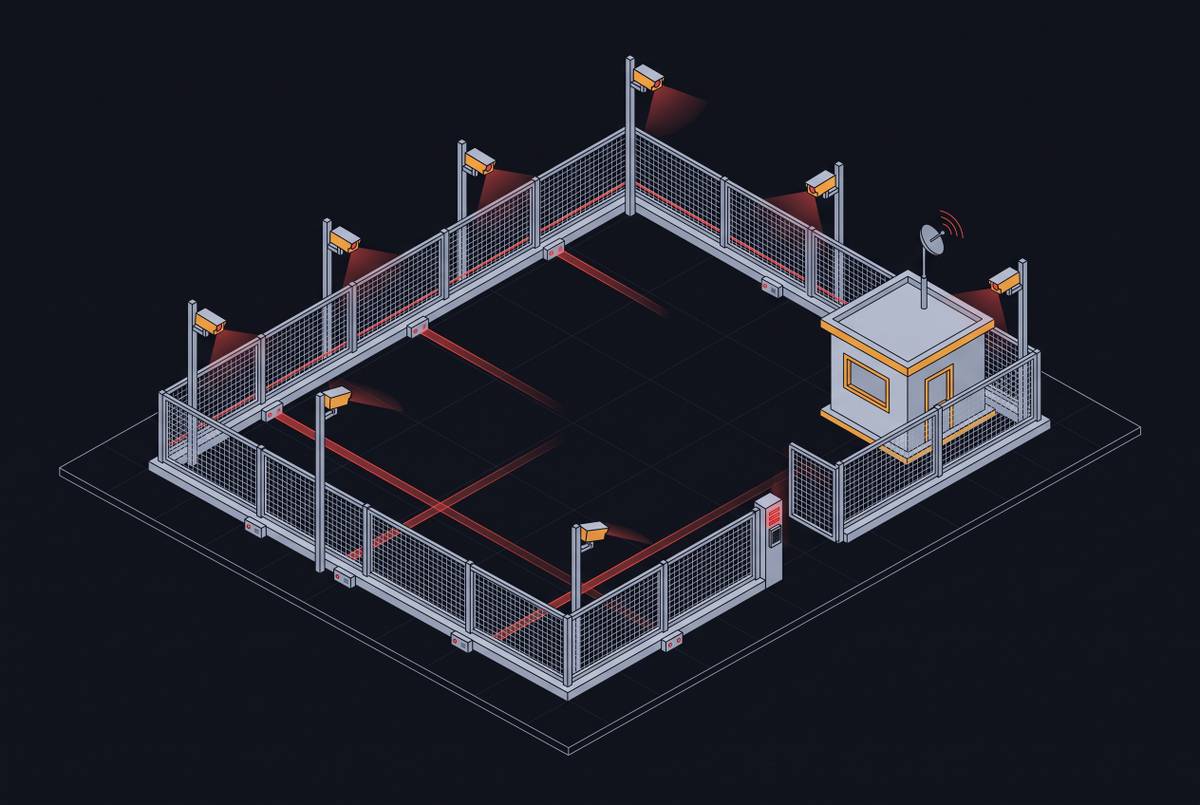
Buyers in freight and logistics should check every step from detection to verified human response. Physical coverage starts with gate LPR, views from above the trailer rows, dedicated views of fuel and equipment, and coverage of a well-lit fence line. Open-lot coverage also needs to change as trailers move so yesterday's blind spots do not stay hidden. Object detection should distinguish people from vehicles and identify movement when the yard should be quiet. These are separate viewing requirements because each exposes a different kind of activity.
AI agents should review every alarm first, using available video, audio, and access-control context to dismiss environmental noise and authorized movement before escalation. Verified threats should arrive with the situational context needed for an informed decision. Expected carriers, access schedules, receiving windows, and dock assignments must be encoded into that review. Fictitious-pickup verification must remain a distinct security layer before freight is released.
Finally, buyers should demand a monitoring SLA for verified-threat response. Verdun is a relevant option for this evaluation because it combines AI review with trained human response and an under-90-seconds verified-threat response commitment. Buyers should weigh that commitment alongside live voice-down, alternatives that comply with local ordinances, verified dispatch, and measures of how well the service follows its protocols. Acknowledgment alone does not interrupt a theft, even when it happens quickly.