Monitoring Service Level Agreement Metrics That Predict Real Performance
Standard SLAs measure speed, not whether real threats actually get caught in time.
A monitoring SLA that promises a fast response time is answering a question nobody asked. The question that matters is whether a real threat gets caught in time, and most contracts are not built to answer it.
Standard monitoring SLAs and the metrics they're written around
Every security buyer has seen the line item: response time, usually expressed in seconds, sometimes backed by a guarantee or a credit if the vendor misses it. That number looks like a commitment. It measures time to first acknowledgment, meaning how fast a signal got logged, not how fast anyone figured out whether the signal meant something. Standard SLA frameworks, built on the same kind of monitoring guidance that governs IT uptime contracts, commit to three things: response time, resolution time, and uptime. All three share a trait that has nothing to do with security outcomes: they are easy to instrument, easy to log automatically, and easy to put in a quarterly report.
What those three leave out is the gap between an alarm being acknowledged and an alarm being verified: a trained person or system actually confirming a genuine threat exists rather than a passing raccoon or a gust of wind against a sensor. That gap is almost never named in contract language, let alone measured. A monitoring contract that reports fast response times gives a buyer a feeling of confidence. It does not tell the buyer whether coverage exists where coverage actually counts: the small number of real events buried in a much larger stream of noise.
Alarm volume, operator cognitive limits, and peak-load performance
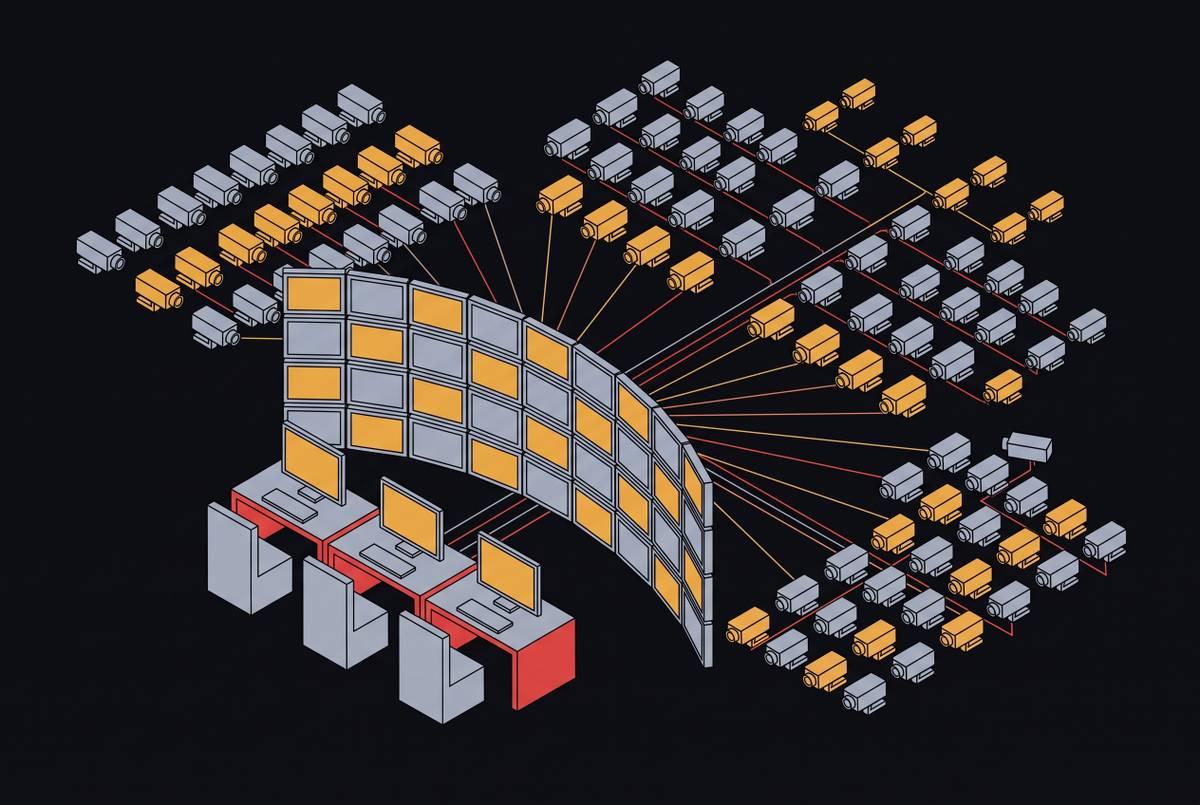
The conditions that stress-test a monitoring SLA are the same conditions under which the humans running that system are least able to meet it. The overwhelming majority of alarm activations at any monitoring center are false. That means an operator's job, most of the time, is sorting through irrelevant signals in order to reach the rare one that matters. The system is built to make the common case cheap to dismiss, which is also what makes the rare case easy to miss.
Adding staff does not fix this the way it looks like it should. More operators reduce the per-capita alarm rate, but the industry's own benchmarks, laid out in EEMUA 191 and carried forward into the ISA-18.2 guidance that governs alarm management, define an overload threshold that more headcount only delays reaching. It does not eliminate the structural problem of too many signals and too little attention. Peak-load performance, not average performance, is the only version of performance worth contracting for, because the moments when alarm volume spikes are precisely the moments an operator's attention is thinnest and most likely to contain something real.
The metric almost no SLA reports is the uninvestigated rate, the share of alarms that receive no decision at all, not a slow decision, no decision. A monitoring center can hit its mean response time target while a meaningful share of alarms simply never gets reviewed. Add to that the turnover common in the security guard workforce, where annual churn runs high and new analysts need real ramp time before they perform at the level a contract implies, and the result is a vendor whose average performance last quarter tells a buyer very little about next quarter. The SLA that only measures the easy average is measuring the wrong shift at the wrong time.
The three specific metrics that predict whether a real threat is caught in time
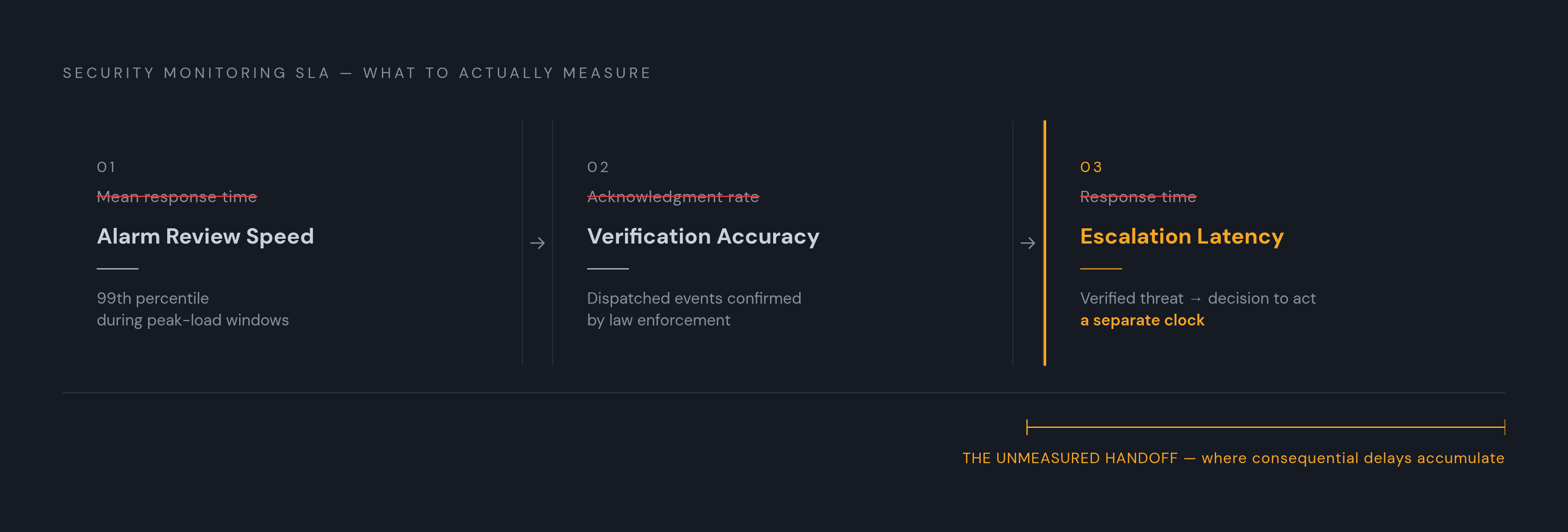
Three metrics map directly onto the failure modes above, and a buyer who asks for them is asking the vendor to prove something the standard SLA never has to prove.
The first is alarm review speed under peak load, measured at the 99th percentile. Percentile-based SLA design exists for exactly this reason in other industries: the commitment should cover the worst-performing fraction of events, not the average across all of them. For physical security, that means asking what the review time looks like for the slowest alarm in the busiest hour of the week, not the average across a quiet overnight shift. A vendor should be able to show p99 performance measured during their own highest-volume windows. A vendor who can only produce a mean number is a vendor who cannot guarantee coverage at the moment coverage is tested.
The second is verification accuracy, which is a different claim than an acknowledgment rate. Acknowledgment means the alarm was received and logged. Verification means a person or an AI agent confirmed a genuine threat exists. That distinction has real consequences downstream: in a growing number of jurisdictions, an unverified alarm gets no police response at all, or a deprioritized one, which makes verification the precondition for the rest of the SLA to produce any outcome in the physical world. A useful way to test a vendor's claim is to ask what share of their dispatched events end with law enforcement confirming a credible incident. A low rate there means a vendor is generating expensive false dispatches. Standard SLA metrics in other industries track error rate, the share of requests that fail, as a core performance indicator. Verification accuracy is the direct equivalent for physical security, and it deserves the same contractual weight.
The third is escalation latency: the time between a verified threat and a human decision to act, whether that action is a voice warning, a call to law enforcement, or a notification to the client. This is a distinct clock from response time as it's typically defined in a contract. It measures the handoff between knowing something is wrong and doing something about it, and that handoff is where the most consequential delays build up. A contract silent on escalation latency lets a vendor claim a fast response while the actual decision to act sits in a second, unmeasured queue.
A vendor who can't report any one of these three numbers is a vendor who hasn't built the systems to track them, which is itself useful information for a buyer to have before signing.
Why the reported average hides the worst-case events
Mean response time doesn't just leave out information. It actively works against the buyer trying to use it to judge risk. A monitoring center that processes a high volume of easy, obvious false positives, like wind against a fence sensor, will report a strong mean almost no matter how it handles the harder cases, because those easy dismissals pull the average down. Meanwhile the complex, ambiguous events, the ones more likely to be genuine, can sit in queue much longer without ever touching that number.
Percentile-based SLA design elsewhere in the technology industry makes this explicit: a system with a fast median latency can still have a p99 that is orders of magnitude worse, so a small fraction of events gets radically worse treatment than the number on the report suggests. In physical security, the events that are hardest to classify, unusual movement patterns, ambiguous perimeter contacts, multiple zones triggering at once, are also the events most likely to represent a real incident, and they are exactly the events a queue optimized for throughput is most likely to push to the back.
This is the clearest case for demanding percentile data over averaged data. A buyer reviewing a contract should ask the vendor to disclose p95 and p99 review times, broken out by alarm complexity where the vendor can do it, not just a mean or median figure. The distance between the average and the p99 is the most honest measure of risk a buyer is taking on during the vendor's busiest hours. Standard monitoring guidance recommends that alerts fire before a threshold is breached rather than after, and the same logic belongs in a security contract: escalation should trigger as per-event latency approaches a limit, not only once an average has already drifted past it. Before signing anything, ask the vendor directly: show the p99 response time during the three highest-volume windows this quarter.
AI pre-filtering and its effect on verification accuracy and escalation latency
AI-based alarm review doesn't just make the existing process faster. It changes what kind of signal reaches a human operator in the first place, and that's why it produces a different ceiling for verification accuracy and escalation latency than adding more staff to the legacy model ever could. In a traditional setup, every alarm goes to a human for first review. In an AI-augmented setup, every alarm goes to an AI agent first, and that agent sorts people from animals, vehicles from weather, and authorized movement from patterns that don't fit, before a human ever sees the queue.
That shift changes each of the three predictive metrics in a specific way. On review speed under peak load, an AI agent doesn't get tired as a shift wears on, doesn't hit a queue limit that produces an uninvestigated rate, and can review many alarms at once, so the p99 under heavy volume is structurally lower because the bottleneck stops being headcount. On verification accuracy, the agent filters out environmental noise before anything escalates, so the human operator who does get a notification is looking at a pre-filtered, already-contextualized signal instead of a raw zone trip, which is the actual mechanism behind a lower false dispatch rate. On escalation latency, when the AI agent bundles a detection image, the camera location, a timestamp, and a threat classification into a single alert, the operator can look at it and act in seconds instead of minutes, because the quality of the information handed off is what compresses the time between verification and decision.
The Port of Virginia offers a concrete, sourced example of what that filtering does in practice. Before adopting AI-assisted review, the safety team there spent two to three hours a day reviewing recorded footage. After deployment, that fell to a fraction of that time. The gain didn't come from humans working faster. It came from the AI handling the volume so the humans only needed to look at what actually required a decision.
None of this makes the human role optional. AI handles volume and pattern recognition well. Judgment under conditions nobody anticipated, the organizational context specific to a given site, and the decision to actually call law enforcement all remain human functions. The right architecture pairs AI pre-filtering with human escalation. It does not replace the human decision with an automated one, and any vendor claiming otherwise is overselling the technology.
Site-specific protocols as a precondition for verification accuracy
Neither an AI agent nor a trained human operator can tell a genuine threat from normal activity without knowing what normal activity looks like at that specific site. Without a protocol that spells out authorized activity, scheduled events, and escalation steps, every ambiguous signal stays ambiguous. That means verification accuracy is capped by the quality of the protocol feeding the system, not just by the quality of the camera or the model behind it.
A post order is what turns a generic alarm into a decision someone can actually make. An operator who knows a loading dock runs authorized traffic until midnight, that one specific vehicle is permitted in a lot overnight, or that a particular door should never open after hours can make a verification call in seconds, but strip that context away and every event looks the same: uncertain. A vendor whose contract doesn't include protocol documentation, what happens when an event is identified, who gets told, in what order, under what conditions, is selling coverage without the decision framework that makes the coverage mean anything.
Those same protocols set the order of escalation: operator verification first, then maybe an audio warning, then internal notification, then a call to law enforcement, or whatever sequence a given site requires. Each step in that chain carries its own delay, and that chain is what an SLA's escalation latency commitment should actually be describing. A truck yard, a retail store after closing, and a parking structure at a multifamily property don't share a threat profile, an authorized-activity window, or an escalation priority. A monitoring SLA that treats all three the same way isn't really covering any of them well.
Before signing, a buyer should ask a vendor directly how post orders get built and updated, how site-specific context gets written into the AI agent's decision logic, and how a change, a new authorized employee, a shifted schedule, a seasonal change in who has access, actually makes it into the live monitoring rules.
Monitoring SLA design that predicts performance
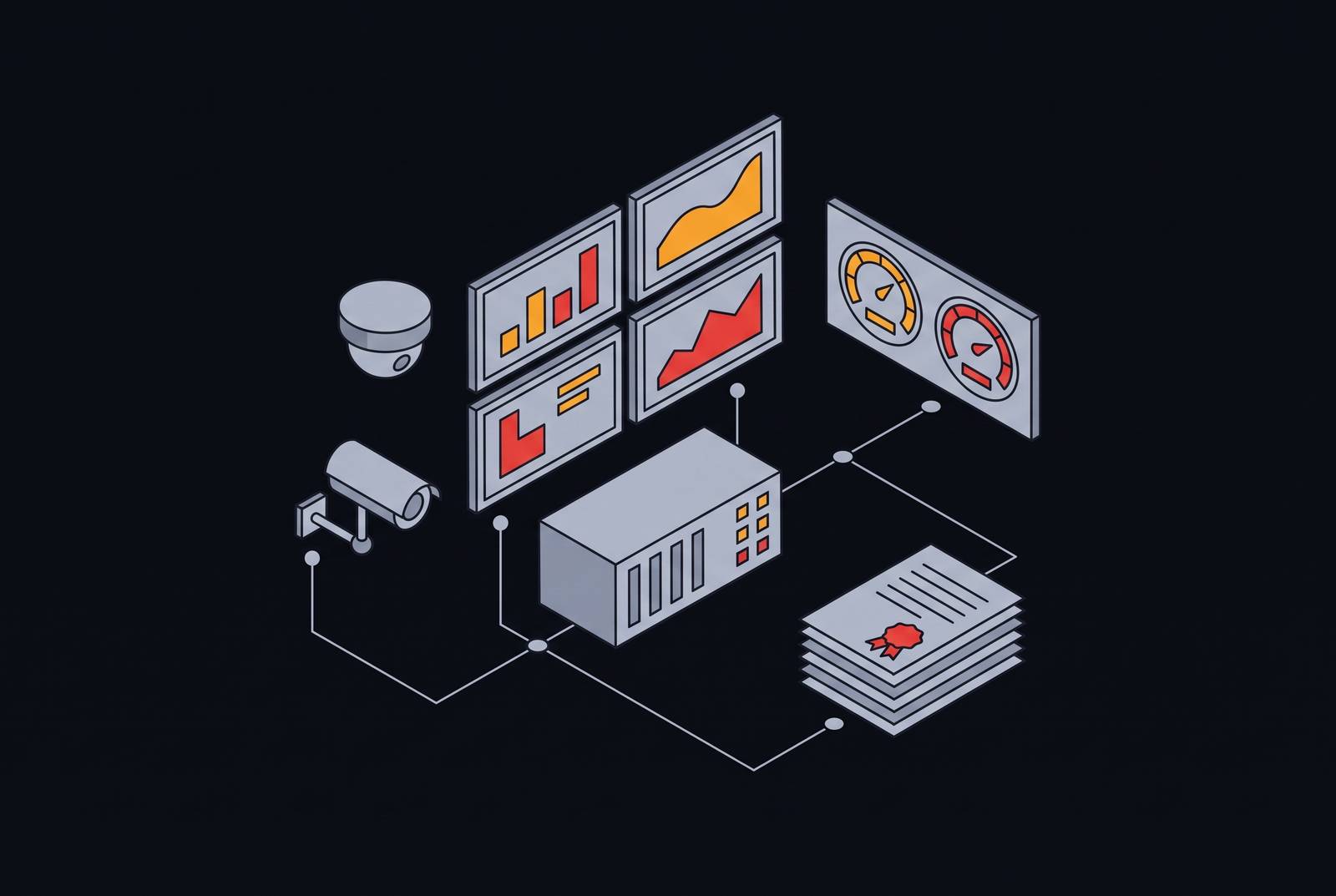
A monitoring SLA that actually predicts performance commits to four things, and a buyer reviewing a contract should expect to find all four spelled out, not implied. The first is p99 alarm review time reported under peak-load conditions specifically, not a mean or median blended across a full month, with the vendor able to produce that number from its own highest-volume windows rather than from a quiet baseline chosen to look good. The second is a verified response rate defined and reported separately from an acknowledged response rate, so a buyer can see what share of alarms actually got confirmed as genuine threats. The third is an escalation latency figure that starts the clock at verification and ends it at a human decision, covering the handoff that most contracts leave dark. The fourth is documentation of the site-specific protocol governing all three, the post order that defines authorized activity, the escalation hierarchy, and the process for keeping that protocol current as a site changes.
A vendor who can produce all four numbers, tied to a real protocol, is offering something categorically different from a vendor who can only point to a fast average response time. The second vendor may be telling the truth about that average and still be the wrong choice for a site where the events that matter are rare, ambiguous, and buried in volume. The contract a buyer signs should measure the thing the buyer actually needs: not whether an alarm got logged quickly, but whether a real threat, arriving at the worst possible moment, gets caught in time.