Camera Muting Practices in Commercial Monitoring Centers
Operators mute noisy cameras because false alarms vastly outnumber real threats.
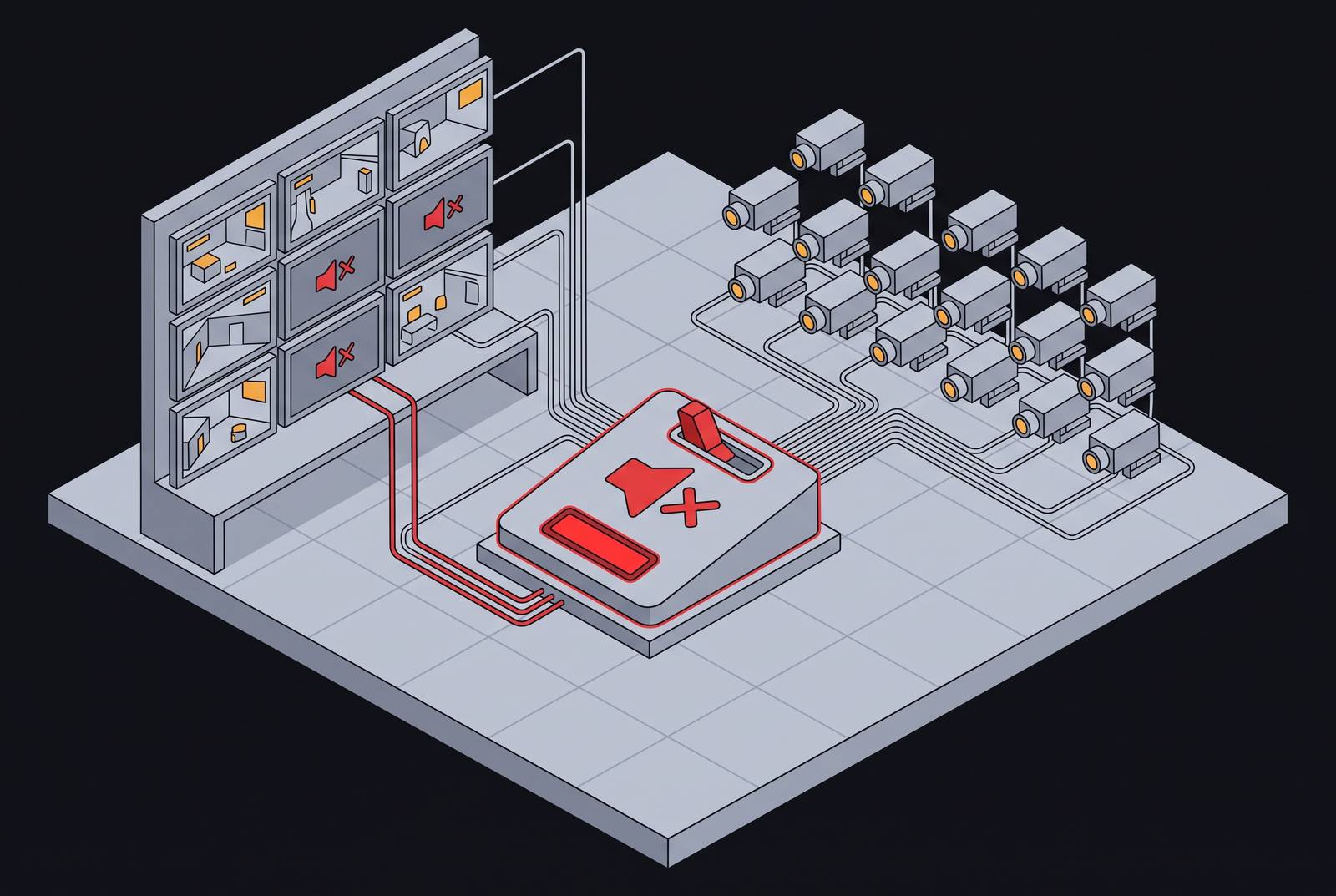
An operator sitting in front of a monitoring center's camera wall does not mute a zone out of carelessness. The decision gets made because the signal arriving at that console is wrong the overwhelming majority of the time, and a human being cannot keep treating a signal as urgent once experience has taught them it almost never is. Research compiled by a policing research center documents that the vast majority of all police responses to alarm activations turn out to be false alarms. That ratio is the starting condition of the entire industry, not an exception to be managed around it.
Camera muting in commercial monitoring centers is the predictable output of an architecture that sends far more alerts than any operator can treat as meaningful, and the muting decision is the only adaptation available to a person facing that volume. Legacy detection systems, tuned broadly to avoid missing anything, fire on shadows crossing a parking lot, headlights sweeping a loading dock, a raccoon crossing a sensor's field of view. Operators learn, through repeated exposure, that most of what reaches them needs no action. That learned skepticism is what habituation research predicts happens to anyone exposed to a stimulus that repeatedly carries no consequence. Once an operator has internalized that a given camera is noisy, muting it, formally through a suppression rule or informally through deprioritization, is simply the operator acting rationally within a system that gave them no better option.
The cost of attention when the alarm queue never clears
The people staffing these consoles are running into a hard ceiling on sustained attention, fixed by physiology, that no amount of additional staffing or stricter policy can raise. Sustained monitoring work does this to anyone asked to perform it, not because of a training deficiency.
The effect does not stay contained to the cameras that earned the skepticism. After prolonged exposure to false positives, operators begin applying that same learned caution to alerts from cameras they have not yet muted, cameras that may be carrying a genuine signal. The damage generalizes past the noisy sources that produced it. Vectra AI's 2026 research into security operations broadly found that a majority of daily alerts go unaddressed because the volume of alerts arithmetically exceeds what any team can process in the time available. Physical security operators face the identical mechanism, though the toll on them tends to get filed under ordinary staff turnover, which obscures the actual cause behind a label that suggests something more mundane. That turnover carries its own cost beyond morale: a control room that cycles continuously through new operators never accumulates the site-specific knowledge that lets someone catch the one anomaly a camera's configuration was never built to anticipate. VideoraIQ treats operator retention as a security metric in its own right, not just a human-resources concern, because an unfamiliar operator reviewing an unfamiliar site has no baseline to judge what looks wrong.
How monitoring centers respond to overload
Faced with a queue that cannot clear, monitoring centers have three conventional levers to pull: mute the noisy cameras, move the labor somewhere cheaper, or charge customers more during the periods when alarm volume spikes. Each of these addresses a symptom, but the underlying arithmetic of the queue stays completely intact.
Muting noisy cameras reduces the volume of false positives reaching an operator's screen, but it accomplishes this by converting a false-positive problem into a false-negative one. A suppressed camera is a camera nobody is watching, and the gap it creates in coverage is invisible until something happens inside it. VideoraIQ's deployment analysis is direct about the instinct behind raising detection thresholds to cut volume: the approach does not solve the underlying problem but converts false positives into false negatives, which in turn become compliance gaps that surface as audit findings and fines. Offshoring the labor to a lower-cost operator changes who is staring at the queue without changing its depth or the quality of what is arriving in it; a cheaper operator inherits the same impossible ratio of noise to signal. Overage pricing shifts the financial burden onto the customer during peak alarm periods, exactly when coverage matters most, but it does not improve the odds of catching a genuine threat inside that surge.
What ties these three remedies together is where they operate. Each one is applied at the level of the operator, the staffing model, or the pricing structure, never at the level of the architecture generating the volume. The same overload persists no matter which combination of these fixes a monitoring center chooses to deploy, because none of them touches the thing actually producing it.
What gets missed while the queue is busy
A perpetually overloaded alarm queue does not produce an abstract increase in risk. It produces a specific, predictable window in which a real threat completes its activity before any operator reaches the alert describing it. The gap between what gets flagged and what gets investigated is where breaches begin. Vectra AI research found that a large majority of daily security alerts go unaddressed across security operations broadly, and the SANS 2025 Detection and Response Survey found that false positives rank as the top detection challenge for most security teams surveyed. Those two findings describe the same structural gap from two different angles: a flood of alerts arrives, most of it noise, and the review capacity needed to separate the signal from that noise does not scale with the flood.
In physical surveillance specifically, VideoraIQ makes the point without qualification: adding more cameras to a site without first solving the quality of the alerts those cameras produce does not make the site safer. It accelerates the fatigue that is already degrading the team reviewing the feeds. So if you add a camera without an architectural change, you add another feed competing for the same fixed amount of human attention, and any single camera on the wall becomes more likely to go unmonitored at the moment it matters. A camera that is recording but not being actively reviewed is providing the appearance of security. The theft that completes before an operator opens the clip and the perimeter breach that goes unlogged because the alert sat in a queue behind forty others are not edge cases. They are the expected outcome of a system asked to process more than its design allows.
So on any given ambiguous alert, the operator caught in that queue faces two bad options. Overreact, and scramble a dispatch response for activity that turns out to be benign, burning resources and credibility. Or they underreact, and file the alert without verification, only to find the actual breach days later during a compliance review. VideoraIQ's operational analysis identifies both outcomes as expensive and both as driven by the design of the system.
Why the ANSI/TMA AVS-01 standard matters
The industry has now admitted, through a formal standard, that the binary alarm model cannot hold. ANSI/TMA AVS-01-2024 replaces the old intrusion-versus-no-intrusion signal with a five-tier classification framework, running from Level 0, no call for service because the event has been canceled, confirmed as no threat, or otherwise determined not to warrant dispatch, up through Level 4, a call for service with a confirmed threat to life.
Level 0 is the formal, standards-governed version of a decision operators have been making informally for years. When a monitoring center declines to dispatch because the evidence does not support it, that is the same judgment call muting has always represented, now codified into a recognized category. The standard also mandates audits no less frequent than every 90 days and requires that records of alarm event handling be retained for a minimum of 12 months. Suppression decisions, once invisible inside an operator's individual judgment, now become part of a documented compliance record subject to review.
The standard has already moved from paper to adoption. In late October 2024, the International Association of Chiefs of Police executive committee ratified a resolution that encourages public-safety answering points to use the AVS-01 framework, so PSAPs can adopt the classification system without having to build their own intake taxonomy from scratch. National Monitoring Center, based in Lake Forest, California, attained ANSI/TMA AVS-01 UL certification in February 2025, counting itself among the first monitoring centers nationwide to reach that distinction. ADT has fully deployed AVS-01 compliance across its monitoring centers, so every burglar alarm gets scored against the standard before that information goes to law enforcement. None of this is paperwork layered on top of an unchanged process. Meeting the standard requires the structural change the rest of this piece has been describing, because a center cannot produce a defensible Level 0 classification without a system capable of distinguishing a non-event from a threat.
What the architecture needs instead
The fix is not more operators, and it is not a stricter muting policy. The fix is inverting where human attention enters the process, so that the filtering happens before a person ever sees the alert, and the only alerts reaching an operator are ones that have already cleared a contextual threshold.
The legacy architecture places a human at every decision point in the chain: a sensor trips, an operator reviews the clip, an operator decides whether to call, an operator dispatches. Every link in that chain draws on the one resource that has already been shown to run out under volume. An inverted architecture moves the first-pass review to an AI layer instead, filtering environmental triggers, shadows, wind, and authorized activity before any of it reaches a human screen, and escalating only the events that clear a contextual bar. Services like Verdun approach this from exactly this direction: instead of asking operators to process every alarm and manage the noise through muting, AI agents filter routine false positives and environmental noise first, and only verified threats reach a human operator, so the backlog that forces the muting decision never has the chance to form.
Context is what makes this filtering meaningful, not just another version of raising a threshold. VideoraIQ's analysis identifies context, not reduced volume, as the actual cure: an alert delivered with a video clip, a precise location tag, and a timestamp is a fundamentally different object from a bare notification, because it is something an operator can act on rather than something they have to investigate from scratch. Site-specific protocol is what turns that context into something useful. An AI agent trained on a site's operating schedule, its pattern of authorized personnel, and the layout of its camera zones can distinguish a vendor arriving ahead of schedule from an intruder attempting the same entry point, a distinction a fixed threshold rule has no way to draw. Every tactical fix available under the old architecture, muting, offshoring, overage pricing, leaves the underlying queue intact and simply trades one failure for another. The architectural alternative changes what reaches the operator in the first place: AI-powered monitoring systems like Verdun review every camera feed on an ongoing basis, dismiss authorized activity and environmental noise automatically, and pass only verified threats forward, removing the false-positive bombardment that makes muting feel like the only available response.
This does not eliminate the human operator from the picture. It clarifies the operator's role into something more demanding and more consequential than reviewing an undifferentiated stream of clips: trained personnel handling talk-down, dispatch, and notification for events that have already been verified as real. The architectural advantage this structure offers is the capacity to absorb a sudden burst of simultaneous alarms without a queue forming behind it, which is the exact condition under which muting starts to feel necessary to an overwhelmed operator in the legacy model.
What buyers should ask their monitoring provider
A buyer who understands that muting is a symptom rather than a solution can put that understanding to work by asking a monitoring provider a small set of pointed questions. Start by asking how the provider handles a burst of simultaneous alarms. If the answer centers on operator staffing levels or alarm prioritization rules, the underlying queue problem is still there, no matter how the provider frames it. But if the answer instead describes AI pre-filtering ahead of the human review stage, the provider may have actually fixed the structural issue.
Ask next which cameras, zones, or time windows the provider has suppressed or deprioritized over the past 90 days. Under AVS-01, a compliant center should have this on record, because the standard requires exactly this kind of documentation. If a provider cannot answer, it is either outside compliance or not tracking its own suppression decisions, and neither should reassure you. Ask what the average time is between an alarm firing and a human reviewing a verified threat, and ask how that figure changes during peak alarm activity. Degradation under peak load is the clearest available evidence of whether a system is genuinely scalable or simply dependent on how many operators happen to be on shift that day.
Ask what site-specific context the system actually uses to separate authorized activity from a genuine threat. A provider without real site-specific protocol integration is making the same kind of filtering decision that legacy muting made, just relocated from the camera level to the rule level, which is not the structural change it may be marketed as. Ask, finally, whether the provider defines a false negative and tracks that figure. A monitoring center that measures only its false-positive rate is measuring the nuisance its alerts cause, leaving the actual security risk unmeasured. Verdun attaches site context, operating schedules, and camera-specific protocols to every AI agent decision, so this is the kind of architecture these questions are built to surface. A buyer who asks them of any provider will quickly find out whether that provider's version of "AI" amounts to genuine contextual filtering or is simply a threshold adjustment wearing a newer label.