Multifamily Property Video Monitoring Challenges and Priorities
AI filtering and trained operators are essential to stop incidents before they escalate.
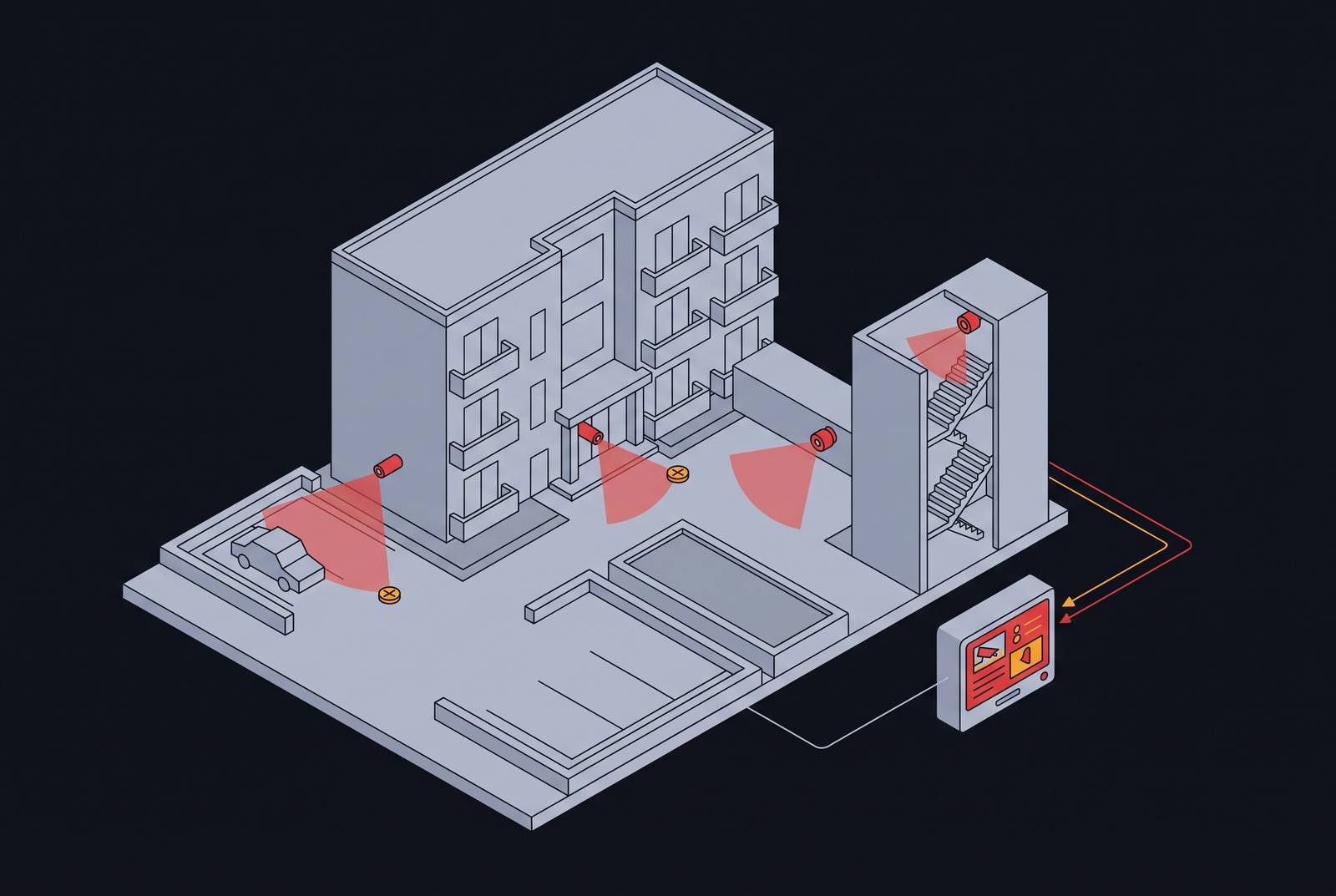
For remote video monitoring to work well for multifamily and employee parking lots, it needs AI filtering that runs all the time, site-specific rules, and trained human operators who can act during an incident. An article on multifamily property video monitoring explains why cameras alone, or operators watching large camera arrays, cannot provide that coverage. The central requirement is an architecture that separates routine activity from threats and gets those threats to a person in time to act.
Why multifamily properties are structurally harder to monitor than other property types
Multifamily properties have no clear split between hours when people are there and hours when they are closed. Residents, guests, delivery drivers, and contractors move through shared spaces all day and night. Their presence is often legitimate, even when their movements fall outside a predictable schedule. Monitoring must distinguish normal use from threatening behavior while people are on the property around the clock.
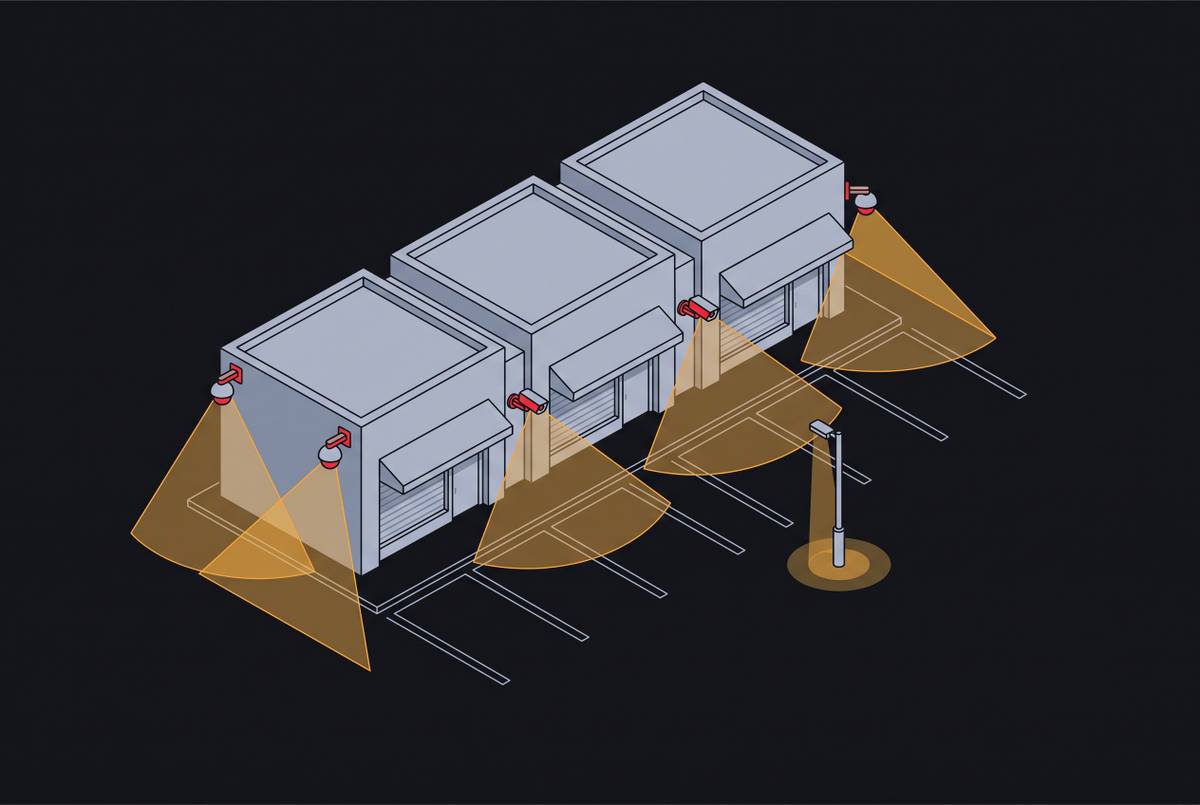
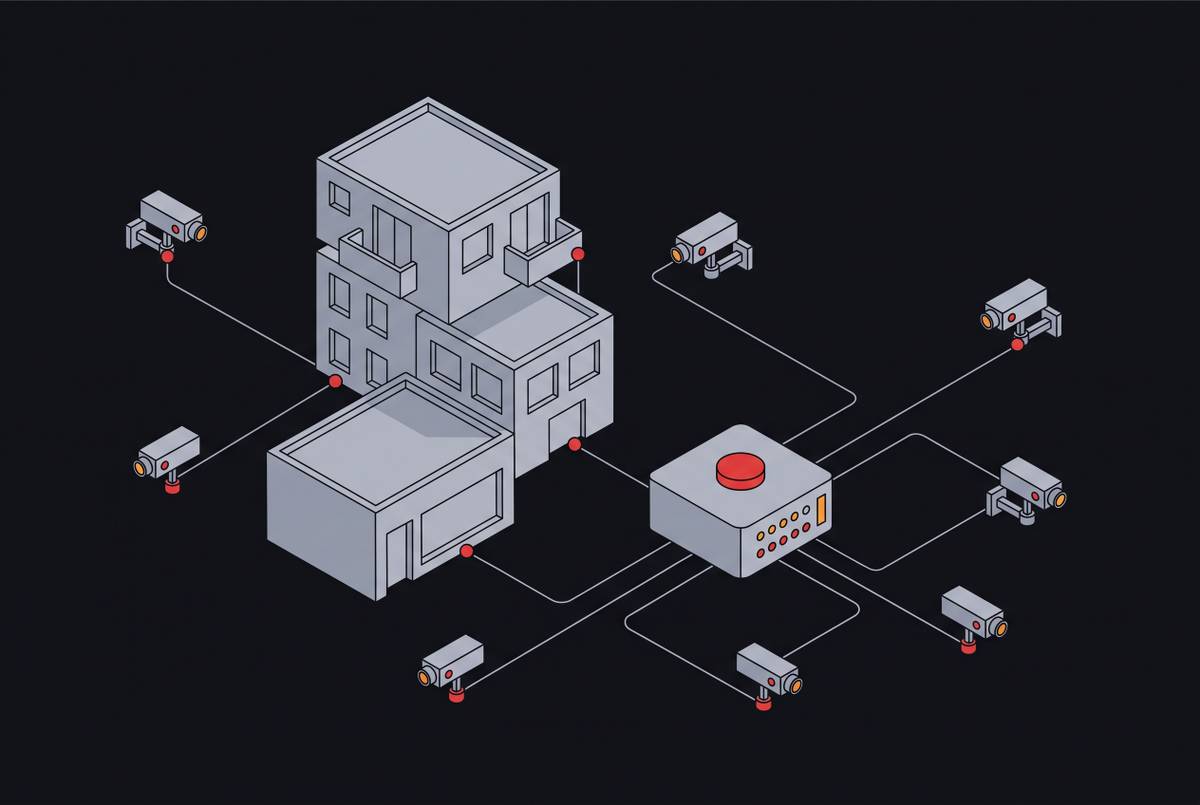
That occupancy pattern extends across a large and fragmented camera footprint. Dozens of cameras may cover parking structures, entries, amenity spaces, hallways, and perimeter points. Other high-risk zones are package and mail rooms, bike storage, and controlled access points. People use these spaces in different ways and have different rights to enter them, so a rule that fits a restricted perimeter may not fit a busy lobby.
Kastle's multifamily resource identifies networked cameras and smart access among the most-requested community features and notes demand for more advanced security. Yet installed equipment does not establish that anyone is watching or able to respond. The size of these sites and their mixed occupancy make them too hard for a single guard or a passive camera system to monitor.
The crime patterns that make parking structures and package rooms the highest-stakes zones
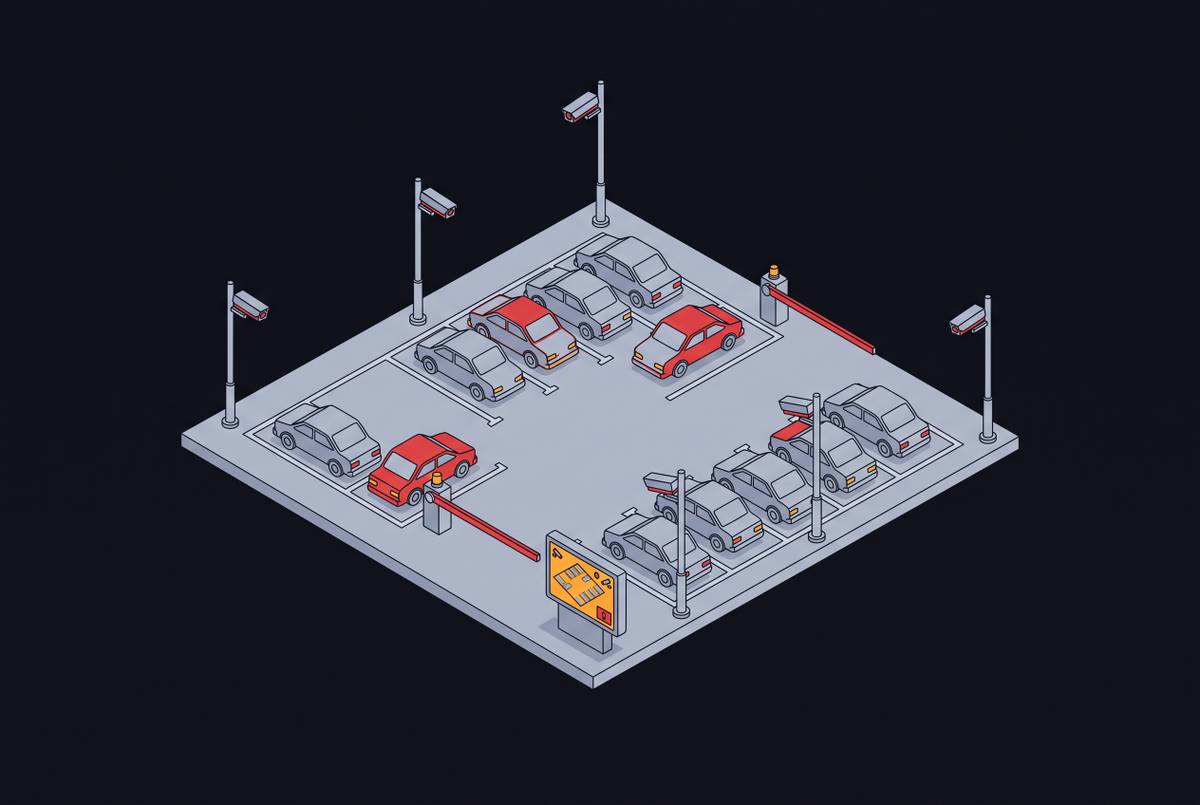
The distribution of risk gives property managers a more useful starting point than treating every camera as equally important. Residents' vehicles are at risk of break-ins in parking garages and lots, while thieves have easy access to targets in package rooms and lobbies. As more e-commerce deliveries arrive, these shared delivery spaces have more to handle. Package theft also leads to complaints to management, insurance claims, and frustration for residents.
Controlled entries matter because they connect those zones. Trespassing and tailgating can allow non-residents to reach secondary crime locations inside a building. An access failure therefore cascades beyond the door where it begins. Monitoring that treats an entry event as isolated can miss its significance for the package room or other interior spaces. The priority is to recognize the breach while a response remains possible.
Other patterns require attention to behavior and timing. Late-hour loitering in stairwells, laundry rooms, and amenity areas can indicate drug activity, vandalism, or escalating conflict. Such behavior is a reason to assess whether a crime is occurring. Together, these patterns establish why monitoring must be zone-aware and real-time. Uniformly recording every space does not give the most consequential activity the attention it needs.
Why cameras alone do not secure apartment complex parking lots after hours
Passive recording preserves an account of an incident without creating a path to interrupt it. Kastle's multifamily resource describes legacy surveillance systems as often useful only as a responsive forensic measure, with needed evidence sometimes difficult to find. That distinction is especially clear in a parking lot after hours. If a resident's car is broken into at 3 AM, reviewing the footage the next morning does not interrupt the break-in or prevent another one the following night.
Even the forensic task can be laborious. Following one person's movements across several cameras to reconstruct theft or vandalism can require hours of manual review. More cameras may provide more footage without making that footage easier to use. The recording system has captured the event, but staff must still assemble an account of what happened. Documentation and protection are different functions, and success at the former does not establish the latter.
Visible cameras do have deterrent value. Kastle notes that cameras reduce the likelihood that criminals will remain on a property. But that benefit has a limit when a determined actor has already scoped the location and proceeds despite being recorded. Once deterrence fails, passive recording offers no way to act as the incident happens. Assigning someone to watch appears to close that gap, but it introduces a separate constraint.
Why human operators cannot watch 40 to 80 cameras continuously and what happens when they try
Human attention is finite, and continuous viewing degrades it. A 300-unit complex with 40 to 80 cameras creates more simultaneous activity than unaided operators can meaningfully watch. There is a mismatch between the property's camera footprint and the attention available to interpret it. Adding screens does not add vigilance, and hiring more people does not remove the underlying attention limit.
Alarm-based monitoring can reproduce the same problem in a queue. When routine movement and false activations repeatedly demand review, operators spend their attention dismissing noise. After several false alarms, skepticism grows and response times lengthen. A genuine threat then receives the same sluggish treatment as the false alarms that preceded it. The system has technically detected an event while failing to distinguish its urgency.
On-site staffing has related limits. High turnover can leave a property dependent on guards who are unfamiliar with its layout, while staffing changes undermine consistent coverage. Kastle identifies traditional guards as often cost-prohibitive for multifamily properties. Even where staffing is affordable, it does not make continuous attention across dozens of feeds sustainable. Human judgment remains essential and must be reserved for decisions.
What AI-assisted monitoring actually does differently in a multifamily context
AI-assisted monitoring continuously filters every camera feed to change what reaches the operator. Instead of flagging any motion, AI agents assess activity against defined threat patterns and site context. A shadow, headlight sweep, or passing cat should not compete with a person breaching a fence line. That distinction makes the filtering layer a structural requirement for large, continuously occupied properties.
Useful alerts depend on behavior rather than the presence of a person or vehicle alone. Examples include a person lingering in a parking structure at 3 AM, an unrecognized vehicle stationary in a fire lane, or two individuals in a confrontation near an entrance. Each warrants assessment against the property's rules. Kastle's multifamily resource describes AI-enabled cameras alerting security personnel or remote operators to suspicious activity.
Verdun uses this approach with AI agents that draw on site-specific context to tell environmental noise and authorized activity apart from threats that need trained operators. Filtering reduces the routine material ahead of a real incident for human judgment. AI analytics can also help with later investigation by using appearance search to find people across cameras and time. That makes footage retrieval more targeted, but the preventive value still depends on what happens after an alert reaches a person.
Why live intervention requires a human in the loop, and what that human actually does
A filtered alert is not an intervention. A trained operator must assess the event and put the site's response protocol into action while the incident is still underway. Available actions include issuing a voice-down, triggering a strobe, and dispatching police. Kastle identifies live audio talk-downs and police dispatch as tools enabled by live monitoring. These actions create the practical distinction between observing a threat and responding to it.
Verification also matters outside the monitoring center. Kastle's 2026 budget resource states that video-verified alerts reduce false dispatches and nuisance calls. Kastle also notes that verification gives law enforcement immediate grounds to distinguish a real incident from a false alarm, supporting priority response. The human role therefore includes deciding what the evidence warrants. Those who handle the response are still accountable even when AI does the screening.
That process is only useful if the queue allows it to work. A real threat waiting behind unverified alarms for 20-plus minutes is effectively unmonitored, regardless of camera count. In an AI-augmented service such as Verdun, agents handle continuous review so trained operators can focus on verified threats. This lets camera coverage grow without the same growth in the work people must do to screen feeds. Any provider should be evaluated on whether that division delivers a timely human decision.
How site-specific protocols determine whether AI filtering produces useful decisions or just fast noise
Filtering cannot distinguish normal activity from a threat without a definition of normal activity. A person walking to a car in the parking garage at 7 PM is different from the same person remaining stationary there at 3 AM for 20 minutes. Time, duration, location, and behavior change the meaning of the event. The second situation warrants scrutiny under the property's rules. The behavioral baseline gives the alert its context.
Delivery drivers, contractors, and maintenance staff may legitimately arrive at unusual hours. Package room protocols, amenity access schedules, and visitor management rules therefore affect what should surface as an anomaly. Without that context, generic thresholds send too many alerts when the site is busy and can miss threats when it is quiet. Faster processing would bring back the alarm fatigue that filtering was meant to remove.
Access records can strengthen those distinctions. Kastle's 2026 budget resource describes integrated access control and video surveillance as a way to match identity, location, and timing to access records. However, authorization does not override an immediate life-safety concern. Panic alarms, physical altercations, and fires require immediate escalation, with protocols treating a P1 event differently from a loitering flag. Effective AI monitoring is configured monitoring, with explicit rules for both routine use and urgent exceptions.
What an effective multifamily monitoring architecture must actually solve for
Property managers should evaluate monitoring architecture against the scale, queue, and intervention problems. Coverage should begin with consequential zones, including parking structures, package rooms, controlled access points, and perimeter fencing. Within those zones, evaluate whether the system supports action during an incident. Camera coverage establishes what can be seen. It does not establish what will receive attention.
The next criterion is whether filtering reduces alerts to a volume that human operators can meaningfully assess. Measure the time from alarm to verified human decision. Evaluation should also establish whether site schedules, authorized activity definitions, and escalation tiers are configured. Those rules shape how well the system tells normal mixed-occupancy traffic from threats. A fast decision based on the wrong context is not effective monitoring.
Integration and growth complete the assessment. Siloed access and video systems leave staff reconciling door-entry events with footage manually, while integrated systems match identity, location, and timing automatically. Kastle notes that live video surveillance can expand to new areas without significant infrastructure changes, and a cloud-based approach supports phased growth using existing infrastructure. As coverage grows, filtering and response must keep working with it in the same way.