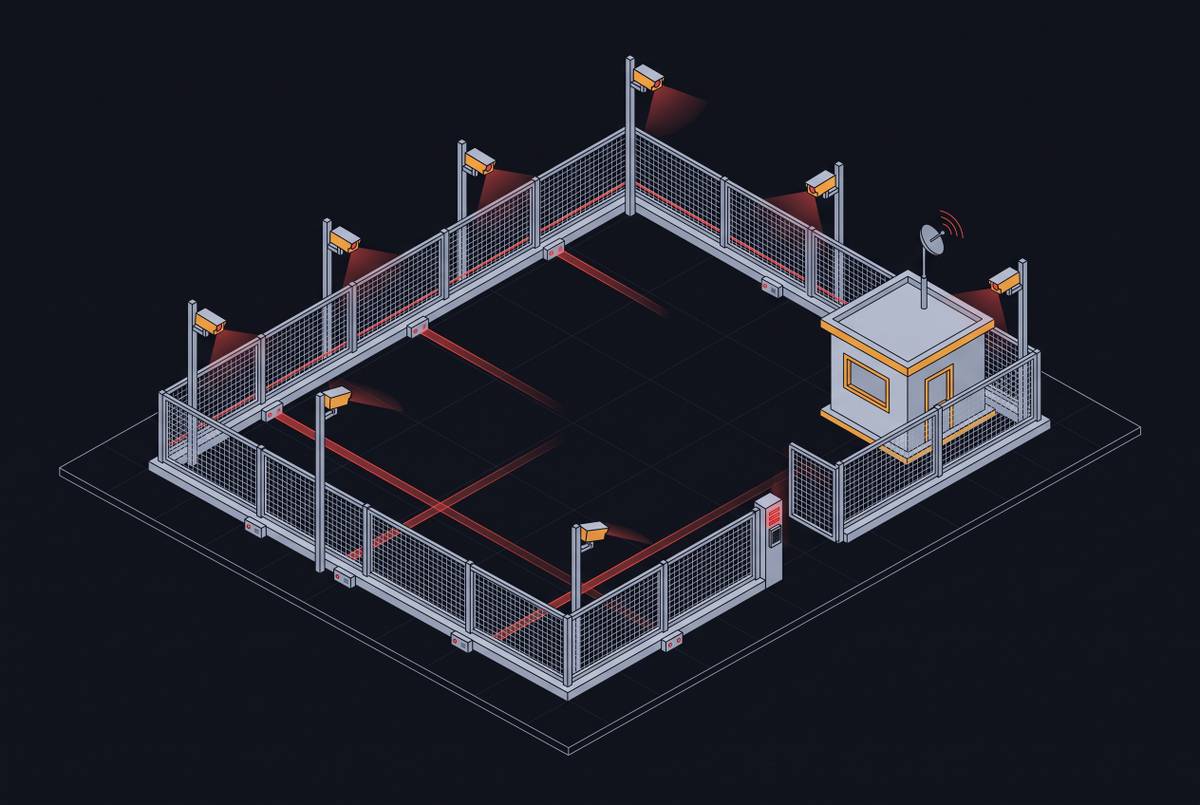
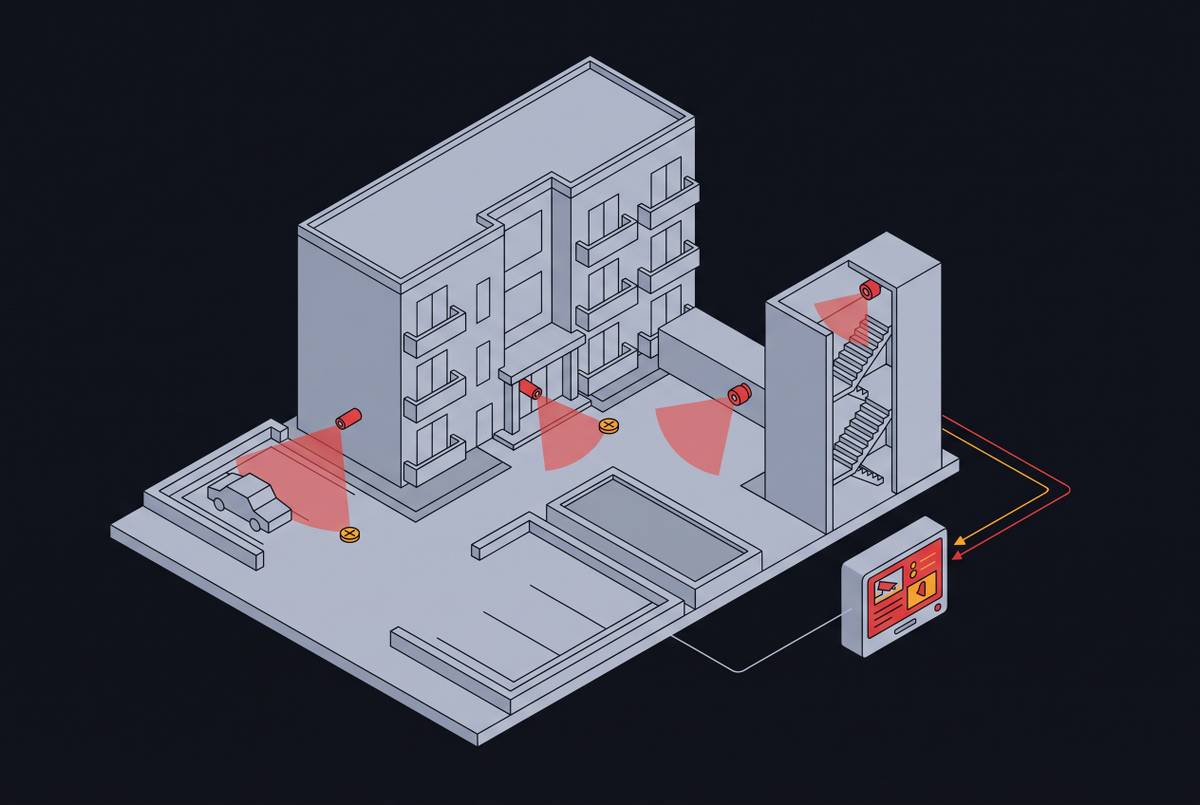
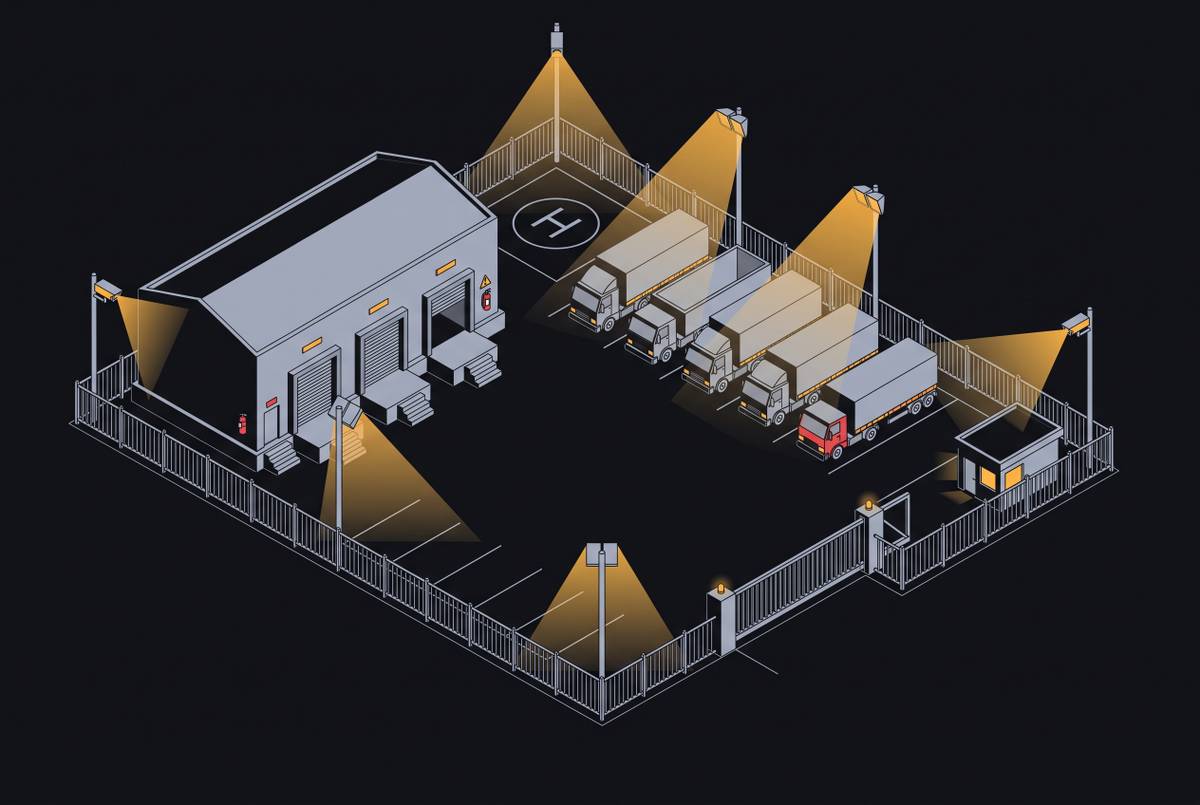
After-Hours Monitoring Requirements for Retail Strip Centers
Strip centers need zone-specific monitoring rules to catch rear-perimeter threats before doors open.
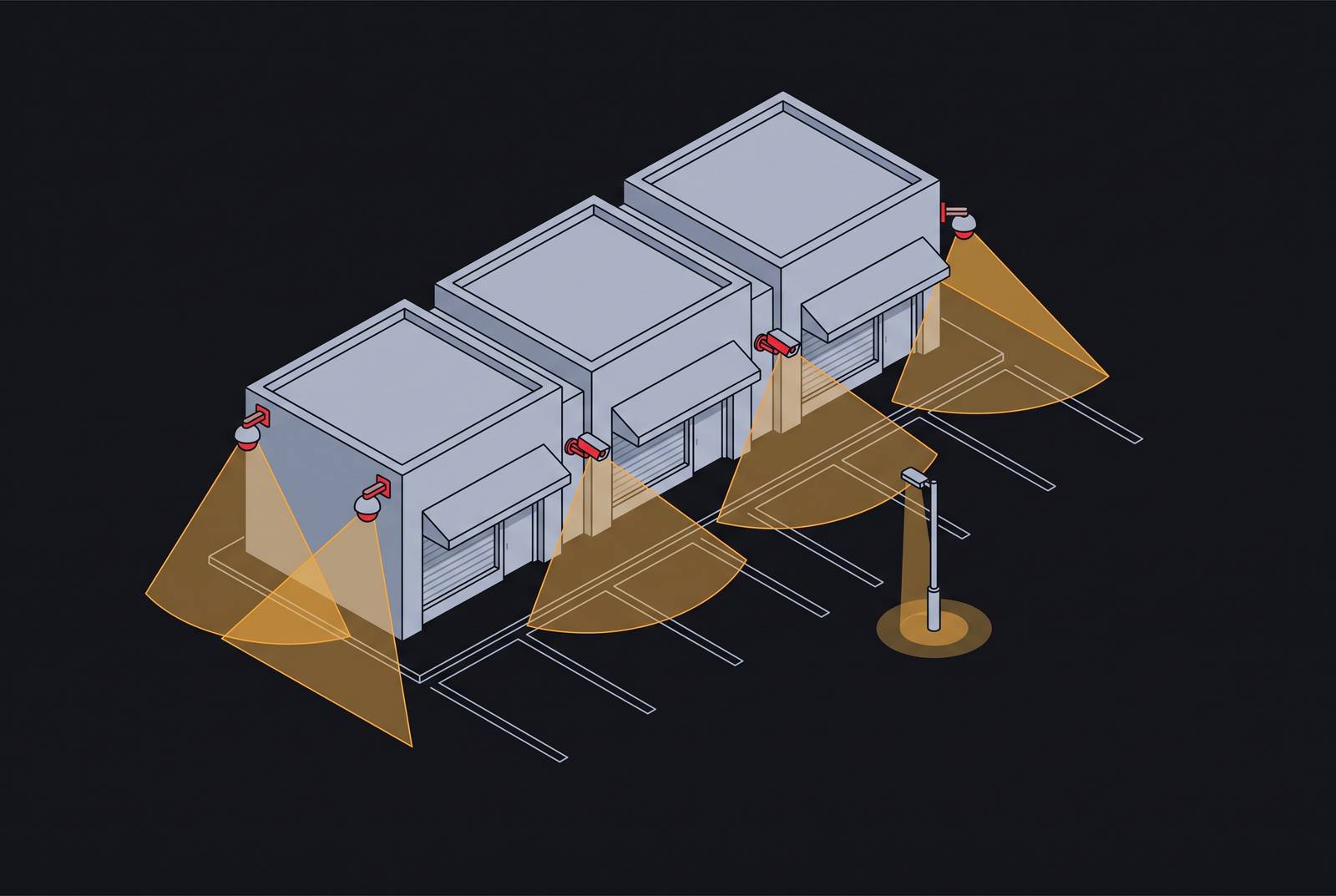
After-hours monitoring for retail strip centers needs camera coverage, rules for each zone, a reliable way to verify threats, and people who respond in time to act. For the program to work, it must tell authorized activity from intrusion in shared parking, rear service areas, and across tenant boundaries. Its measure is whether a verified threat reaches a trained operator in time to act.
Why strip centers are harder to monitor after hours than they look
A strip center has a long, linear footprint rather than the contained layout of an enclosed mall or standalone store. Its shared parking field faces the storefronts, while each tenant’s rear exits and loading areas often face away from the street. Once tenants close, no on-site staff are left to watch those areas. The property has several exposed edges in place of a single clear entrance.
That layout leaves a large perimeter for the amount of rentable square footage. Rear corridors, dumpster enclosures, and service alleys sit outside tenant camera coverage and outside most landlord monitoring contracts. A well-covered store interior can consequently sit next to an exterior approach that nobody monitors. The distinction matters because the route toward a business and the space inside it belong to different coverage areas.
Responsibility follows a similar divide. The landlord controls parking fields, drive aisles, and building exteriors, while tenants control their interior cameras. No single party has full-site visibility unless the landlord deliberately builds it. Tenant turnover adds another discontinuity when cameras go offline or a monitoring contract ends, leaving a dark space in an otherwise covered row. Meanwhile, delivery vehicles, cleaning crews, and early-morning restocking keep the property active after closing, so an empty storefront does not mean an empty site.
The threats that actually materialize after close, and where on the property they happen
The principal after-hours threats concentrate in the rear perimeter and loading dock area, the parking field, and the tenant entry points along the front façade. Each zone presents a different detection problem. Rear delivery bays, roll-up doors, and emergency exits are the main ways into strip centers for those involved in organized retail crime. They combine low surveillance with distance from street view, leaving an approach to the building less visible than the storefront itself.
Parking fields present threats that need not involve entering a tenant space. These include loitering, vehicle break-ins, and use of the lot as a staging area for crimes targeting adjacent businesses. Door and window sensors do not detect these activities, and interior cameras cannot see them. Front-façade breaches follow another pattern, with smash-and-grab through storefront glass concentrated immediately after close and again in the early morning. At those times, the street is quiet until commuter traffic makes it busy again.
Yet presence in any of these zones does not establish a threat. Cleaning crews, restocking vendors, and HVAC technicians can use the same approaches, vehicles, and entry methods as unauthorized visitors. The distinction depends on authorization and context. Simple motion detection therefore cannot resolve the central after-hours question of whether an observed person belongs there.
Why traditional monitoring fails before a real threat ever reaches an operator
Traditional monitoring puts the burden of resolving that ambiguity on operators after alerts have already accumulated. A multi-tenant property sends out different kinds of signals from across a large perimeter, and the reactive model puts those signals in a queue for people to review. Continuous observation has its own limit, with an operator’s ability to detect incidents dropping sharply after 20 minutes of monitoring a live feed. Adding headcount does not remove that attention limit or change how alerts enter the system.
Legacy motion detection makes the workload worse by treating pixel changes as events. A passing headlight, a windblown bag, and an intruder crossing a loading dock can all trigger the same configured zone. Parking cameras that face passing traffic can thus send noisy alerts all night. Operators adapt by raising thresholds or muting zones, but muting converts a false-positive problem into a false-negative problem. The apparent reduction in alerts can conceal a breach until a tenant arrives the next morning.
Split coverage makes the queue harder to manage than at a single-tenant site. Headlights can generate parking alerts while a cleaning crew triggers door sensors at several units, leaving a genuine loading-dock breach behind unrelated activations. Fragmented coverage does not give the operator a unified account of what those signals mean. Sensor dependency creates a separate blind spot because an intrusion through an unsensored panel, skylight, or shared wall produces no alarm. Cameras may record that intrusion while the footage remains unreviewed, so recording and detection remain separate functions.
What coverage protocols for a strip center actually need to specify
A working protocol sets rules for each zone in place of one rule for the whole property. Each area needs rules that spell out what to detect, how to respond, and what escalation path to follow. The rear perimeter and loading docks take priority, with active visual coverage for human and vehicle presence. Their response protocol must begin with detection of the approach or attempted breach, before a door sensor trips.
The parking field needs a different rule because drive-through traffic is not the same as lingering after close. Dwell-time thresholds should define when a person or vehicle remaining in the lot warrants review. Along the front façade, coverage must include the full storefront glass and entry vestibule. The response requirement there must reflect a smash-and-grab threat that develops in seconds.
Common-area interior corridors and trash enclosures are a lower priority during normal after-hours periods. Their priority rises after a tenant reports an incident or during high-risk periods, including holiday weekends and the period following a nearby crime. Interiors that tenants control need a clear rule on where coverage ends because the landlord’s contract usually stops outside them. The protocol should state whether the monitoring center receives a tenant’s interior alarm and how that signal connects with perimeter coverage.
Those zone rules need site context before monitoring begins. Cleaning schedules, vendor delivery windows, and the names and vehicle descriptions of authorized personnel establish what normal activity looks like. A predefined playbook then specifies the response to each confirmed scenario, including live voice intervention through speakers where authorized. The first weeks of deployment are a calibration period for unexpected legitimate visits and zones producing false activations. Adjusting the protocol during that period prevents unresolved noise from pushing operators back toward muting.
How AI-assisted verification changes what the operator sees and when
AI-assisted verification changes the operator’s task by separating detection from the decision to intervene. At the detection layer, object classification takes the place of pixel-change logic, picking out human or vehicle activity that matters from all the visual changes. AI analyzes every frame from connected cameras and surfaces activity that matches a trained detection signature. For strip centers, those signatures include people in restricted areas, vehicles at loading docks outside delivery windows, and parking activity that lasts longer than a dwell threshold. Classification alone, however, does not establish whether a person is authorized.
The verification layer makes that distinction by assessing the detection against the site’s schedule, known vehicle list, and access log. Authorized activity and environmental noise are filtered before escalation to an operator. Instead of searching through cameras or interpreting a notification badge, the operator receives a short video clip with a location tag and timestamp. Reducing false alarms also gives the operator a reason to trust the queue and keep it active.
Verdun applies this architecture by having AI agents review every alarm first and escalating verified threats to trained human operators. Its approach is designed to bring a verified rear-perimeter breach to a responder in under 90 seconds, avoiding delays behind false activations. For loading areas, an approach such as Verdun’s combines recognition of intrusion patterns with human verification and response, using site-specific context.
The division of work remains important. AI agents handle filtering, while human operators authorize intervention under the site’s playbook. A system that responds automatically without human approval is a different and riskier design. The value of verification is not to remove the trained responder but to give that responder a relevant event while action is still possible.
What response speed actually means for a strip center threat, and what SLAs should say
For a strip center, useful speed is the time required to put a verified threat in front of someone who can act. Smash-and-grab and rear-perimeter breaches can be resolved or become irreversible within minutes of initiation. A fast notification therefore has little value if the evidence or human review arrives too late. Buyers need separate, defined speed claims for evidence delivery, alarm verification, and response.
Evidence delivery itself must be immediate. A short clip, location, and timestamp should arrive in under three seconds, while delivery taking over five seconds is too slow for an active threat.
An SLA should specify average alarm verification time, platform uptime, and escalation path, in that order. A contract that stops its response clock when an automated ticket confirmation is sent measures receipt. Without a defined verification measure, the published time does not tell a property manager whether the service can support intervention. The escalation path must also make clear what happens after verification, so the promise extends beyond recognizing an event.
UL 827 provides central-station context, but it was written around trained humans staffing a hardened room around the clock. It does not evaluate AI-first detection layers for model performance or verification accuracy, so certification is not a proxy for speed. Buyers should ask every vendor, including Verdun, for verification time data showing how quickly a trained human sees a verified event from the property’s rear perimeter, distinguishing that time from how quickly a system acknowledges an alarm.
What landlords and tenants each need to get right for monitoring to actually work across the property
The landlord’s program must cover the common areas that no individual tenant can cover for the whole property. Those areas include parking fields, drive aisles, the rear perimeter, loading zones, and building exteriors. The landlord also needs a master authorized-activity schedule that covers cleaning crews, overnight vendors, and maintenance windows in all tenant spaces. Each common-area protocol must identify who receives the call, what voice-down authority the monitoring center has, and when law enforcement is contacted.
Tenants still affect that program when the systems inside their spaces are kept separate. When interior alarms are muted or authorized-personnel lists are out of date, threats can be missed or take more work to verify. An unannounced cleaning crew can trigger a perimeter response while a real event elsewhere needs attention. The landlord therefore needs a mechanism for tenants to communicate changes in vendors, personnel, and hours. Without it, the shared protocol falls further out of step each time a tenant changes how it works.
Unified monitoring also requires a service capable of accepting feeds from independent camera networks and applying consistent verification logic across the property. The same alert protocol must be able to address activity at a tenant’s rear exit and in the parking field. Before vendors are evaluated, there should be agreement on who handles each alert, who can contact law enforcement, and who gets incident reports. A vendor that asks these questions before proposing a contract is demonstrating site-specific competence. During the first weeks after installation, teams should measure alert-mute rate as well as incident rate, because a muted channel can conceal a monitoring failure.
This coordination supplies the final test of the investment. If coverage boundaries, outdated schedules, or a noisy queue prevent a verified alert from reaching a trained human, the footage serves only as documentation. Effective after-hours monitoring depends on that complete chain working, from the relevant zone to an authorized response.