Structured Triage Protocols That Reduce Alert Noise Without Sacrificing Camera Coverage
Layered analytics filter noise while keeping all cameras active and recording.
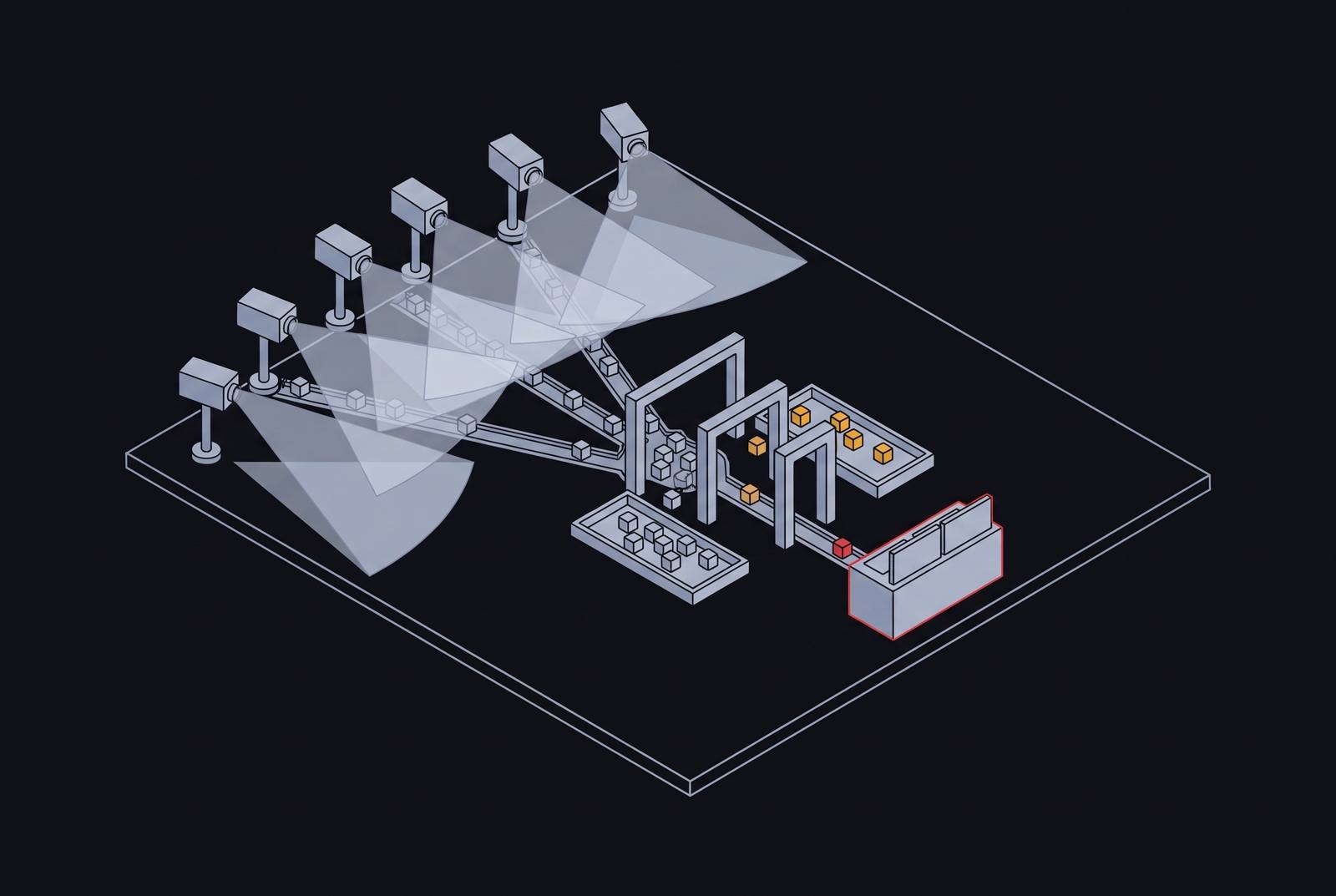
Muting noisy cameras is not a monitoring solution because it removes alerts from the coverage those cameras provide, rather than distinguishing harmless activity from threats. Structured triage preserves camera coverage while filtering environmental noise and authorized activity before human review. The goal is fewer raw alerts competing for attention while preserving opportunities to detect an incident.
Why the alarm queue is the real security vulnerability
A real threat cannot get attention in time when it sits behind a flood of false alarms. That is the structural weakness in traditional video monitoring. Motion, weather, and equipment faults generate work for the same operators who must recognize an intrusion and authorize a response. Without classification before review, real events go into the same queue as nuisance notifications. More cameras can therefore deepen the backlog without improving the speed of intervention.
The Urban Institute found that the vast majority of security alarm calls received by police are false. The ASU Center for Problem-Oriented Policing estimates that an alarm notification indicates a real threat only a small fraction of the time. Those findings concern alarm calls and notifications, but they show how inaccurate signals increase the workload. Every false signal demands attention that could otherwise go to a real incident. Volume and accuracy are inseparable in that queue.
Alarm fatigue makes operators less sensitive to all notifications, including genuine ones, while trust in the system erodes. The causes are varied, including disarming errors, equipment malfunction, animals, weather, and environmental motion. No single threshold eliminates them all. Reducing camera count or muting the busiest feeds makes the queue quieter by withdrawing coverage while leaving the causes of false alarms unresolved.
Why muting noisy cameras is not a monitoring solution
Effective noise reduction changes classification while preserving camera coverage. A camera that continues recording while its notifications are muted may still capture an incident, but its activity no longer reaches the monitoring workflow through those notifications. Recording and active monitoring are not interchangeable. A quieter dashboard is therefore not evidence of better protection.
Other apparent fixes require the same scrutiny. Broadly raising alert thresholds can discard low-confidence events without resolving whether they represent threats. Moving operator review offshore does not itself classify events and can leave latency unresolved or make it worse. Overage fees that push clients to cap camera counts also push them to cut coverage.
The proper constraint is that every camera remains active and every alarm receives review through the classification process. Human review need not be the first step. Basic motion detection leaves the operator to distinguish wind-blown leaves from an intruder, whereas analytics can classify people, vehicles, animals, direction of travel, and dwell time. That distinction reduces what reaches humans without reducing what cameras capture.
How a layered triage architecture separates noise from threats before the human queue
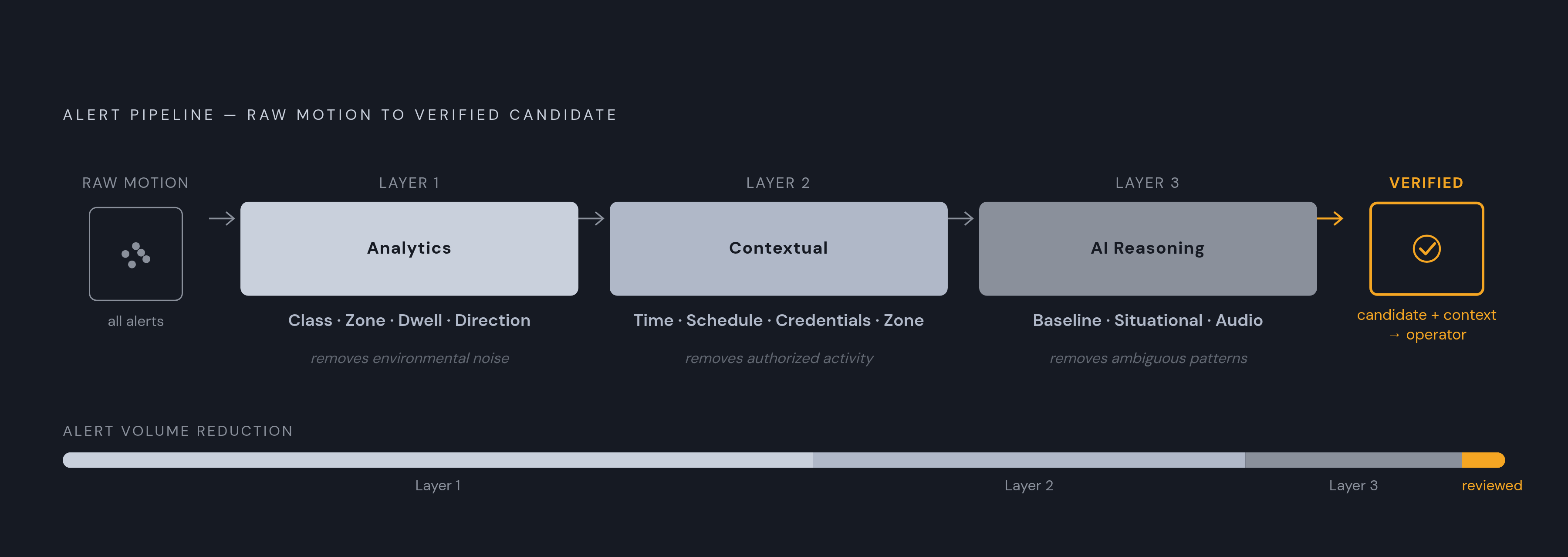
The first layer uses analytics to remove environmental and incidental motion from the escalation stream. Class detection distinguishes a person, vehicle, or animal, while zone masking, dwell-time rules, and direction-of-travel logic refine which activity warrants further assessment. Without this layer, an operator has to review the movement itself. With it, movement becomes a classified candidate.
The second layer checks that candidate against what is happening at the site. The time of day, known schedules, access credentials, and activity in adjacent zones help the system judge whether the movement it detects is part of authorized behavior. A person at a loading dock at 2 a.m. on a Sunday presents a different question from a person there at 10 a.m. on a Tuesday. Presence alone cannot resolve the difference. Access control, door contacts, and adjacent-zone motion provide corroboration so that one sensor's false positive does not automatically become a verified escalation.
The third layer applies AI agent reasoning after those earlier decisions. The agent assesses the remaining event against the site's learned behavioral baseline, performs situational analysis, and can initiate a preliminary audio challenge or site notification. It then presents a verified candidate with context attached for human review. This is distinct from detecting an object class. Without that deeper analysis, ambiguous events still arrive with the operator responsible for assembling their significance.
Each layer addresses a different source of noise. Analytics handle environmental activity, contextual checks distinguish authorized-but-anomalous behavior, and agent reasoning assesses the ambiguity that remains. These are sequential decisions. Collapsing them into a single rule set leaves some category of noise unresolved. The architecture works by progressively improving the evidence before attention is committed.
Why site-specific context is the variable that determines whether the pipeline works
A correctly detected person can still be incorrectly classified. A model tuned to daytime retail activity can misfire at night or after a floor layout changes because its assumptions no longer match the site. A contractor who comes for a scheduled Saturday visit can also be misclassified. Without the access window, the system cannot reliably distinguish that visit from an unauthorized presence.
Useful context includes staff schedules, shift patterns, contractor access windows, authorized vehicle lists, and zone-specific rules. The learned behavioral baseline adds what normal activity looks like over time. Together, these inputs give the classification layers a basis for interpreting a detection. A person in frame is only the starting point. The triage decision depends on whether that person is expected in that area at that hour.
Layout changes, seasonal hours, new contractors, and revised shifts can all make the existing baseline inaccurate. Maintaining context creates a real operating burden. However, a static generic model recreates legacy false alarms under an AI label, returning unnecessary events to the human queue. For buyers, whether a provider maintains site-specific protocols is consequently a stronger evaluation question than how many cameras it can handle.
How verified-response policies have changed what an unverified alarm is worth
An unverified alarm has consequences beyond the monitoring center. In jurisdictions with verified-response policies, a raw notification may no longer reliably produce police dispatch. False-alarm reduction plans can also include fees and verification procedures, so an escalation that was not needed can carry a cost. Camera coverage alone cannot satisfy a requirement for evidence of a threat.
Only a small number of U.S. law enforcement agencies have formally adopted verified response, and several agencies that tried it reversed course. Nevertheless, the absence of a universal mandate does not make raw signals more informative. Technology-driven verification provides evidence even where policy does not require it.
The TMA's Automated Secure Alarm Protocol (ASAP) provides standards-based digital dispatch of alarm event data from monitoring centers into PSAP CAD systems. This pathway distinguishes the delivery of structured event information from the mere generation of a notification. Verification and dispatch are connected, but they are not identical. An event that is video-confirmed, timestamped, and human-reviewed gives a monitoring provider more evidence for escalation, though local requirements still govern the response that follows. A contract that cannot produce such evidence leaves its central promise dependent on an unverified signal.
Where the human operator belongs in this workflow — and why removing them is the wrong goal
The operator belongs at the decision point the pipeline protects. Instead of reviewing hundreds of raw alerts per shift, the operator assesses a smaller number of verified candidates with relevant context already attached. That role requires authority as well as information. Law enforcement engagement, dispatch authorization, life-safety incidents, and use-of-force situations still need a human to review and authorize the response.
An AI agent can initiate an audio challenge, site notification, or alarm activation and present recommended options to the operator. The operator makes the final call. Research presented at CHI '26 found that a prompt-engineered video understanding model reduced reported manual workload and increased operator confidence compared with raw video review. The study concerned multi-robot video sensemaking, so it supports the value of assisted review rather than establishing performance for every monitoring deployment.
The same research found that false alarms and privacy were still concerns when putting the model to use. Human judgments also provide feedback when a candidate clears the pipeline because of a false positive or contextual misread, improving future site-specific classification. The operator is therefore both the final decision-maker and a source of correction. Speed to a verified, human-reviewed response is the output the architecture is designed to produce.
How the triage architecture applies differently across commercial, multifamily, and industrial sites
Commercial properties have large, varied authorized populations, including employees, customers, contractors, and delivery personnel. Access depends on role, area, and time of day. After-hours retail areas and employee lots can have an authorized population near zero, making detected presence a strong triage candidate. The same presence when normal activity is under way may need no escalation. Commercial workflows also include contacting on-site personnel before law enforcement, which makes pre-loaded contact protocols part of the decision process rather than information an operator must search for during an event.
At multifamily properties, someone's presence says less about whether there is a threat. Residents are authorized somewhere on the property, while activity in lobbies, parking structures, package rooms, and pool decks varies by person and hour. A person in a parking structure at 3 a.m. could be a resident returning home or an unauthorized individual. Context must resolve what detection cannot establish. Zone-specific schedules therefore help the system classify events, while documented workflows and timestamped response records support premises-liability documentation because they show whether an alert led to a verified response or a documented dismissal.
Industrial sites require additional distinctions for protective equipment compliance, perimeter intrusion, and fire or smoke detection, each with its own dwell-time and confidence thresholds. The number of cameras also puts pressure on bandwidth and latency. Edge inference keeps alert generation local, reducing the round-trip delay and cloud dependency that could impede detection during a WAN outage. In truck yards, warehouse perimeters, and loading docks, a license plate read or scheduled arrival window may distinguish an authorized driver from an unauthorized presence. Those inputs must be available before review rather than reconstructed by the operator during the incident.
What buyers should actually evaluate when a monitoring provider claims to reduce false alarms
Buyers should look at how a provider cuts alerts as well as whether the alert count it reports goes down. Buyers should first ask whether it maintains site-specific schedules, access rules, and authorized-personnel protocols or applies generic detection rules across accounts. The next is where the operator enters the pipeline. Reviewing raw motion events is fundamentally different from reviewing verified candidates with context attached. A claim of AI filtering does not establish which workflow the provider actually uses.
Queue performance requires a measure that cannot be improved simply by silencing cameras. The useful measure is average time from alarm trigger to human review of a verified event. Buyers should also ask how the provider updates baselines after contractor changes, seasonal hours, or layout changes. A verified event record should connect the timestamp, video confirmation, and documented operator action, giving the buyer evidence of the workflow.
Coverage preservation is a separate and necessary test. Buyers should ask whether the provider has recommended cutting active camera coverage to keep the number of alerts down. Such a recommendation exchanges a classification problem for a blind spot. Likewise, a large camera count does not establish effective protection when each additional feed adds raw alerts to an already congested queue. The service must demonstrate that it can preserve those inputs while making the resulting events usable for human decisions and verified-response requirements.
The buying objective is therefore a monitoring service that preserves total camera coverage and applies AI filtering across the decision layers before an event enters the human queue. Operators should have evidence on which to base verified decisions, with environmental motion already sorted out so it does not take up their attention. Response speed must reflect that cleared path. The performance target is a verified, human-reviewed response in under two minutes rather than the thirty-to-forty-five-minute range associated with the legacy model. That is a claim to evaluate through response records.