Silencing Cameras Shifts Operational Risk Without Resolving the Alert Volume Crisis
Muting noisy cameras trades alert overload for blind spots.
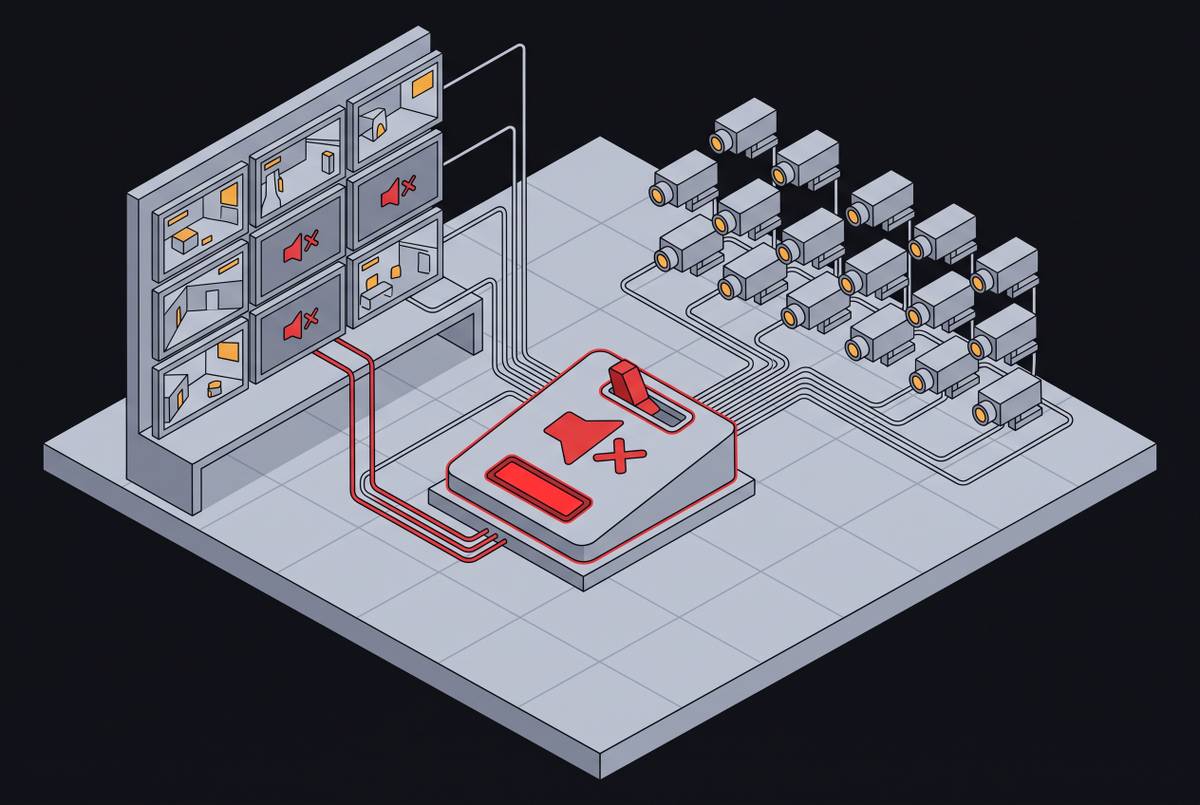
Muting noisy cameras reduces notifications by removing coverage. It shifts operational risk from an overloaded queue to a zone where genuine events may go undetected. Triage resolves routine events before they reach an operator while preserving human review for ambiguous or high-stakes events.
Why the queue breaks before operators ever think to mute a camera
The relay model sends a sensor activation to a central station, where an operator calls the premises and dispatches police. There is no verification step built into that sequence. Every activation has the same priority in the queue, whether it comes from an intrusion, an employee mistake, or an environmental disturbance. The operator becomes the point where an undifferentiated signal must acquire meaning. As activations accumulate, review capacity must absorb the noise before it can identify the threat.
The ASU Center for Problem-Oriented Policing compiled research for the DOJ showing that the overwhelming share of police responses to burglar alarms are false activations. LAPD handles an enormous volume of alarm calls at a nearly total false-alarm rate, while Chicago handles an even larger volume with a similarly poor signal. False activations consume the work the model exists to perform.
The causes also extend beyond detection algorithms. Wind, rain, animals, and PTZ cutover at dusk can generate signals without a security event. User error, including wrong keypad codes, propped doors, and off-hours employee access, is the largest category in many deployments. Traditional motion detection treats those triggers identically because it sees movement without interpreting its meaning. That design places the burden of discrimination downstream, where human attention is finite.
How alert fatigue turns a noisy queue into a silent gap
Alert fatigue is a documented cognitive pattern, also studied in hospital ICU monitoring, in which urgency declines, response times lengthen, and alerts eventually receive no review. The problem includes excessive workload and the loss of trust in what an alert signifies.
Muting follows the same logic as ignoring alerts. From the operator’s position, it removes an immediate source of interruption and makes the remaining workload more manageable. Under that constant pressure, the choice makes sense for the operator and says little about their discipline. Training cannot make a chronically unreliable signal more informative.
Some of that pressure comes from discrete, recognizable events. PTZ scene transitions, IR cutover at dusk, and focus shifts can flood a queue with spurious alerts. A short suppression window after a known transition is a targeted response to a mechanical cause, but that minimal adjustment is often skipped. The resulting repetition encourages broader suppression by operators. Unlike deliberate tuning around an understood event, muting a channel is a coping behavior whose effect can remain invisible to management.
What happens to security coverage when high-alert cameras are muted
A muted camera leaves the underlying activity unchanged. What disappears is the notification that would bring that activity to an operator’s attention. During the interval between muting and the next genuine event, the site has traded a noisy detection path for no active warning from that path. Recording may still give evidence afterward, but that serves a different purpose from stepping in while an event is happening. The risk has moved from review overload to missed detection.
Cargo theft makes that distinction concrete. Verisk CargoNet’s January 2026 analysis found that confirmed cargo theft incidents rose year-over-year while the total number of supply chain crime events stayed about the same. That finding shows why a stable event count cannot stand in for control of actual theft. At entry gates, tailgating exploits brief windows when attention is low or cameras are suppressed after a scene transition. A truck yard operator documented more than 75 tailgating incidents deterred in under three months after continuous AI monitoring was in place.
Retail exposes the same gap through coordinated sweeps. Cameras that record a twelve-person coordinated sweep after the fact have documented the loss. Active monitoring is the link between visibility and response. If chronic false alarms have also led police to deprioritize the address, a real event faces another obstacle even when someone detects it.
Why the standard workarounds all preserve the queue problem
Overage fees make excess alarm volume financially manageable for a central station by charging the site more. They do not improve the incoming signal. Instead, the queue remains and the financial incentive to remove its cause is diluted. The arrangement can be rational for a service managing its costs while leaving the buyer with a larger bill for the same underlying defect.
Offshore staffing addresses a different part of the expense. It lowers cost per seat without reducing alerts per camera, so cheaper labor absorbs the same unresolved volume. ASIS International documents annual turnover in the U.S. security guard workforce at a level that exposes continuous human watching to recurring recruitment and training demands. Adding seats can relieve today’s workload without stabilizing the operating model. Neither staffing decision establishes which events deserve attention.
Object-detection-only AI can reproduce the problem in a faster form. Identifying a person in a frame does not establish whether that person’s behavior is anomalous for that zone at that time. If every detection becomes another clip for human review, automation increases the queue. Production performance also runs below published benchmarks, and an uncalibrated deployment can produce more false positives than the motion-detection system it replaced. Each workaround optimizes a local constraint, whether price, staffing, or detection speed, while leaving humans responsible for separating routine activity from threats.
How law enforcement's response to false alarms has already begun to change the stakes
Police response introduces a constraint outside the monitoring service’s control. Salt Lake City’s 2000 verified-response policy led to a large drop in alarm responses right away. Los Angeles moved to require verification after finding that the overwhelming majority of its annual alarm calls were false, costing roughly $11 million in lost patrol time. Those policies address the burden on public resources. For a site, they change whether an alarm signal is enough to obtain a response.
The Security Industry Association reports that only a small share of U.S. law enforcement agencies have formally adopted verified response. It also reports that at least eleven agencies tried it and reversed course after citizen complaints and concerns about crime. The pressure is therefore real but uneven. Public expectations that police will answer an alarm make formal restrictions politically fragile, while repeated false dispatches can still produce an informal response-time penalty for an address.
That distinction makes alarm quality both a site liability and an internal efficiency measure. A monitoring provider cannot control how a department responds once a history of false calls has accumulated. Muting the noisiest cameras may reduce the number of alarms generated, but it does not establish better discrimination between routine activity and threats. Genuine events in the muted zones can go undetected and unreported. An absent record is not evidence of improved security.
What actually clears the queue — triage that resolves events before they reach a human
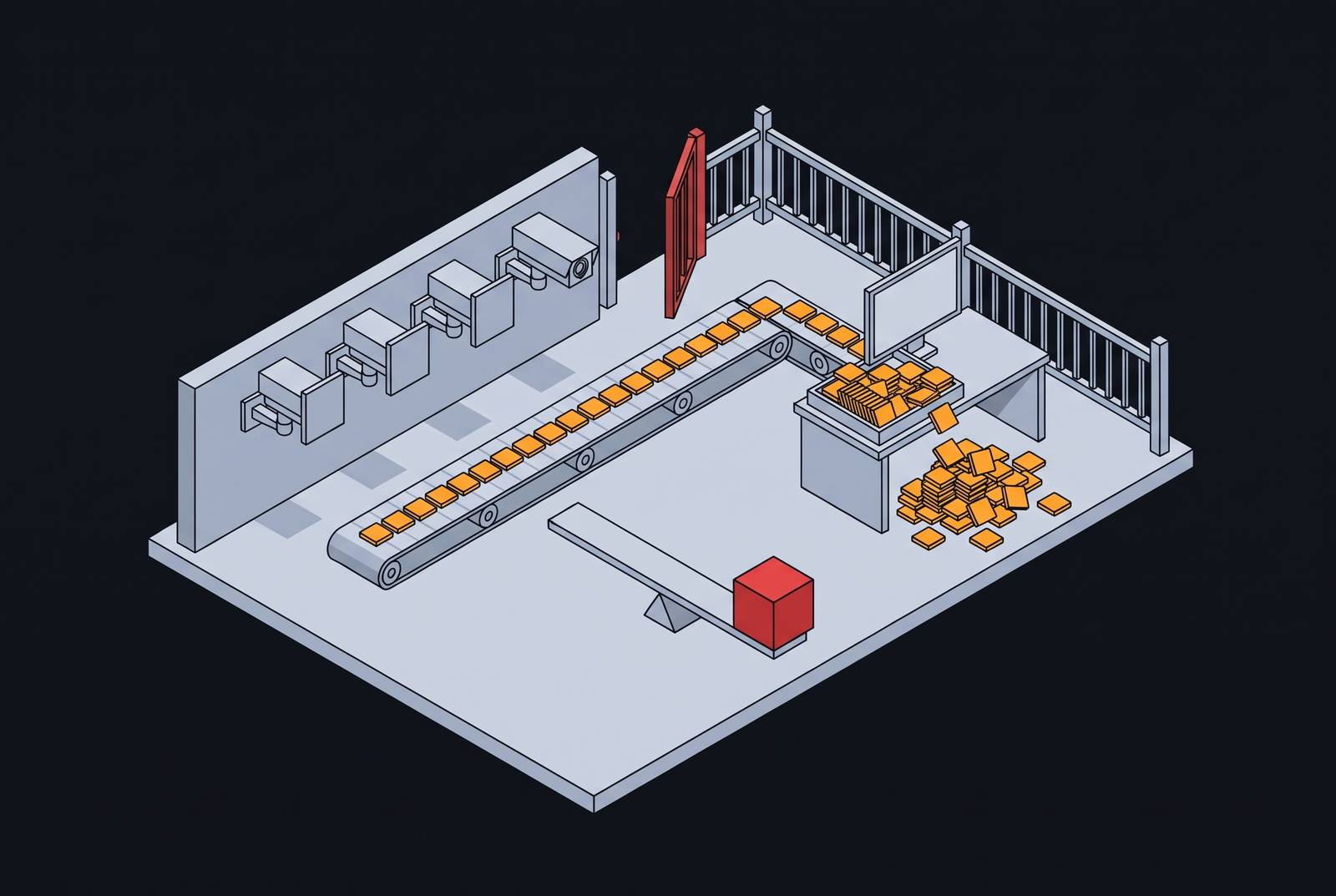
Triage-first architecture moves discrimination ahead of the operator queue. Object detection remains a prerequisite, but anomaly detection also needs a model of normal activity for each zone and reasoning across time. A person’s presence becomes an input. Agentic triage evaluates zone, time of day, and prior activity patterns, resolving routine events without creating an operator alert. Ambiguous or high-stakes events escalate for human judgment.
Site calibration makes that distinction operational. Fora Soft documented a VMS deployment in which false alerts fell from 6–8 per camera per day in week one to under one per camera per day after a site-specific calibration pass. At four weeks, operator adoption was still above 80 percent. Adoption was tracked because silent muting was the failure mode. The result links reduced noise to continued use, rather than treating detection performance alone as success.
Human verification then addresses the events that remain. In professional remote video monitoring, operators review live footage, assess the threat, and decide how to respond when an event is escalated. The Monitoring Association’s AVS-01 standard formalized lower priority for alarms without corroborating evidence, while leaving dispatch decisions to local verified-response policies. Verification applies that evidence-based distinction before police policy forces it.
The market has also moved toward this layer. Alarm.com’s February 2025 acquisition of CHeKT, a cloud platform for remote video monitoring services, gave central stations a way to use proactive video-verification. The acquisition supports the commercial importance of verification, though it is not proof that every implementation performs equally well.
Where AI triage still requires honest limits and human judgment
A vision model cannot resolve every reason an alarm activates. An employee entering the wrong code, a contractor arriving for an unscheduled shift, and a delivery at an unexpected hour all require context beyond object classification. Some analyses attribute roughly half of alarm activations to user error. Pixels alone do not establish intent. Human judgment is therefore part of the architecture.
Trained operators weigh intent and body language alongside what is happening around the person. Automated systems can identify behavioral patterns, but genuinely ambiguous patterns still require escalation. Footage quality adds a separate limit. Night and IR capture, motion blur, low light, rain on a lens, and weather-driven scene changes reduce performance below benchmark figures. Calibration must take the site’s camera geometry, lighting, and activity into account, because a model may be less accurate there than its published figures suggest.
IHL’s AI Reality Check study found that only 9% of retailers have an active computer vision deployment, though a much larger share already have cameras mounted. A pilot baseline provides firmer evidence than a vendor’s outcome claim. The NIST AI Agent Standards Initiative, launched in February 2026, addresses identity, authorization, auditing, and non-repudiation for autonomous agents. Those concerns frame how decisions are bounded and reviewed, especially where escalation can lead to law enforcement response.
What a site should actually evaluate before choosing a monitoring architecture
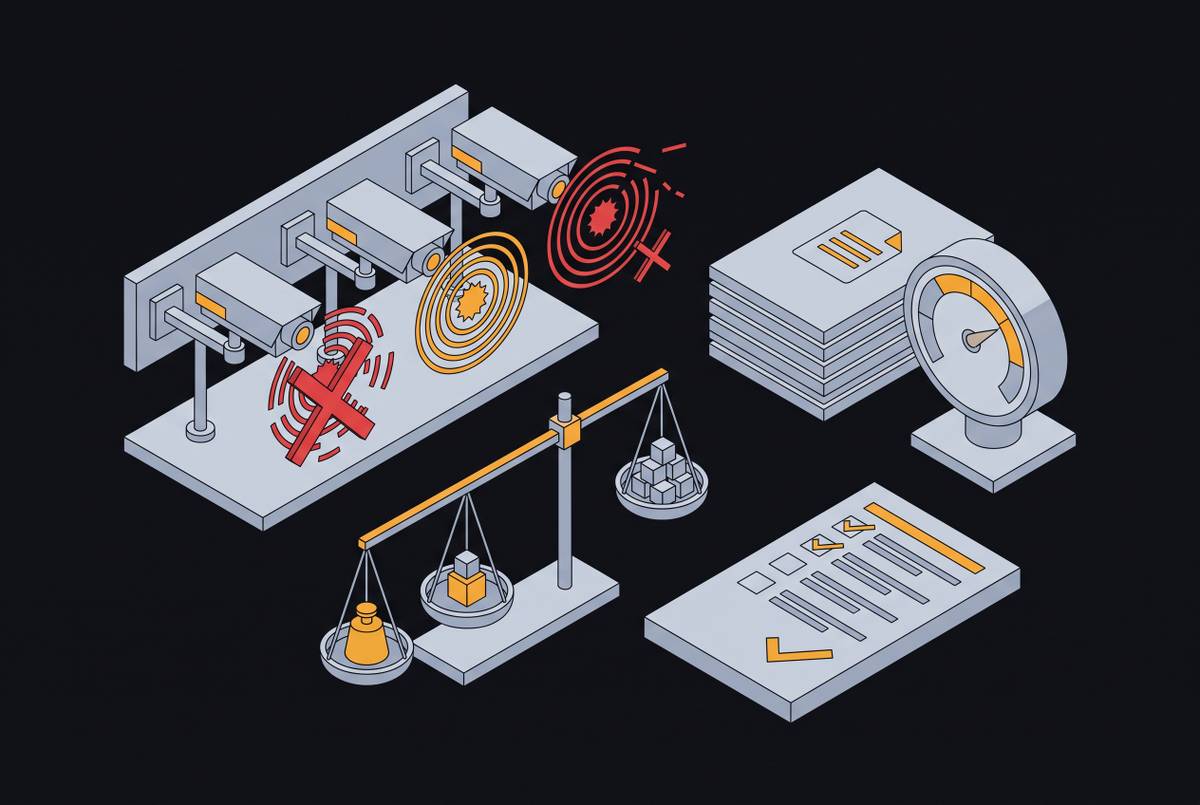
For buyers, the first question is which layer performs triage. A system that resolves routine events before human review changes the workload structurally. A system that sends every detected object to a reviewer preserves the queue, regardless of its marketing. The distinction is visible in what reaches an operator.
Performance evidence should come from the site itself. A sound pilot tracks the false-alert rate per camera per day before and after calibration, using the site’s own cameras, lighting, and patterns of activity. It should cover Night and IR capture, weather, low light, and edge cases specific to the site. Benchmark figures cannot substitute for this evidence. The test must show whether the system is still usable in the conditions that caused noise before.
The human layer requires equally close scrutiny. Trained operators should assess live footage, the nature and severity of a threat, and the appropriate response. The review SLA should establish how quickly escalated events receive attention. Triage creates capacity for prompt review. It does not promise that no queue will ever form.
A service’s handling of the cameras generating the most alerts is decisive. A service that recommends muting them, restricting their zones, or charging overage for their volume is managing around the defect. A triage-first service must demonstrate how it distinguishes routine activity from actionable events without surrendering that coverage.