What Muting a Camera Actually Costs a Monitoring Center Versus Fixing Its Alarm Logic
Muting cuts alarm noise by cutting coverage; fixing logic cuts both.
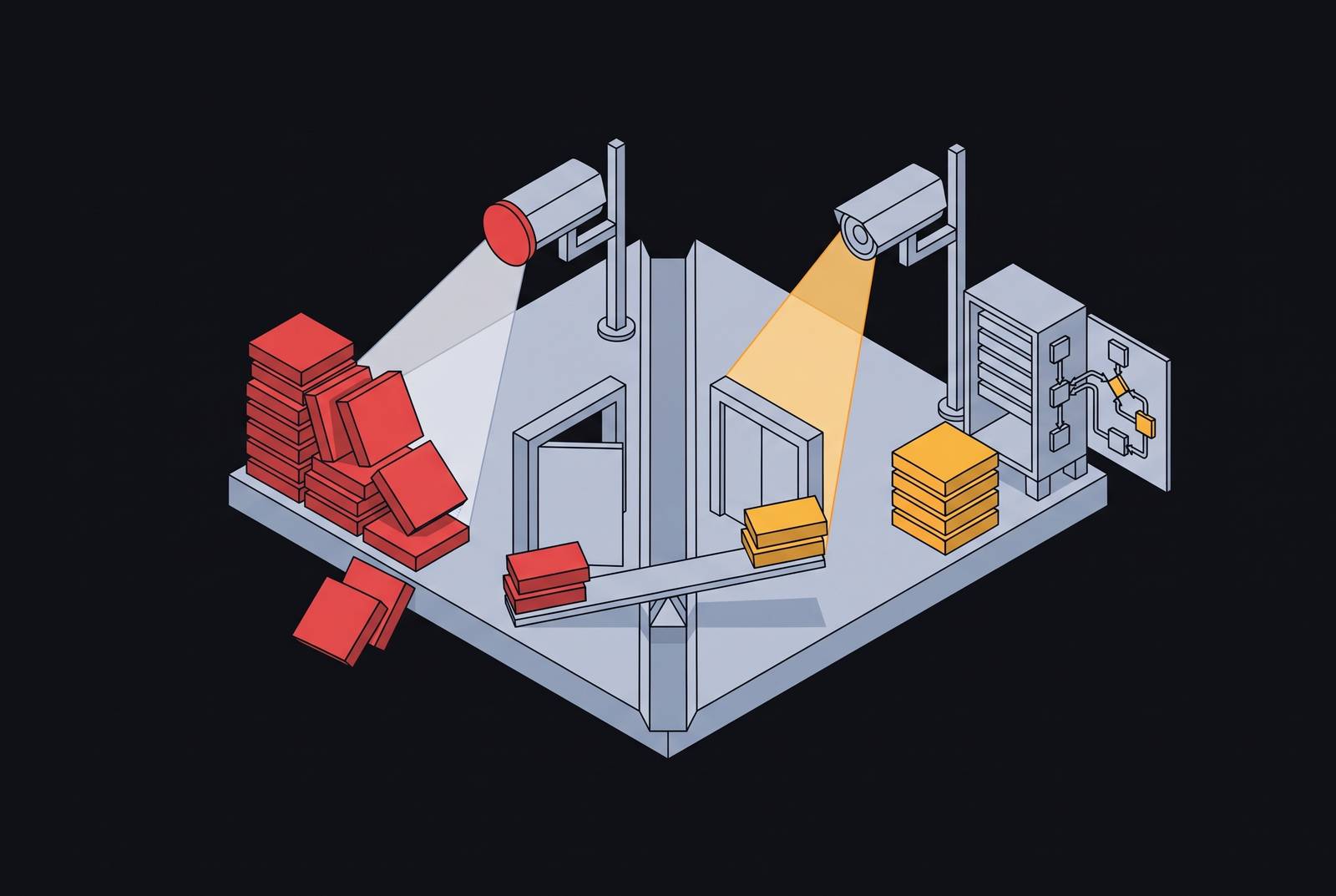
Muting a noisy camera reduces the alarm queue by removing coverage and leaves threats undistinguished from routine activity. Fixing alarm logic cuts both costs by giving people fewer needless alerts to review while keeping the alerts that call for action. The comparison therefore turns on whether a monitoring center is processing fewer false alarms or simply watching fewer zones.
Why the queue breaks before anyone decides to mute a camera
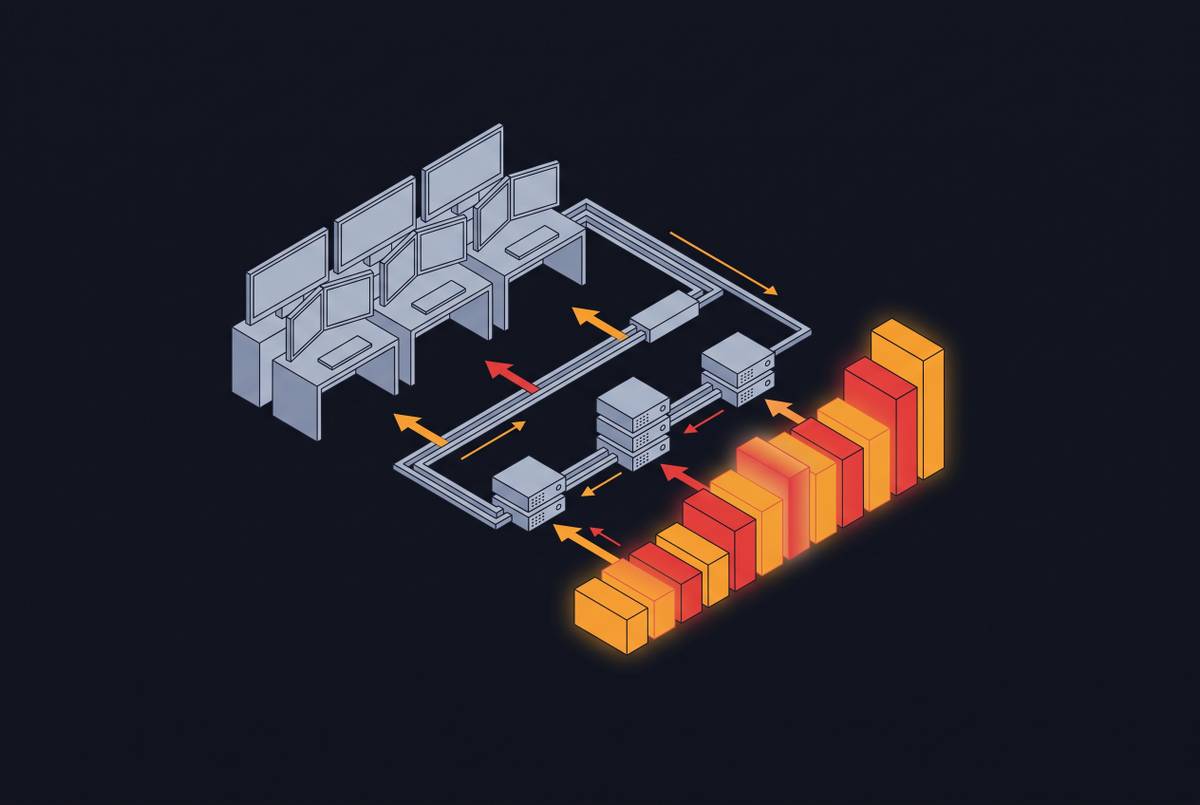
The alarm queue receives movement faster than operators can establish its meaning. Pixel-change motion detection cannot distinguish a shadow, a deer, or a bag in the wind from activity associated with a smash-and-grab. Object detection adds classification, but knowing what an object is does not tell operators whether they need to act. Movement is not the same as a threat. When routine activity calls for review, the number of alarms grows even though there is no more real danger.
Camera counts have expanded across commercial sites without matching growth in operator headcount. That imbalance places more events into each operator’s shift than a review-every-clip model can sustain. Problem-oriented policing research compiled for the U.S. Department of Justice found that the overwhelming majority of police responses to alarm activations are false. The burden begins before dispatch, inside the review queue. Muting becomes attractive only after that queue has already defeated the operating model.
How operator behavior degrades silently under sustained alarm load
Repeated false signals change how operators respond to the next signal. Perceived urgency falls, response slows, and genuine threats eventually encounter the same skepticism as routine noise. The adaptation is predictable. Hospital ICU research examines the same alarm-fatigue pattern, in which repeated alerts erode confidence in the warning system. For a monitoring center, the consequence is that an active notification channel becomes progressively less effective at prompting action.
The progression can begin with silencing an audible alert. The analytic channel then becomes background activity, and the camera eventually becomes passive in operational terms. Each decision offers relief from an immediate burden. Together, those decisions dismantle the connection between detection and response, even while the camera remains part of the nominal monitoring inventory.
Stricter rules cannot make repeated false signals tell operators more. Better training does not remove the cognitive pressure created by a queue dominated by events that require no action. The upstream failure is therefore the alarm logic that repeatedly demands attention without earning it. Operator trust is a finite operational resource, and bad logic consumes it before an important event arrives.
What happens to security coverage when a monitoring center mutes a camera
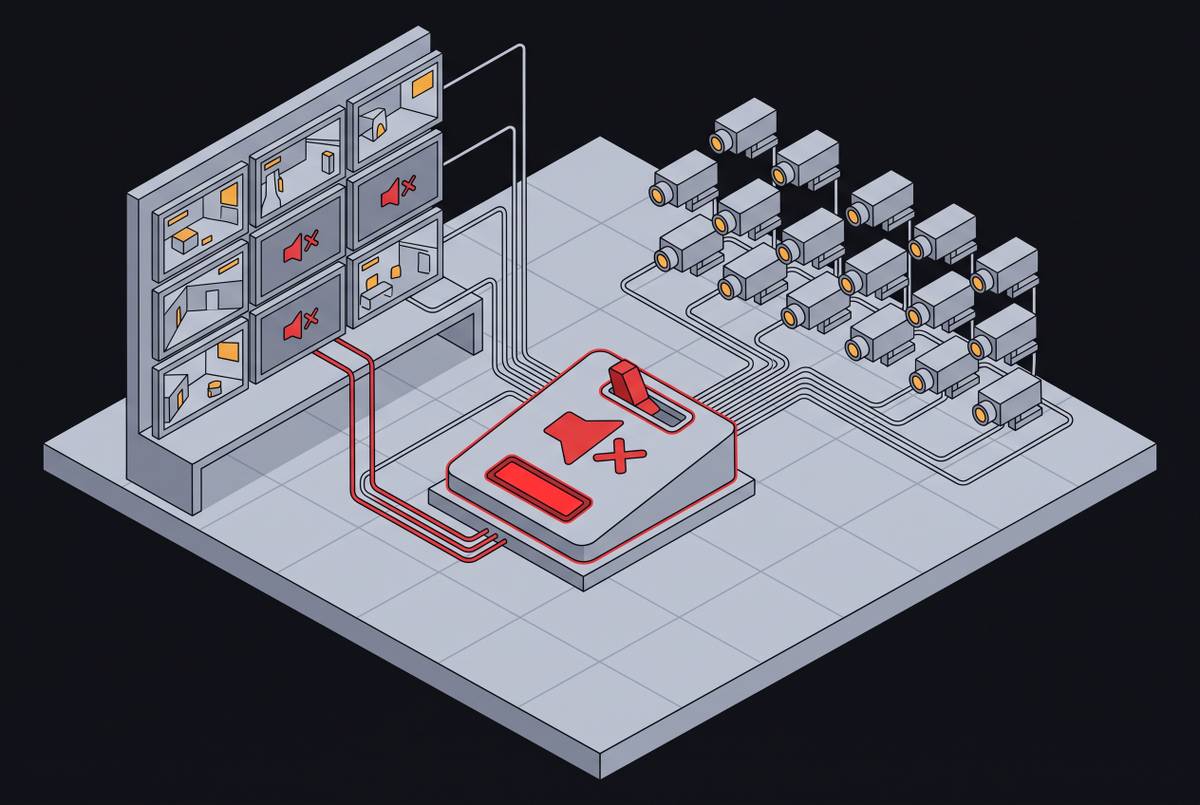
Muting trades a visible queue reduction for a less visible coverage gap. During the mute window, events in that camera’s field of view no longer trigger the monitoring response that the client expects. The zone has no monitored coverage through that alert channel, even if the camera can still record separately.
The gap also creates liability exposure when an incident occurs in the muted zone. A monitoring center cannot claim that the muted alert channel provided active monitoring during that time. Documentation of the mute decision can become evidence in a dispute. The decision that relieved queue pressure can therefore undermine the center’s account of the service it provided.
Temporary muting can also outlast the condition that prompted it. Without a formal reconsideration schedule, an overloaded team has little opportunity to return to cameras removed from the queue. Silence makes the problem easy to overlook. Coverage loss then accumulates while standard activity reporting shows fewer alarms and omits the missing response opportunities.
This is not an argument about operator negligence. Centers mute cameras because the alternative can be a queue that prevents effective response anywhere. Nevertheless, undisclosed gaps in the camera inventory compromise the monitored coverage the client pays for. Discovery through an incident or audit puts both client trust and contract renewal at risk.
The financial cost the queue imposes before and after a muting decision
False alarms consume minutes of operator time, so high event volumes turn individually small interruptions into substantial labor waste. Per-event pricing exposes the same burden to clients. Unlike flat per-camera monthly fees, it makes a noisy site more expensive precisely because its alarm logic sends more events into review.
Chicago’s fine structure and Los Angeles’s per-dispatch costs make repeated false alarms more than a small nuisance by adding to the cost of running a site. Baltimore’s City Code establishes a threshold-based no-response status under which police will not dispatch to investigate an alarm signal. Chronic noise can therefore increase the bill and weaken access to response.
Muting offers immediate relief from these measurable burdens. Labor and false-alarm costs are visible in routine operations, while the cost of a missed event remains unknown until an incident exposes the gap. Liability, loss in the unmonitored zone, and a damaged client relationship sit on the other side of that decision.
There is no honest way to put the same cost per muted camera on those consequences. Their scale depends on the event that goes undetected and the coverage the center undertook to provide. Muting removes a known expense by accepting an unmeasured exposure, whereas fixing alarm logic addresses the source of the expense without deliberately abandoning the zone.
Why fixing alarm logic is harder than it sounds and what makes it actually work
Switching from motion detection to AI object detection is not enough. A model that identifies a person or vehicle still has to check that presence against the expected activity in that zone at that time. Without that check, bounding-box noise just takes the place of pixel-change noise. Effective alarm logic needs temporal reasoning and a definition of normal activity for each zone.
That reasoning must work on the footage sites actually produce. Night and IR footage require models trained on IR data, while reliable human detection in pitch-dark IR conditions remains subject to physical range limits. Software cannot remove those limits by itself. Rain on a lens, snow on the ground, and fog reducing contrast require weather-aware thresholds and seasonal recalibration. Occlusion and crowded scenes create further difficulty, making a busy entry at shift change a different detection problem from an empty warehouse at 02:00.
Model selection is therefore part of the fix. A model poorly matched to the camera type, lighting, or scene geometry can produce confident wrong answers. Confidence alone does not establish operational reliability. The nuisance-alarm rate per camera per day must stay low enough that operators still think alerts are worth reviewing.
Calibration must also continue after deployment. Staffing patterns, site conditions, and seasons change, so a system that performs well in week one can degrade by month three without another calibration pass. A successful installation is not a permanent setting. The system must keep noise down and keep operators using it as those conditions change, even if it looked convincing in the first demonstration.
How agentic verification changes the math instead of moving the problem
Traditional monitoring places a human between detection and verification. Every detected event thus gives someone work to do before anyone knows whether action is needed. In high-volume monitoring environments, 85–99% of alarm signals require no intervention. Under the traditional sequence, that routine volume still consumes the attention needed for consequential events.
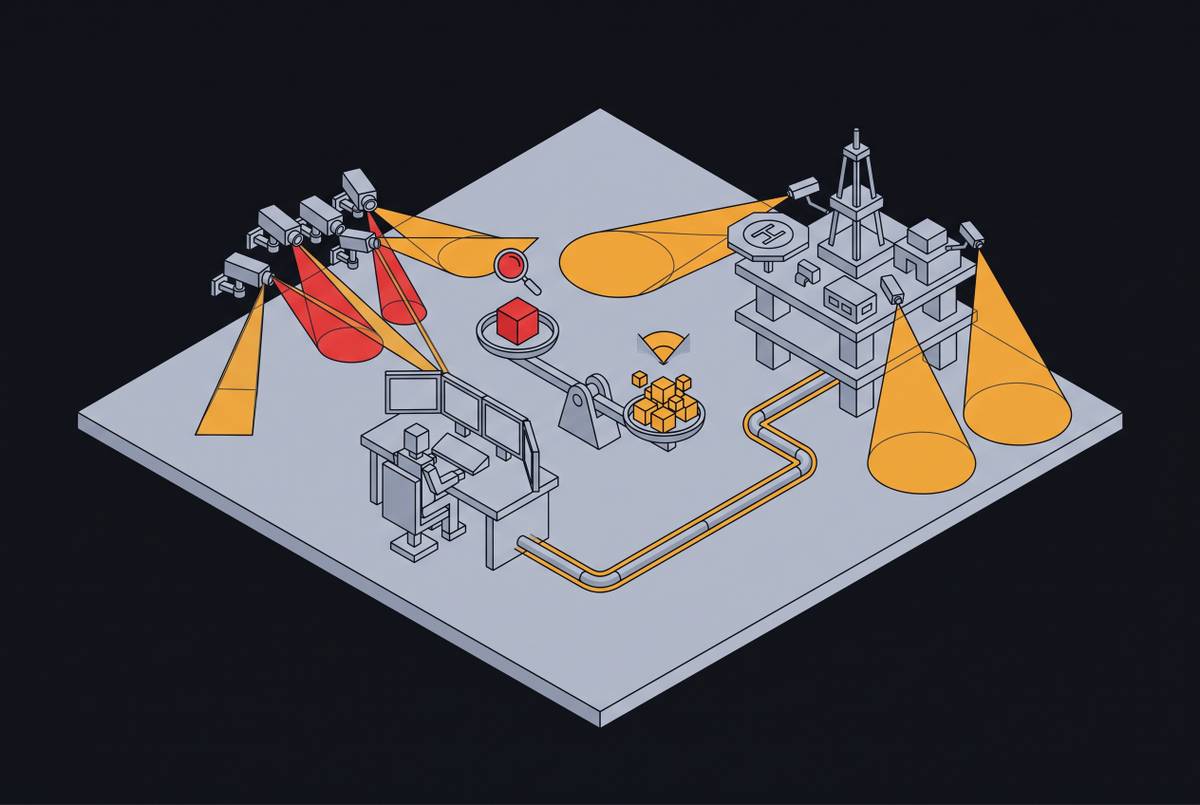
Agentic verification changes the order of the work. An AI agent examines whether a detected person or vehicle belongs in the zone at that time, considers behavioral context, and resolves routine events before they reach an operator. Ambiguous or confirmed high-stakes events then move to human review. This is verification before escalation, rather than more detection followed by the same overloaded human filter.
AI that generates additional alerts can enlarge the queue even when its object classifications are accurate. AI that verifies events first can reduce human workload without suppressing the camera’s entire alert channel. The benefit depends on what the system resolves.
The agent will still make mistakes, especially under difficult night, weather, or occlusion conditions. That is why human judgment remains in the architecture. The human layer is repositioned to review low-confidence cases and attend to high-stakes cases even when the agent has identified the event confidently.
This design prevents routine noise from defining the operator’s work. A real threat should not wait at position twenty while an operator clears nineteen false alarms by hand. Pre-review verification addresses that delay before the human queue forms. Its value is the preservation of attention for events that need judgment or action, rather than a lower event count achieved through muting.
What fixing alarm logic actually looks like in practice across retail, lots, and truck yards
Retail alarm logic must distinguish expected occupancy from suspicious behavior. Cashiers, deliveries, cleaning crews, and customers during off-hours can all create alarms without creating threats. Expected occupancy varies by both time and zone. A rule that flags every person after hours cannot work for a 24-hour operation, but verification with the right scope can clear routine presence without an operator having to review it.
Concealment events, self-checkout anomalies, and organized retail crime patterns require behavioral reasoning. The objective extends beyond reducing review costs. External theft and employee theft together represent the majority of retail losses, so filtering must preserve the events that reveal those behaviors.
Parking lots and truck yards require a different account of normal movement. Headlights sweeping across the image, weather, and vehicles that have a reason to be there overnight keep setting off noisy alarms. Which vehicle it is and when it is expected to arrive give the agent context. An agent using that context can distinguish a flagged vehicle from a routine delivery instead of sending both to an operator because movement occurred.
Perimeter logic must also spell out which events call for a response. Intrusion, tripwire crossing, fence climbing, and unauthorized vehicle approach require zone-aware temporal reasoning. A changed patch of pixels does not establish any of those behaviors. Perimeter, behavioral, safety, conflict, and crowd anomalies also require different models and different definitions of normal, so a generic sensitivity adjustment cannot substitute for correctly scoped logic.
Accurate verification still does not provide deterrence by itself. Cameras can document a coordinated retail sweep, but they cannot intercept it. A human operator can initiate a live audio intervention or coordinate a response. Clearing routine events from that operator’s queue creates the opportunity to act, which is the practical purpose of improving detection and verification.
How a monitoring center evaluates whether its alarm logic is actually working
Queue health requires measurement at camera and site level. The core criteria are false alarm rate per camera per day, time-to-human-review per event, and muted camera count as a share of monitored inventory. Each exposes a different failure. False alarm rate measures noise, review time reveals delay, and muted share shows how much nominal coverage has been withdrawn to manage the workload.
Muted camera count is the most direct warning of hidden degradation. If it rises while the reported number of alarms falls, the queue may be quieter because coverage has shrunk. The denominator cannot disappear from the assessment. A center must tell apart events cleared through contextual verification and cameras taken out of active monitoring.
Calibration results provide a second test of performance. A well-tuned deployment reduces false alarms significantly during the first calibration pass and sustains operator adoption afterward. Initial improvement alone is not enough evidence. The center must keep measuring to tell whether the system still works well or operators have quietly gone back to suppression as conditions change.
Dispatch requirements add an external test. In verified-response jurisdictions, a center that cannot produce a verified event cannot expect an unverified signal to receive the response the client may assume is available. Verification therefore serves more than internal efficiency. It connects the center’s event-handling process to the conditions under which police response is available.
For a buyer, the practical evaluation begins with three requests. Ask for the false alarm rate per camera across the relevant site type, the muted camera policy, and an explanation of what the agent-verification layer resolves before a human sees it. The answers should make any trade-offs in coverage clear. A center that cannot answer the first two requests cannot demonstrate that its quieter queue represents better monitoring.