What Alarm Response Time Actually Measures in Video Monitoring
The metric stops at operator assignment, missing queue delays, verification, and response time.
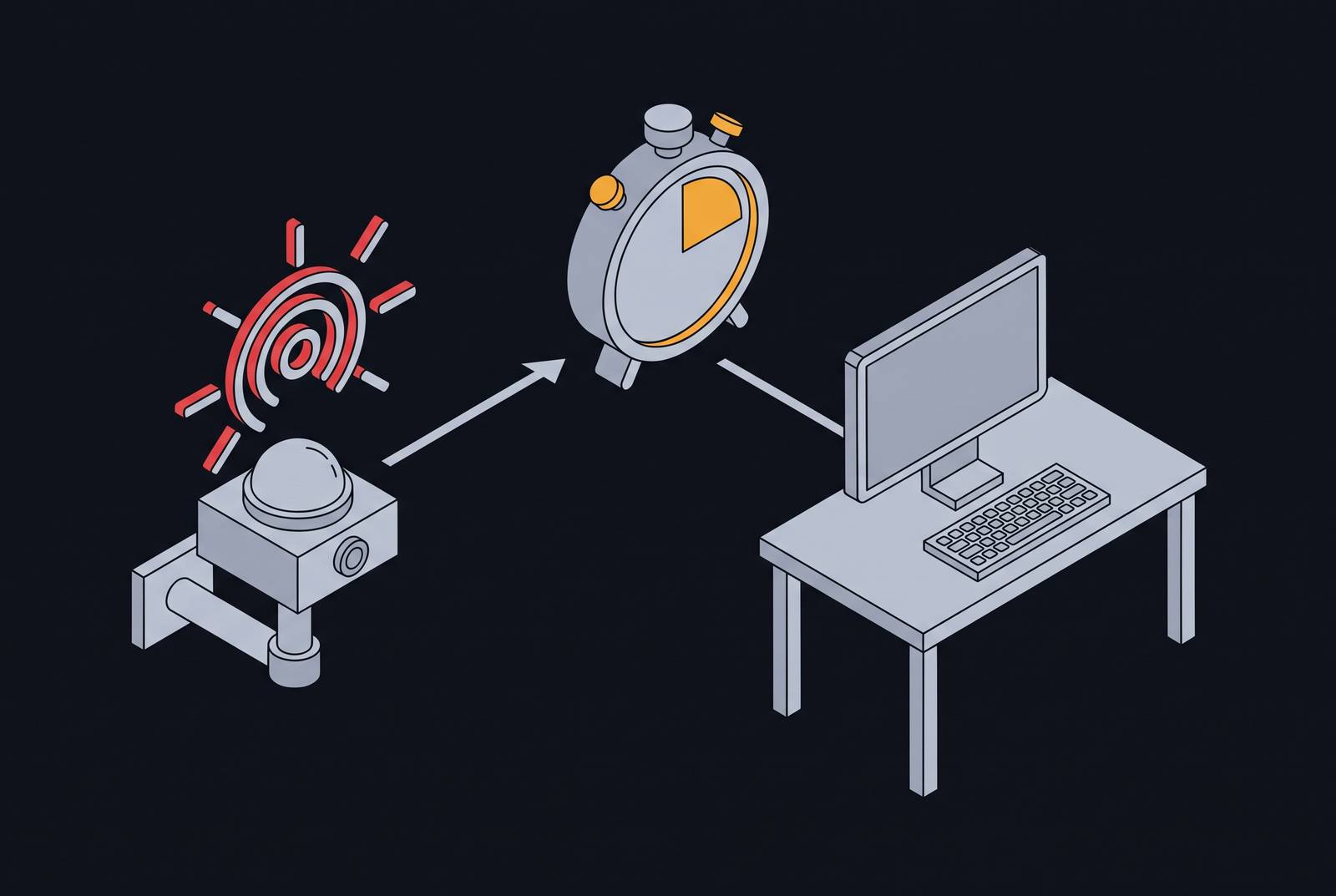
Alarm response time failure in traditional video monitoring centers begins with a measurement gap. The advertised metric usually counts only the time from signal receipt to operator assignment, leaving out the rest of the time from alarm trigger to protective action. False-alarm queues, verification, dispatch decisions, and responder travel can delay that action even when the reported handoff is fast.
How the industry defines "alarm response time" — and what that definition leaves out
A buyer hearing “response time” imagines someone acting on a real threat. The industry's standard measure stops well before that. Its clock starts when a signal reaches the monitoring center and stops when the signal is assigned to an operator, rather than when the operator confirms a threat, requests dispatch, or secures a response on the ground. A fast result therefore describes an internal handoff.
That distinction becomes harder to see because “response” can name several different events. A provider may use it for the first automated acknowledgment, the first analyst review, or completed containment, choosing an endpoint that presents its service favorably. Those measures are not interchangeable. A receipt-to-assignment commitment leaves out the time spent on signal travel, verification calls, dispatch decisions, and ground-to-site transit.
Why do traditional video monitoring centers fall behind on alerts?
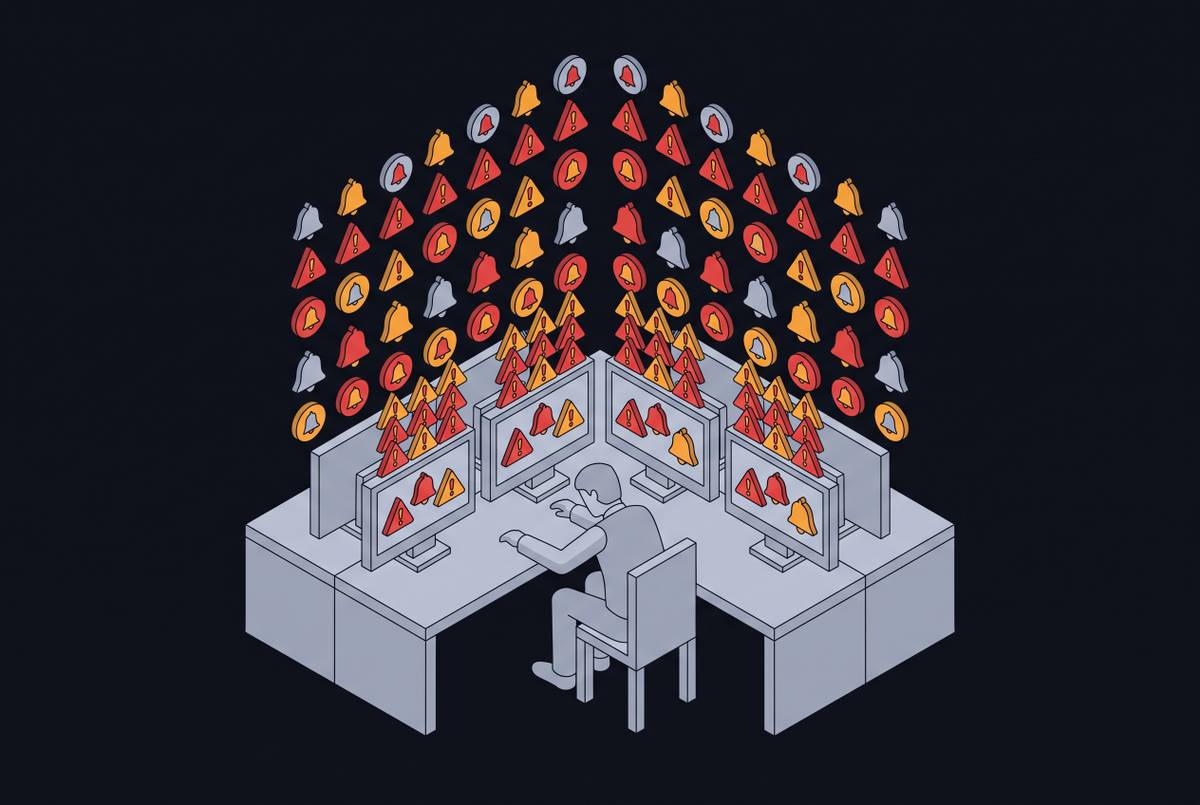
Operators have to work through false alarms before they can tell which events need action. Problem-oriented policing research gathered for the DOJ finds that the vast majority of alarm activations that reach police are false. In reactive monitoring, operators therefore deal with noise almost all the time, with few credible threats in the stream. A genuine event can be one signal among hundreds of false ones during the same shift. Its urgency does not remove the review work ahead of it.
The queue is therefore an architectural output of the false-alarm rate. When noise goes through the same review process as a possible intrusion, each false signal competes for the operator's attention. High-volume periods intensify that competition. Adding staff does not remove the source of the workload, because the system still sends operators events that require review but do not warrant action. The distinction is between expanding the capacity to process noise and preventing that noise from consuming human attention.
Continuous viewing also weakens the review on which this model depends. Manual operator review of feeds degrades significantly within 20 minutes of continuous viewing, after which operators miss a large majority of screen activity. Waiting and detection are thus connected problems. A real event must not only reach an operator but also be recognized by someone whose attention has been occupied by false signals.
The clock boundary needs particular care here. If signal receipt starts the clock and operator assignment stops it, the time spent waiting between those events counts in that metric. Any queue before the defined receipt point, however, remains outside it, while an acknowledgment-only measure can stop before human review begins. A handoff figure cannot establish the whole waiting time unless its boundaries are explicit. The structural failure is the accumulation of noise before meaningful review, whether a provider counts that delay or leaves part of it unmeasured.
What the SLA clock also ignores after the handoff: verification, dispatch, and ground response
Operator assignment stops the narrow SLA clock, but the next part of the response then begins. The operator still has to review the event and escalate only if justified. The Security Industry Alarm Coalition recommends Enhanced Call Verification, or ECV, with a two-call minimum before police dispatch. Those calls take additional time after the handoff. A receipt-to-assignment SLA says nothing about how quickly they establish a basis for action.
Police departments across the country deprioritize unverified alarms, and a growing number of jurisdictions refuse them entirely. The Security Industry Association records that only a small fraction of U.S. law enforcement agencies have formally adopted verified response. Yet formal adoption is not the only source of delay. An unverified call can receive lower priority even where no formal verified-response policy applies, extending the gap between the monitoring center's request and officer arrival.
Ground-to-site transit is the last stretch of time that the monitoring commitment leaves out. SAS Security TX notes that, for a Plano business, a break-in may already be complete by the time officers arrive at an unverified call. The complete sequence includes signal travel, queue wait, operator review, verification calls, the dispatch decision, the police queue, and transit. The narrow SLA covers only the receipt-to-assignment portion of that sequence. Completing it quickly does not establish when anyone capable of intervening will reach the property.
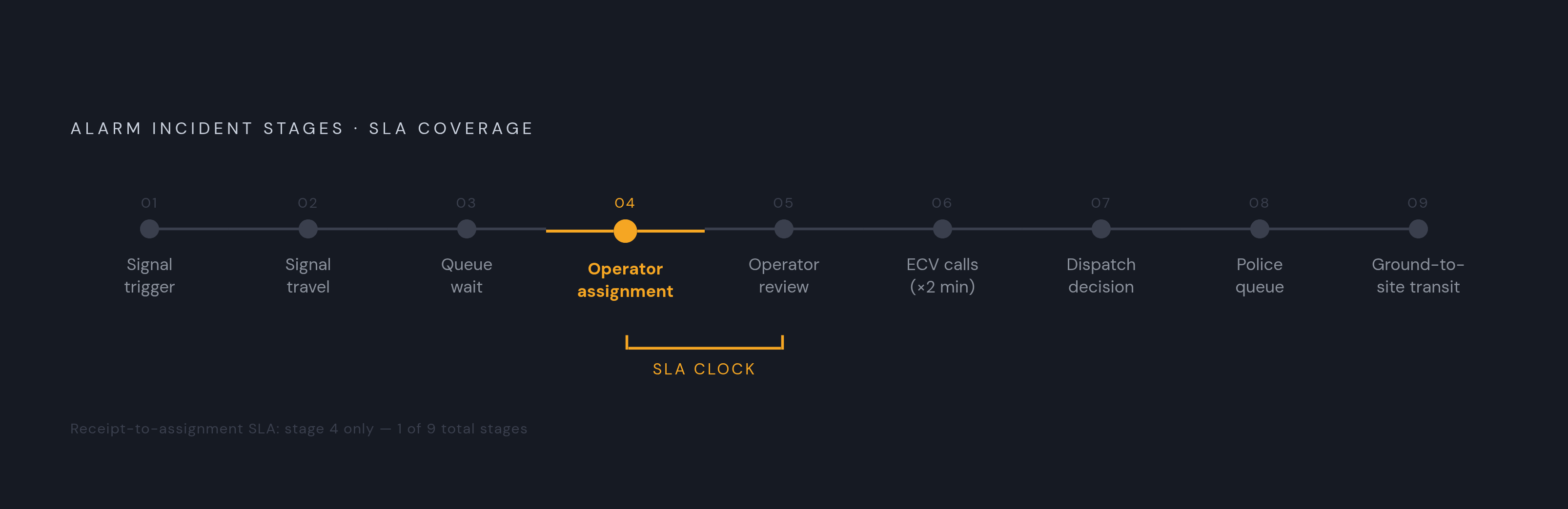
How the confidence-versus-results gap shows up in practice
HiveWatch's June 2026 report found that most physical security leaders expressed confidence in their ability to detect a coordinated threat, but fewer than one in five always met their own SLAs for response time, alarm processing, and time to resolution. Confidence was broad, while consistent delivery was not. The finding exposes a gap even against organizations' own service commitments, before asking how much of the complete incident timeline those commitments cover.
That contrast shows that confidence and measured performance can diverge. An SLA that excludes difficult portions of the response chain offers an incomplete basis for judging coverage, even when its reported result is favorable. Failure to meet that narrower commitment creates a further gap.
Initial acknowledgment can itself take substantial time before an investigation begins. Whether that delay appears in an SLA depends on the stated starting point, just as queue time depends on the receipt boundary. A buyer who assumes the commitment closes the coverage gap may discover during an incident that meaningful review started too late. The service may have been processing other activity while the real event waited. An internal milestone is a weak substitute for evidence that the threat reached someone who could act.
What verification actually requires, and why site-specific context determines whether it is real
Verification requires more than deciding that a person appears on camera. Effective response must establish what the signal means, prioritize the risk, and escalate through the appropriate channels. Those decisions depend on what authorized activity looks like at that site and at that time. A person in view is not automatically an intruder. Without the relevant context, a fast handoff can produce a fast unverified call.
Generic SLAs sit over highly variable site protocols. Authorized schedules, restricted access areas, and known contractor activity help a reviewer tell whether what they see is expected or needs action. The time spent checking those conditions is needed for meaningful verification. A reviewer who lacks them cannot reliably distinguish permission from intrusion. Speed in reaching that reviewer does not supply the missing knowledge.
ECV addresses missing visual context through calls before dispatch. It substitutes an attempt to obtain information by phone for direct visual confirmation, adding elapsed time without necessarily establishing certainty. Reaching a contact and confirming a threat are different outcomes. The two-call minimum describes a procedure, but completion of that procedure alone does not establish what is happening on the property.
The Monitoring Association's ASAP-to-PSAP program addresses a different bottleneck by delivering alarm data digitally into a 911 center's dispatch system. The program is a public-private partnership with APCO and participating PSAPs/ECCs. Digital delivery can address the phone-call handoff without resolving the quality of the upstream assessment. The distinction is essential to evaluating verification. A more efficient transfer of alarm information does not make that information more conclusive.
How AI-first filtering changes where time is spent across the full response chain
In an AI-first approach, AI agents dismiss noise before it reaches human review, leaving operators a narrower set of events to assess. Traditional analytics fire on pixel change, while AI classification distinguishes the triggering entity and behavior. That distinction can separate a person from HVAC airflow. With the relevant site context, classification can also distinguish authorized access from a possible intrusion before an operator sees the event.
Multi-frame validation checks that a detection appears in frames one after another before it goes on to escalation. It aims to cut the false positives that would otherwise go into the queue. The benefit begins before the handoff. Instead of asking operators to clear an unchanged flood more quickly, filtering reduces the volume requiring their judgment. This changes where the system spends review time, rather than simply improving the reported speed of assignment.
AI-driven investigation can compress the manual investigation window to as little as 3–10 minutes. That figure covers only the investigation portion of the total time to protection. The operator's role shifts from passive watcher processing everything to exception verifier assessing events already classified and contextualized. A pre-filtered alert lets the operator focus on what action to take because the first check for whether anything real happened has already been made. Site knowledge remains necessary because classification alone does not establish authorization.
When a human reviewer confirms a real threat in a pre-classified clip, the resulting police contact can include an active intrusion, the number of individuals, their location, and a real-time description. Those details provide the verified information needed to support priority dispatch. This is the downstream value of upstream work. Filtering reduces noise before review, context supports verification, and verification strengthens the dispatch request. None of those changes eliminates the separate police queue or ground transit, so they must not be presented as a guarantee of arrival time.
What buyers should actually measure when evaluating a monitoring SLA
The lesson for buyers is to interrogate the clock behind the label. What starts it, namely automated signal receipt, first human review, or verified confirmation? What stops it, whether queue assignment, a dispatch request, or confirmed responder arrival? Each pairing defines a different interval. The answer should also establish where signal travel, acknowledgment, and waiting sit relative to those boundaries, because excluded time does not disappear from the incident.
What is the false-positive rate on verified escalations, and how much escalation volume reaches operators? Low volume with a high true-positive rate shows that pre-filtering is keeping credible events apart from noise. High escalation volume can mean operators are still spending their attention on false signals. A handoff commitment alone does not reveal that burden, so queue performance needs to be read with the quality of the events being escalated.
Does the service encode authorized schedules, known activity patterns, and restricted zones? How does that context support the distinction between expected activity and a threat at the particular site? Without those conditions, the service lacks what it needs for meaningful verification, however quick the review is. The buyer needs to tell whether the evidence supports action or the procedure just passes along an alarm that is still uncertain.
Does the SLA distinguish time-to-acknowledge, time-to-verify, and time-to-contain, and are those commitments severity-tiered? These intervals show what the provider must do at each stage and keep a fast acknowledgment from counting as a completed response. A provider's “response time” should be judged by how much of the total elapsed time from trigger to real-world action the SLA covers, and what happens during the rest.