Monitoring Center Response Protocols That Distinguish Real Threats From Noise in Residential and Employee Parking Environments
Layered protocols filter parking-lot noise to catch genuine threats.
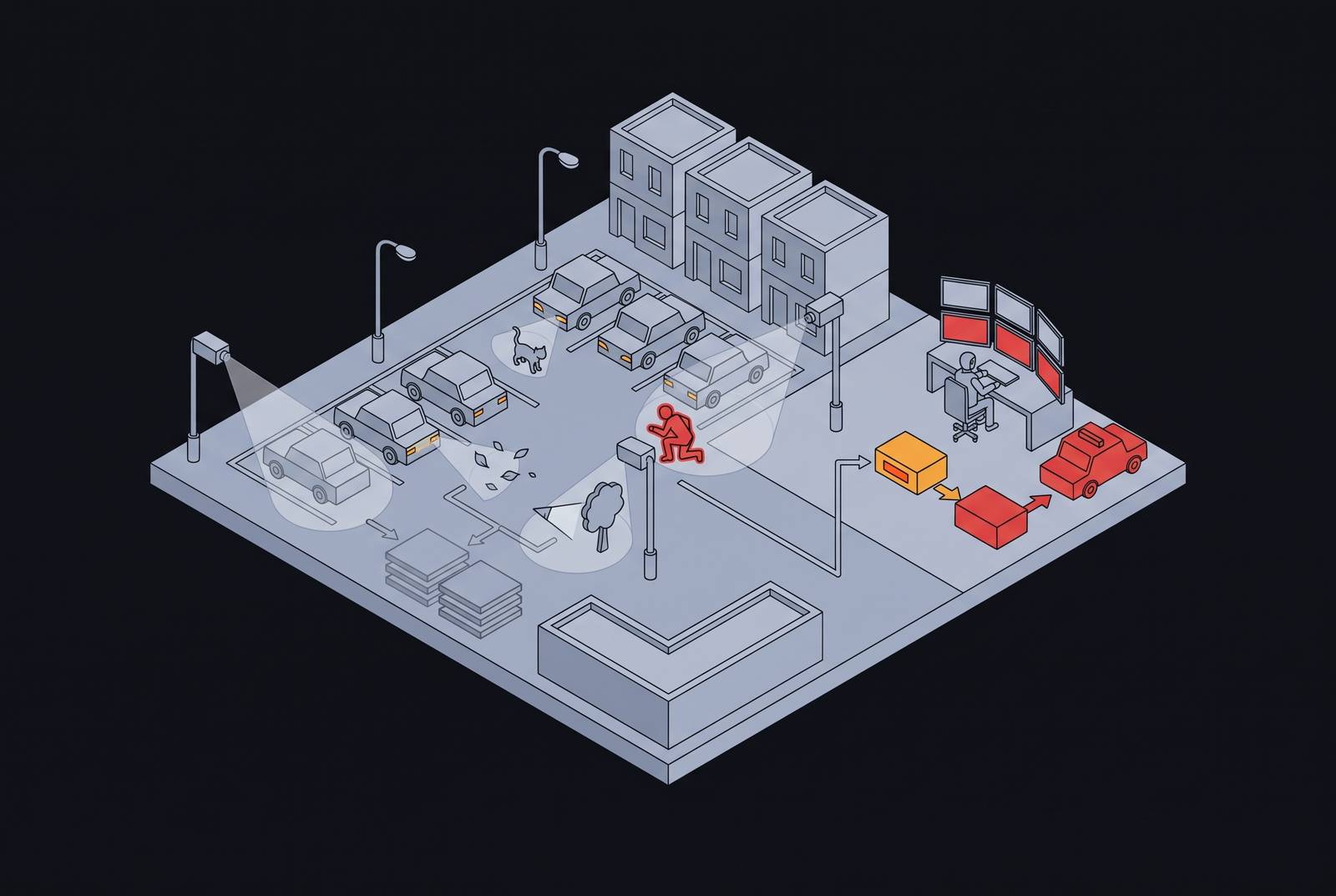
For remote video monitoring to work in multifamily and employee parking lots, three protocol layers must come before human review: site context, behavioral rules, and verified escalation thresholds. Cameras alone record activity, while a layered response protocol distinguishes routine movement from events that warrant intervention. Securing parking areas after hours therefore depends on how the monitoring center filters evidence and escalates threats.
Why parking environments are structurally different from other monitored sites
Wind, shadows, rain, animals, delivery traffic, and routine vehicle and pedestrian activity create chronic noise that differs from activity inside controlled-access sites. Shift changes add concentrated surges of legitimate movement. After business hours, that movement does not necessarily stop, because residents return home and employees leave late or arrive early. The environment does not label its own noise.
A resident returning late, a guest waiting for a ride-share pickup, and someone loitering near vehicles can all produce similar motion signals. Employee lots have the same problem with smoke breaks, authorized overtime, and after-hours access. Even a tree branch or an HVAC-driven shadow can trigger the same basic signal as a person. Consequently, an activation establishes that something moved, but not whether the movement represents unauthorized activity, suspicious behavior, or a threat requiring response.
What the false-alarm rate actually means for a parking lot operator
ASU Center for Problem-Oriented Policing research found that the vast majority of police responses to burglar alarms were false activations. LAPD fielded more than a hundred thousand alarm calls a year at a nearly all-false rate, while Chicago logged greater volumes at about 98 percent false. These burglar-alarm measurements illustrate the response system into which a parking site's alarms enter, where high volumes of unreliable signals consume resources needed for genuine incidents.
For the property manager or employer, that unreliability has direct consequences. Municipalities fine businesses for repeated false dispatches, and police departments use verified-response or enhanced call verification requirements that deprioritize unverified alarms. The cost extends beyond the fine itself. A property can still have cameras and a monitoring contract but lose the trust of responders, so a real event may go without the priority response the buyer expected those services to help secure.
How operator attention degrades when alarm queues are built from noise
The same chronic movement also imposes a cost inside the monitoring center. When routine parking activity repeatedly produces false alarms, operators can become less responsive to new notifications through information overload. Donald, Donald & Thatcher's 2015 study found that professional CCTV operators spotted only around half of target behaviors during a task that required them to keep watching video. That finding demonstrates the limits of trained attention.
Parking noise makes that limitation operationally significant because each authorized arrival or environmental trigger competes with a possible threat. Alert-fatigue research identifies signal quality, rather than volume reduction alone, as the central lever. Adding more people cannot make an unreliable signal clearer. In parking monitoring, operators may mute or turn off noisy camera feeds to cut the load on their attention, which also silences genuine threats along with the unwanted notifications. The resulting coverage gap can remain unknown to the client or site manager, even though the equipment and monitoring contract remain in place.
Why generic alarm-response workflows cannot solve a site-specific noise problem
A generic workflow treats activations as equivalent because the signal contains no site context. It cannot distinguish a resident returning to a car at 11 p.m. from someone attempting a vehicle break-in, or an employee working late from a trespasser. Traditional “detect and notify” monitoring passes that ambiguity downstream. A sensor trips, a signal reaches the central station, and an operator calls the premises and dispatches police without a built-in step that establishes whether the event represents a threat.
Motion detection detects movement alone. Even when a property has shift schedules, authorized-access lists, and delivery windows, the generic workflow has no mechanism to use them. Authorized activity thus joins genuine intrusion in the same queue, making it longer before anyone can judge which events matter. The defect is structural. Its correction must be built into the workflow rather than depend on an individual operator remembering every site's exceptions.
The first protocol layer — encoding site context before any alarm is reviewed
The first layer sets out which activity is authorized before AI reasoning or human review begins. Its inputs include business hours, shift schedules, authorized after-hours access, known vehicle patterns, delivery windows, and zones where presence is routine or anomalous. These inputs establish a baseline for later decisions. Without that baseline, subsequent analysis can recognize a person or vehicle but still lack the information needed to interpret its presence at that location and time.
Zone boundaries are as important as schedules. A loitering rule creates noise in an area where people normally pass through, but the same rule at a restricted perimeter after hours can flag activity that needs a closer look. Residential context includes vehicle registrations, visitor access windows, and expected patrol routes where they apply. Employee context includes shift rosters, authorized overtime, and contractor schedules, so that an HVAC technician arriving at 2 a.m. is not automatically treated as a trespasser. Because these permissions change, the configuration is a maintained operational record.
The second protocol layer — behavioral rules that distinguish presence from threat
Site context establishes what is expected, but observed activity crosses a threat threshold when it meets behavioral criteria. Loitering detection answers whether a person has remained too long inside a defined zone by classifying the object, tracking it across frames, and measuring continuous dwell time. Movement alone is insufficient. Similarly, intrusion rules tell someone walking past a perimeter apart from someone entering a restricted area, so fewer needless notifications come from loading docks and lot boundaries.
A vehicle passing through once does not trigger the same concern as one repeatedly circling the lot or stopping in unusual locations associated with vehicle or catalytic converter theft. Recurrence can also change the interpretation. A vehicle that appears on three consecutive evenings and stops near a restricted entrance may go unnoticed when each event is reviewed on its own, but rules that track behavior across sessions can reveal the pattern. Site-specific routing then sends the alert where it belongs, with main-lot loitering going to the property security contact and activity near restricted mechanical access taking a different route.
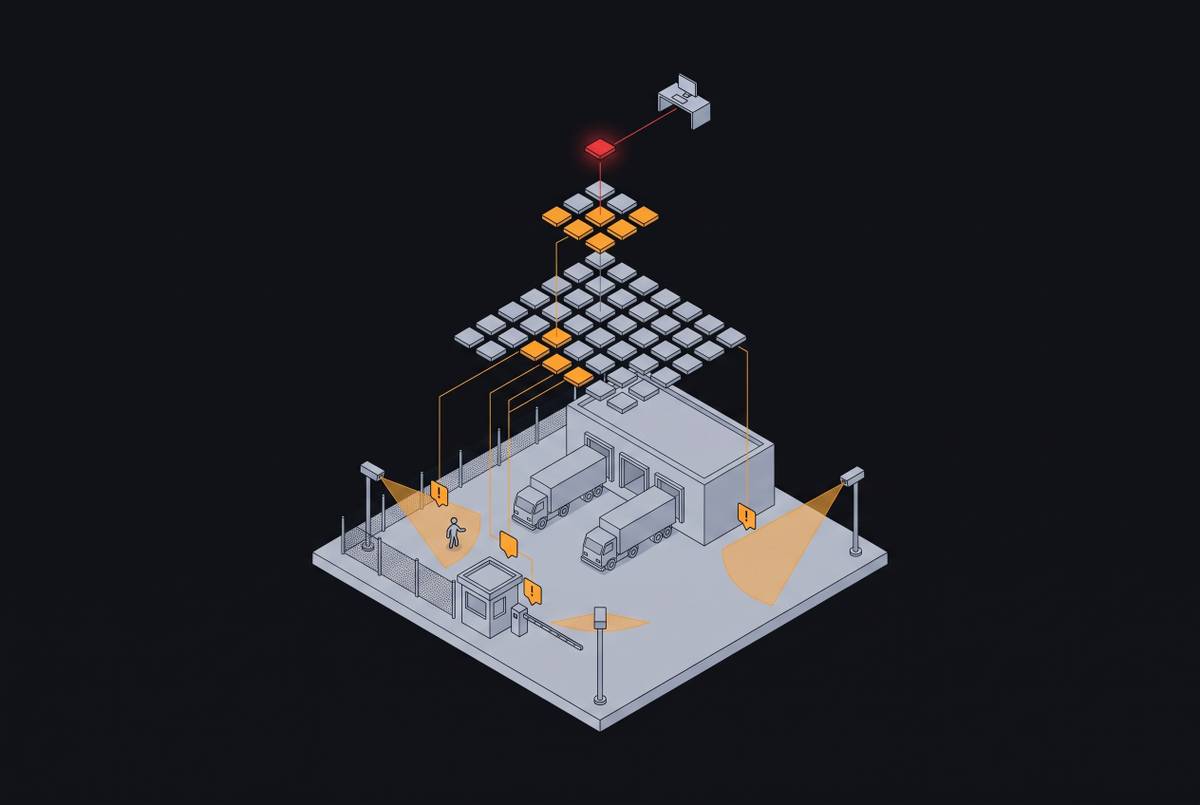
The third protocol layer — verification thresholds that determine what reaches a human operator
The third layer requires reviewable video evidence supporting unauthorized activity. Audio can add evidence from beyond a camera's field of view, including threatening sounds during video review. This gate prepares an event for human judgment. It does not replace the monitoring professional's final determination that a genuine threat exists before emergency services are called.
ANSI/TMA-AVS-01-2024 provides a five-tier classification framework based on evidence available at dispatch, from Level 0 for no threat through Level 4 for a confirmed threat to life. Police departments can elevate video-verified alarms to crime-in-progress status, supporting priority dispatch over unverified signals. Panic, holdup, and fire require dispatch right away without waiting for verification, while ordinary parking-security events should reach a human operator only after they meet the evidence threshold.
What happens when a verified event reaches a human operator
Site context indicates that the activity is unauthorized at that hour, a behavioral rule identifies excessive dwell in a restricted zone, and video establishes that the subject is a person. The operator reviews a live or near-live clip, confirms the classification, and decides whether to dispatch, typically within seconds of receiving the escalation. A confirmed threat proceeds with a video-verified flag. A false trigger, such as a staff member who forgot to disarm, results in a canceled dispatch and a record for protocol tuning.
Ambiguity still requires an explicit escalation path. A supervisor deals with classifications that are unclear, verified events that happen at the same time, and non-standard actions, and must be available within a set window. The Automated Secure Alarm Protocol (ASAP-to-PSAP) can then deliver alarm details digitally into the PSAP's computer-aided dispatch system over the Nlets law-enforcement network, reducing the delay of a voice handoff.
How does remote video monitoring differ for multifamily and employee parking lots?
In residential parking, a resident returning late is not an exception to normal use simply because the lot is quiet. Guests, ride-share vehicles, and service providers also make authorized-access information change frequently. Behavioral thresholds must follow those patterns instead of applying the closing schedule of a commercial site. A verified loitering event can route to the property manager and on-site security where present. Timestamped response records also have a distinct role here, because documented monitoring protocols can become evidence in premises liability litigation.
Employee lots have more predictable schedules but a different ambiguity at shift transitions, when unauthorized actors can blend into legitimate traffic. After the shift, presence in a restricted area is generally less ambiguous. A contractor arriving in a truck yard nevertheless requires context covering vehicle type, access window, and individual credentials. The same behavioral and evidence layers still apply, but an after-hours verified event may route directly to dispatch without an intermediate call, depending on the site's protocol and verified-response standing with local law enforcement. The layers remain constant while authorization, thresholds, and routing reflect the site.
What breaks the layered protocol and how to prevent it
Stale context can undermine the entire sequence silently. A new shift schedule, changed contractor access, or staff turnover can make onboarding settings obsolete within weeks, generating alarms for legitimate activity or causing anomalies to be dismissed as routine. A boundary that includes a public sidewalk produces unnecessary alerts, while an excessive dwell threshold can delay escalation. A timer that fires on residents accessing their own vehicles restarts the fatigue cycle the layers were designed to interrupt.
Undocumented decisions prevent correction of those defects. When operators cancel dispatches or settle unclear events without recording why, they lose the information needed to tune thresholds and routing. Maintenance calls for regular reviews, with context audits on a schedule, reviews of behavioral thresholds when the false-alarm rate changes, and rules that require operators to log each cancellation so it can guide later tuning. These reviews address hidden degradation before a missed event exposes it. With active maintenance, site context becomes richer, behavioral rules become more accurate, and the operator's work becomes more consistently meaningful.