Alert Triage Hierarchies and Escalation Logic in AI-Monitored Truck Yard Environments
How AI filters, classifies, and escalates alerts to stop yard theft before it happens.
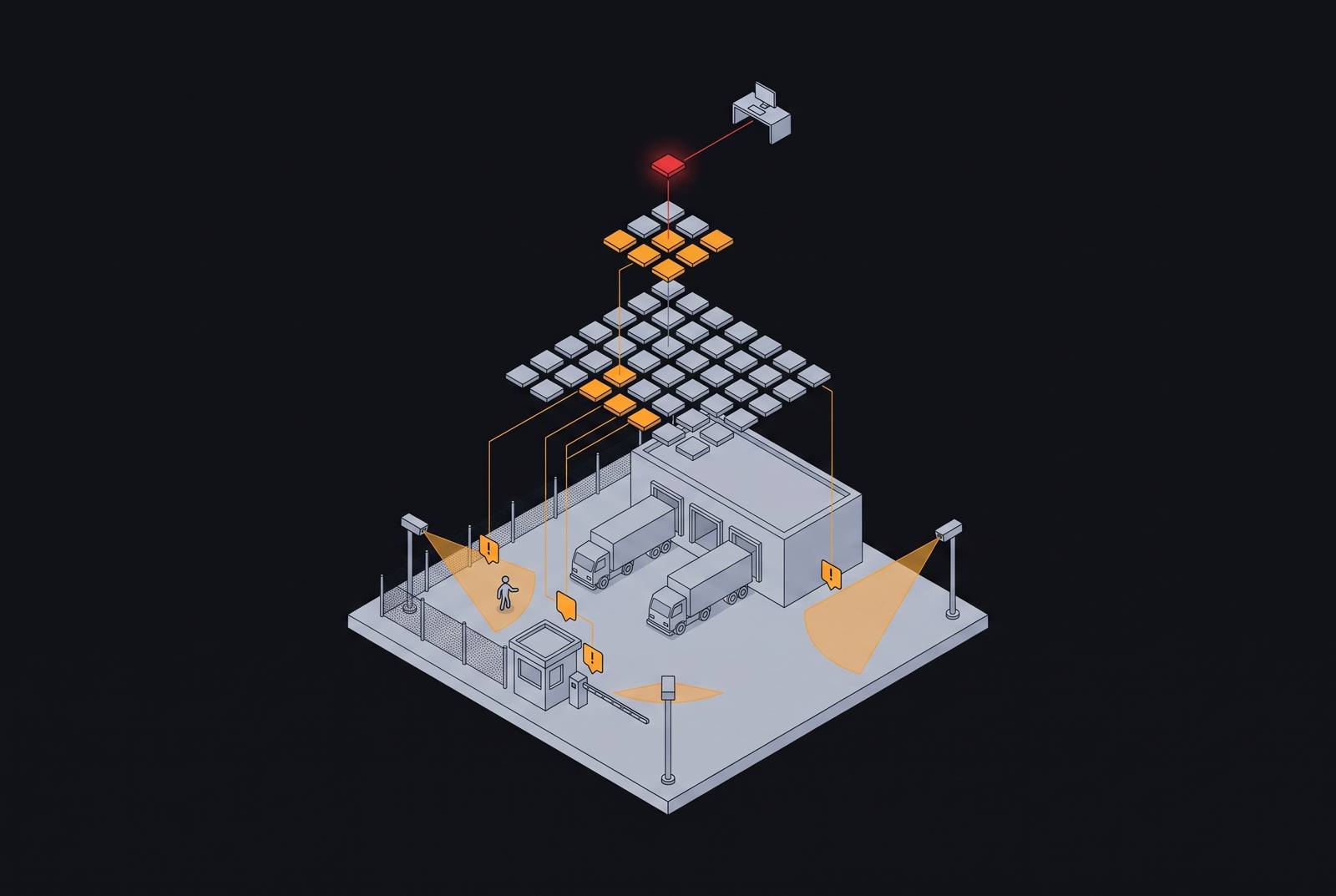
AI-augmented remote video monitoring for truck yards and freight facilities works by filtering site-specific noise, classifying the remaining events with reasons, and escalating verified threats to human operators. This sequence makes alert triage hierarchies and escalation logic central to yard security. Its purpose is to put operators in a position to respond to a threat, rather than discover it in a queue of routine activity.
Why truck yards defeat generic perimeter monitoring
A truck yard is not simply a larger commercial property. Trucks arrive and depart at all hours, loading bays remain active, and yard vehicles move among workers, drivers, vendors, and visitors. Yet authorized activity and a real intrusion can look alike without knowing who belongs in a given zone and when.
The physical layout compounds that ambiguity. Long perimeters and multiple entry points create extensive areas to watch, while reconfiguring trailer rows produce blind spots that fixed camera layouts cannot fully cover. The scene changes as the yard operates. A view that exposes an approach at one point may be obstructed by parked equipment later.
The losses also differ from those at a generic commercial site. Targets include diesel in saddle or bulk tanks, catalytic converters on parked chassis, staged freight, and whole trailers. Fraudulent pickups introduce a less visible risk because plausible information can conceal an impersonated carrier. Such a pickup may look legitimate until the load fails to arrive. Traditional CCTV records these events, but footage alone does not distinguish ordinary operations from theft in real time.
How alert volume overwhelms operators before any threat is evaluated
Feeding this activity directly into a human monitoring queue creates a mismatch between event volume and the attention available to evaluate it. Every routine movement competes with a possible intrusion for review. The operator encounters volume before evaluating danger. Faster detection leaves that mismatch in place if each detection adds another item for a person to judge.
Ndichu et al.'s 2026 preprint submitted to ACM Computing Surveys describes alert fatigue through three conditions that simultaneously exceed site-specific tolerances. These are the uninvestigated rate, the false positive rate, and degradation in decision quality over a shift. The survey describes how people cope through blanket suppression, severity-based skimming, and relying too much on tool scores. These habits can leave alerts unchecked during review. The failure is structural.
In a yard, that structure has an immediate operational consequence. A fraudulent pickup or after-hours intrusion arriving during a busy alarm window can wait behind routine alerts until the load is gone. Adding staff alone leaves the same low-signal stream in place, even if more people are available to review it.
What a triage hierarchy actually does — filter, classify, escalate in sequence
Filtering suppresses routine or environmental activity before it reaches the operator queue. Classification assigns a severity grade and attaches reasoning to events that survive. Escalation then routes verified, classified threats to a human with the context needed for action. Human judgment remains, but its position changes.
The survey provides a broader framework for this arrangement. It separates AI alert screening into filtering, prioritized triage, correlation of related alerts into incident hypotheses, and generative augmentation of the information an analyst receives. A physical monitoring system must decide which observations deserve attention and make that decision understandable.
The three-stage yard hierarchy applies that principle operationally. A filtered alert is not yet a response-ready alert because removing obvious noise does not explain the significance of what remains. Classification supplies that missing interpretation before escalation. Skipping it merely transfers the unresolved decision to the operator.
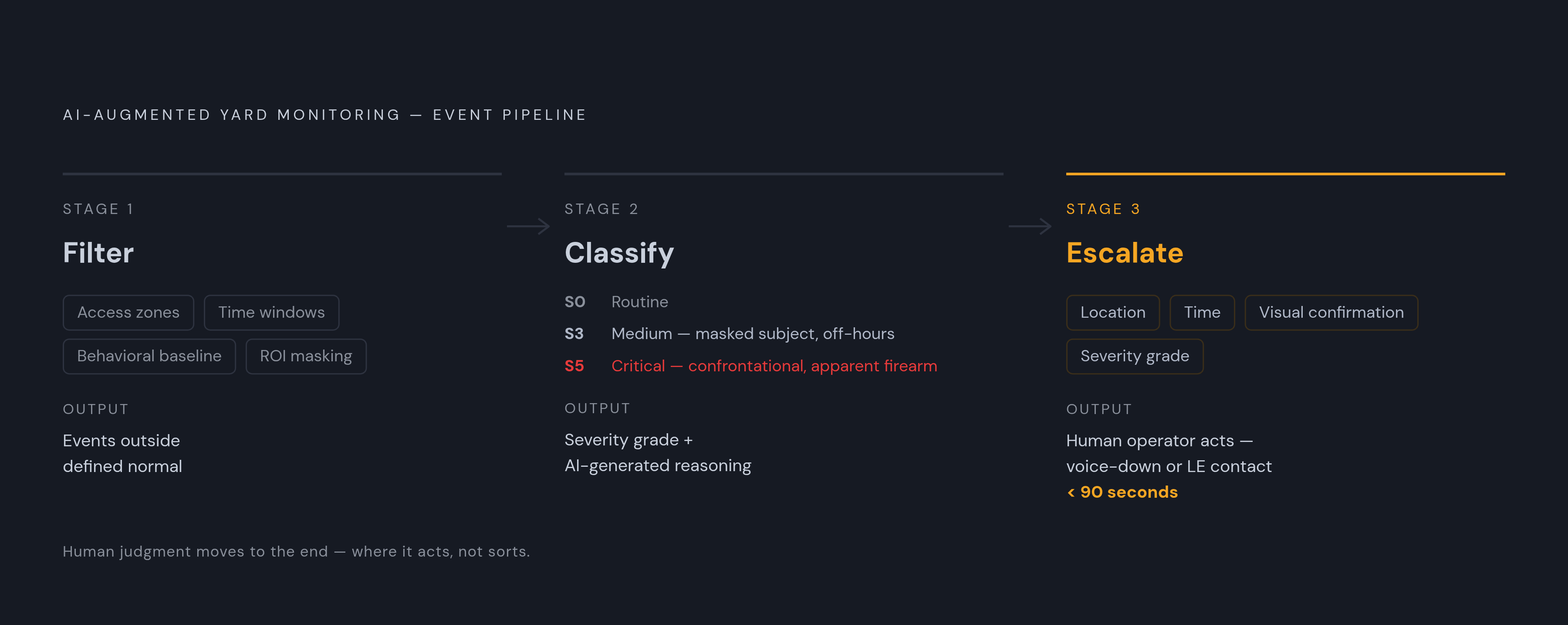
How the filter stage uses site-specific context to separate yard noise from real events
Filtering depends on a definition of normal activity for the particular yard. It must define access zones, authorized time windows, behavioral baselines for yard equipment, and dock-level schedules. Timing changes the meaning of the same movement. Equipment running within its expected window may be routine, while movement outside that window needs to be checked.
Facilities can use AI-enabled gate management to pair driver IDs with high-definition video and real-time credential verification. Per-camera region-of-interest masking addresses a different problem, allowing a swaying branch or windsock to be ignored while movement in the zone behind it remains relevant. Each narrows suppression to a defined context.
The Vigil AI platform specifications describe a two-tier autonomous surveillance agent that looks for patterns in confirmations and false positives to adjust per-camera silence rules. Those rules have a 24-hour time-to-live, and the agent rechecks its decisions on the next cycle while high-severity events continue through. A live deployment illustrates the contextual distinction. Workers in high-visibility vests operating drilling equipment in a commercial parking lot were classified S0 Routine and suppressed because the activity was planned construction, with no notification sent. The authorization came from the schedule, and changing site activity requires the filter configuration to change with it.
How the classify stage produces severity grades with attached reasoning
Classification turns a surviving observation into an account of what was seen and why it warrants attention. Vigil uses a six-tier severity ladder from S0 Routine through S5 Critical, with AI-generated descriptive text attached to alerts that clear suppression. The grade establishes priority within that ladder. The reasoning lets an operator assess the observation.
Live 2026 examples from deployed Puget Sound trailers show the distinctions. An alert for a large truck fully engulfed in flames in a parking lot at night reached S5 Critical after cloud LLM review raised it from a lower severity. Another S5 Critical alert described two individuals in a confrontational posture, with one appearing to point a firearm. Both received the same grade for different reasons. The descriptive text preserved those differences for the person receiving the alert.
A masked subject leaning over a silver sedan's hood/windshield in an off-hours parking lot received S3 Medium, with suspicious posture and face covering identified in the alert text. Two individuals at a blue van with its rear door open in an off-hours parking lot received S1 Info for monitoring.
Vigil's edge inference classifies interesting frames on-device first. Ambiguous or higher-severity events proceed to Claude Sonnet and Gemini for review of three to four surrounding frames. That review adds context to the initial observation. Applied to a yard, the same distinction separates an after-hours vehicle in a restricted zone from a person at a trailer coupling in a posture consistent with theft.
What the escalation stage delivers to a human operator and why sequencing determines response speed
The operator's primary task becomes response. That inversion is what makes sub-90-second human contact with a real threat achievable, rather than a guarantee supplied by fast detection alone. Detection and classification can happen in seconds, but a human-first queue can still consume the response window.
An escalation packet makes that difference concrete. A perimeter intrusion delivered with location, time, and visual confirmation gives an operator grounds to issue a voice-down command or contact law enforcement without first reconstructing the event. Detection alone cannot perform that intervention. Live monitoring agents convert the alert into a response.
Automated escalation triggers can notify supervisors and prepare downstream responders before a hold-time threshold is reached. This is part of tiered service-level agreement design. Otherwise, the operator may discover the missed response window only after the fact. More cameras leave that delay in place when their views feed a queue that is already overwhelmed.
How the triage hierarchy handles the specific threat patterns unique to truck yards
An after-hours perimeter breach shows the sequence directly. With no authorized vehicle or credential match, the event falls outside the established access window and passes filtering. Classification then evaluates posture and zone. A person near a trailer coupling at 2 a.m. presents a different concern from someone near the office entrance. The escalation must preserve that distinction so the operator receives more than a generic perimeter alarm.
Fraudulent pickup tests a different part of the architecture because the activity may resemble an authorized transaction. A camera alone cannot confirm that paperwork that looks right comes from a legitimate carrier. CargoNet's Q1 2026 analysis identifies carrier and broker impersonation as a central theft method. AI-enabled gate management that pairs driver IDs with real-time video verification adds information beyond what can be seen at the site. Here, classification depends on access verification as well as visible behavior.
Equipment stripping shifts the emphasis back to posture. Vigil captured an S4 High alert involving crouching at a vehicle's undercarriage or wheel well in live deployment. The relevant signal is a known theft posture during off-hours activity. Filtering lets the unexpected activity through, and classification explains why it is a concern before escalation. This can support evaluation of threats to catalytic converters, tires, or batteries without claiming that video establishes which component will be removed.
Cargo staging and trailer theft depend more heavily on operational baselines. Unusual dwell time at a bay or vehicle movement where none is authorized can expose activity outside the schedule. Fuel storage introduces a similar time-and-zone distinction. Activity around saddle tanks or bulk storage outside expected windows passes filtering, after which posture informs whether it warrants escalation or logging.
What the audit trail from triage generates for insurance and liability purposes
The same staged workflow can produce evidence beyond the immediate response. Timestamped records of detection, classification, escalation, and response show how an observation became an operational decision. Record-only footage does not provide that workflow history. Insurers evaluating a yard security program want to understand the cameras present, active AI detection categories, alert routing, response-time SLA, and captured audit trail.
Those records distinguish deployment from demonstrated operation. For liability review, records of how alerts were handled and timestamped response protocols help show that security practices were reasonable, including in cargo theft claims or premises liability disputes. Vigil records each cloud escalation call's latency and cost on the alert, making changes to escalation thresholds auditable.
What should buyers look for in AI video monitoring for truck yards?
Buyers should ask a service to describe filtering, classification, and escalation in operational terms, with site-specific configuration and documented SLAs at each stage. Before go-live, that configuration should set out the access zones, authorized activity windows, and behavioral baselines. Default sensitivity is not a yard protocol. The service should explain how its suppression decisions reflect the site's actual operations.
The next criterion is what reaches the operator. A severity number without context puts interpretation back into the human queue, while a useful alert explains what was observed, where, in what posture, and at what time. The detection-to-human-contact interval should be a named contractual commitment rather than “best effort” language that can conceal a 20-plus-minute queue. A service dominated by dismissal of unclassified alerts has placed human attention too early in the sequence.
Auditability should be treated as a requirement. Timestamped logs must document detection, classification, escalation, and response, and their absence should be a disqualifying gap. The buying commitment is to an architecture that turns verified threats into timely human action.