Why Camera Coverage Creates a False Sense of Security in After-Hours Parking Environments
Recording a crime isn't stopping one, and after-hours lots need live response.
Camera coverage creates a false sense of security in after-hours parking because recording an incident is not the same as responding to it. For remote video monitoring to work in multifamily and employee parking lots, it needs usable footage, behavioral AI triage, human verification, and live intervention. The distinction is whether the system gives someone a chance to prevent harm or supplies footage after the opportunity has passed.
Why after-hours parking environments concentrate risk in ways most camera deployments ignore
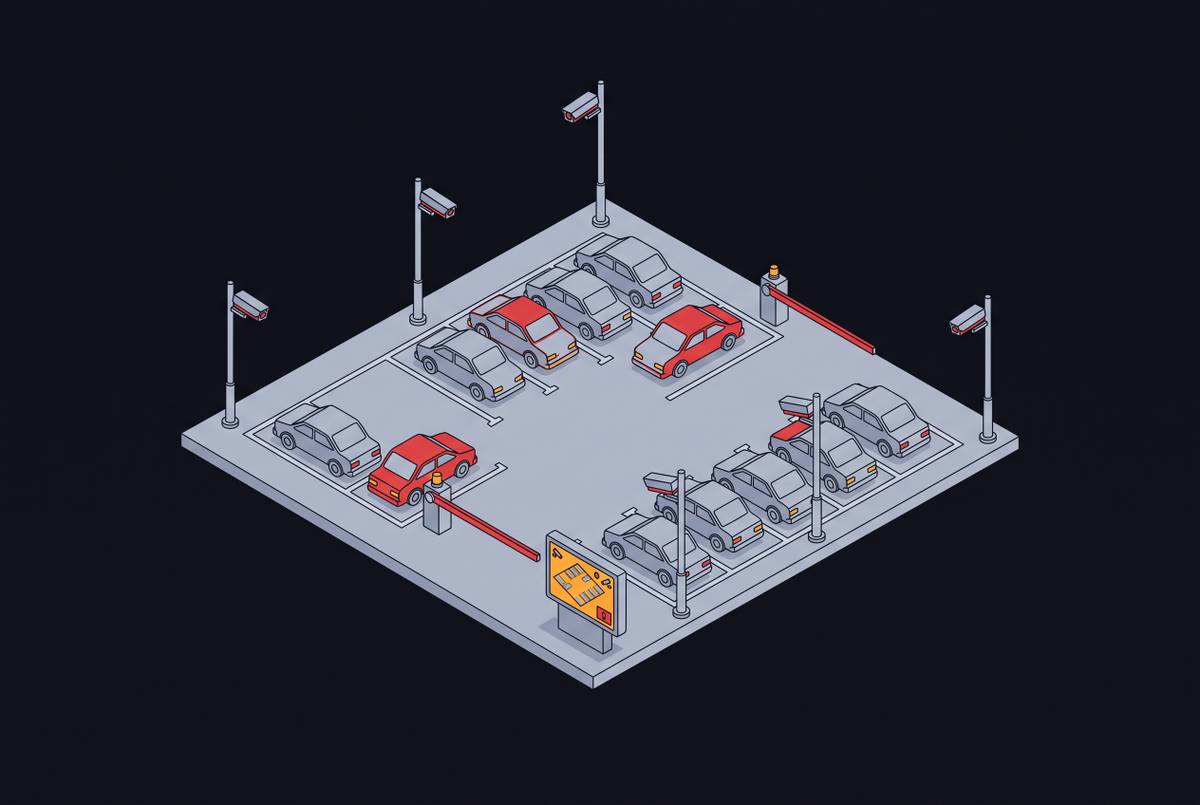
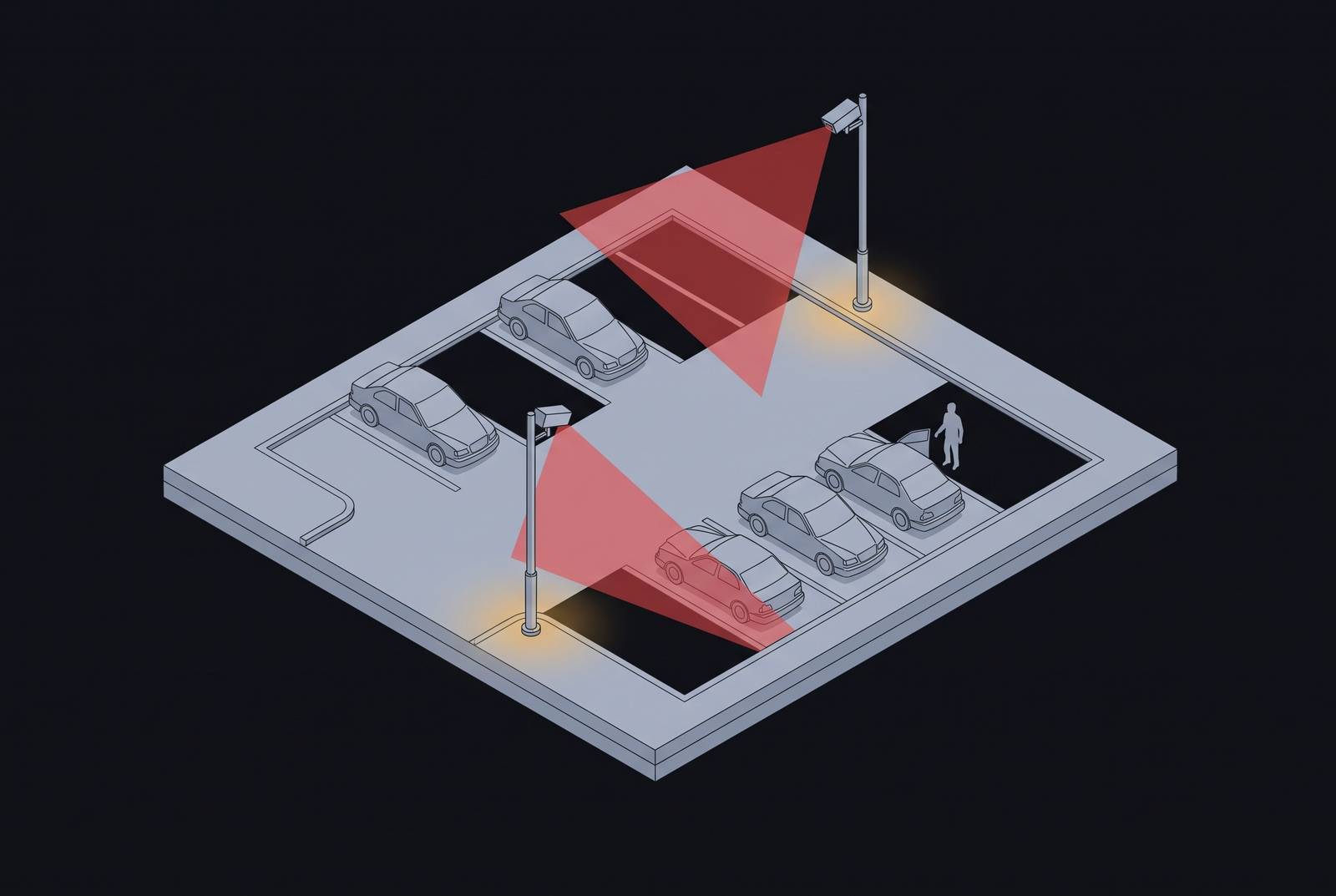
Parking facilities combine isolation, limited sightlines, and predictable human routines in a space where people must pass between vehicles and buildings. After hours, low foot traffic and poor lighting make those conditions more dangerous. People and staff who are around during the day to witness what happens may be gone at night. Someone moving through an enclosed level or pedestrian walkway can therefore be exposed without anyone nearby recognizing the risk.
Stairwells, elevator lobbies, below-grade levels, and pedestrian walkways are among the hardest areas to monitor and the places where people are most exposed. Robberies, assaults, and sexual assaults cluster in enclosed, low-traffic zones where a potential offender’s dwell time can go unnoticed. A view of the vehicle entrance does not resolve what happens beyond it. Security depends on whether the facility’s most vulnerable spaces receive attention while people use them.
Predictable routines compound these physical weaknesses because offenders can learn when activity falls and staff leave. After-hours risk is therefore not an unforeseeable change in an otherwise safe environment. It follows known conditions of layout, lighting, occupancy, and time.
What a camera actually does — the distinction between recording and responding
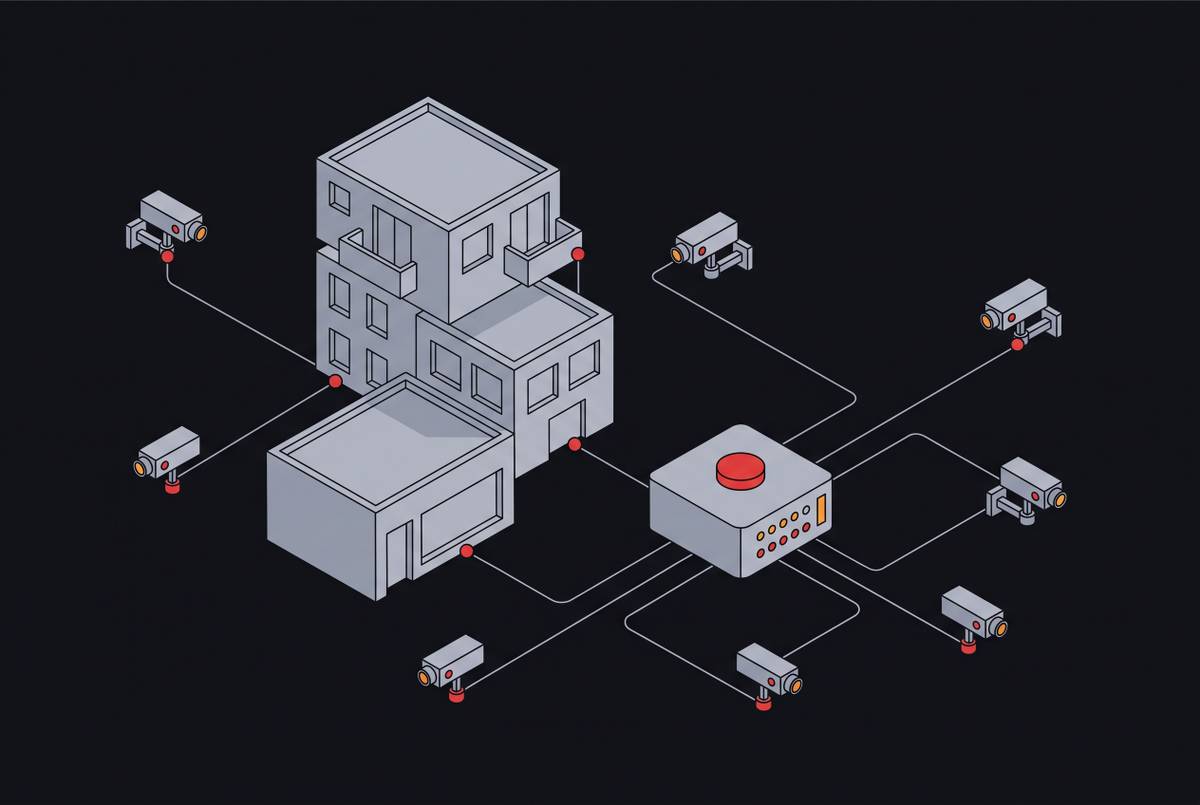
A standard recording-only camera captures footage for storage and replay. It does not independently recognize an unfolding threat, alert responders, or intervene when nobody is watching. Recording preserves an account of an event. Responding requires a separate process that detects a concern, assesses it, and initiates action. These are different functions, even when they use the same video feed.
A reactive system tells a team what happened. A proactive system gives that team the chance to act before harm occurs. Without a person or an AI-powered monitoring layer assessing the feed, the recording becomes useful for investigation after the incident, when the suspect may already be gone. Reviewing that footage can support an investigation, but it cannot recover the lost opportunity to intervene. Image capture alone provides no response capability.
Visible cameras can still influence an offender’s decision. That deterrent effect is strongest when the person believes someone is watching and can act. Visibility alone raises perceived risk for some offenders, so an unmonitored camera is not necessarily without deterrent value. However, the effect diminishes after hours when active monitoring is absent. A recording-only deployment depends on what an offender believes about the camera, rather than on an operating process capable of answering the threat.
Why tenants and property owners mistake a camera for a shield
Tenants and visitors encounter the visible parts of a security system. Bright lighting and prominent camera poles signal that a property has invested in protection. The inference that someone is watching is understandable. The way a camera looks gives no clue to whether it feeds a live monitoring service or simply records to storage. The same visible equipment can therefore represent very different levels of protection.
Property owners can make a similar inference about their investment. Once cameras are installed, the site looks monitored, and the apparent completion of the security project can suppress further corrective work. An owner who believes the cameras already protect the lot has less reason to address the missing response layer. Meanwhile, repeat offenders can learn that no one steps in right away when an incident occurs.
The discrepancy becomes apparent when an incident occurs and tenants learn that nobody was monitoring in real time. Trust can erode quickly after that discovery. The consequences extend to occupancy and lease renewals, making the failure more than an abstract reputational concern. For an apartment community, the appearance of protection can attract confidence that the operating system does not justify. That mismatch exposes both occupants and owners to costs that the camera installation was supposed to reduce.
How unmonitored cameras convert from a defensive asset into a legal liability
Negligent security claims turn on whether a crime was foreseeable and whether the owner took reasonable steps to prevent it. Parking facilities are heavily litigated settings for those questions. Cameras can provide evidence relevant to both, but their presence does not settle either in the owner’s favor. A record of prior incidents can help establish that further crime was foreseeable. It does not, by itself, demonstrate that the owner acted on the risk.
This is where documentation can work against its owner. Footage that preserves a history of incidents may support the argument that the threat was known while offering no evidence of an effective response. The distinction is between possessing information and taking reasonable preventive steps. Installing equipment does not automatically bridge it.
Low resolution, unsuitable angles, and missing details may prevent recordings from supporting the owner’s defense. The property can incur the cost of surveillance without obtaining either effective intervention or useful evidence. This makes the choice to use unmonitored cameras legally consequential. The exposure arises from documentation without action, which leads to the operational question of why adding people to watch the cameras has not reliably closed the gap.
Why legacy monitoring infrastructure cannot close the gap at scale
Legacy motion-triggered monitoring produces more alerts than actionable information. Shadows, leaves, moving vehicles, reflections, and garage doors can all trigger events without indicating a threat. A motion trigger identifies movement. It cannot reliably distinguish the significance of a person entering a closed level from routine activity elsewhere. The queue fills before an operator has established which events deserve attention.
Human operators must then perform the discrimination that the system has failed to provide. Repeated false alerts create alert fatigue, making discounting the next alert a predictable consequence of the input stream. Talent does not remove this cognitive constraint. No operator can sustain equal attention across every camera in a multi-level structure, and a real threat can wait behind irrelevant events. The architecture constrains what the diligence of the people monitoring it can achieve.
Labor shortages further constrain efforts to expand human triage for after-hours demand. Adding seats may let a team handle more alerts, but the alerts that come in are no better. Other workarounds, including muting noisy cameras or absorbing false-alarm fees, leave the underlying noise unresolved. Muting also trades away coverage to make the workload manageable. Because unverified alarms have been deprioritized by law enforcement in many cities, poor triage can weaken both internal attention and the external response that monitoring is supposed to obtain.
What behavioral AI detection changes — and where it still depends on hardware quality
Behavioral AI changes which events people see for review. Rather than treating movement itself as the reason for an alert, it can flag defined risk patterns across camera feeds. Those patterns include loitering in a stairwell, unauthorized entry through a closed level, or a person moving against normal flow at 2 a.m. Detection can also cover falls, medical events, sudden crowding, and possible altercations. The purpose is to direct attention toward events requiring judgment.
That distinction depends on usable visual input. When cameras work poorly in low light or lack enough resolution, footage can be too grainy to make out faces or license plates. A blurry silhouette may support a limited detection while failing to provide the detail needed to understand what is happening. Detection quality and identification quality therefore remain tied to the cameras and their environment.
Optical improvements can reduce that limitation. Full-color night vision in near-zero light and adaptive infrared illumination can help operators see more detail as conditions change. But vendors make different claims about what these features can do, so each deployment’s camera-angle-lighting combination needs to be tested where it will be used. Good analytics on poor footage may narrow the monitoring gap without closing it. Such a system can be better than recording alone yet still fall short of its marketing, which makes human verification a necessary complement.
How the AI-triage-then-human-verify model changes the response timeline in after-hours parking
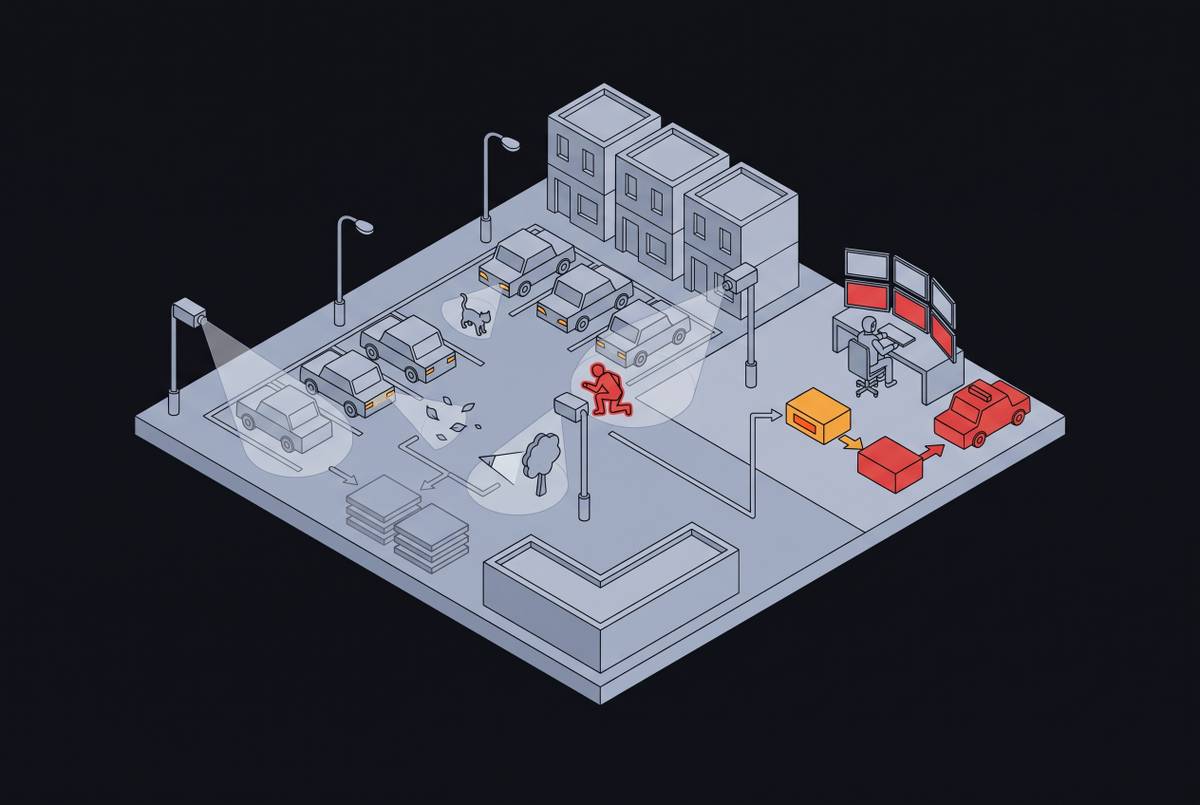
In the AI-triage-then-human-verify model, the system assesses events before they enter the queue for human review. AI evaluates events across the feeds and directs ambiguous or high-stakes cases to operators. Human attention is reserved for consequential decisions. This reverses the legacy arrangement in which a person must inspect every motion alert before the system can establish its significance. The operational gain comes from reducing the work ahead of a real threat.
Human-governed agentic security builds on that approach with a detect-decide-orchestrate-verify-log loop that can run in seconds. AI detects, triages, and coordinates the workflow, while people retain responsibility for escalation, governance, and resolution. People who take or oversee physical-security actions with serious consequences should follow strict rules. Actions without human oversight should remain narrowly scoped and low consequence. Speed does not remove the need for control.
Verification connects the workflow to a credible response. Operators can rule out false positives from wind, animals, or changes in lighting before they contact law enforcement. Verified alerts help get priority dispatch, while a growing number of cities may give unverified alarms low-priority or no response. Trained operators can also trigger audio deterrents or dispatch security personnel while an event is unfolding. Those capabilities create an opportunity for deterrence that a stored recording cannot provide.
A person lingering in a stairwell can become an event for assessment while it is unfolding. Serious events should be reviewed and escalated quickly, without waiting behind routine motion. No monitoring architecture guarantees that every incident will be stopped. Its value is the chance to act while intervention is still possible.
What should property owners evaluate before trusting remote video monitoring for parking lots?
Property owners and operators should evaluate a monitoring claim as a complete response process. First, establish whether AI triage occurs before or after human review. Sending every motion event to an operator leaves the team with just as many events to check, even if the service uses AI elsewhere. The next question concerns peak after-hours demand. Muted cameras, overage fees, or additional lower-cost monitoring seats can indicate that the service is managing the queue while leaving its cause unresolved.
Coverage needs a separate examination from camera count. Fixed cameras cover defined zones, PTZ cameras cover large open lots, license plate recognition covers points where vehicles enter and leave, and multisensor cameras can help where wire runs are limited. Each choice has coverage trade-offs. Even with many cameras, a site has critical blind spots if its stairwells and below-grade levels are out of view. The relevant test is what the monitoring layer can assess in the places where people are exposed.
Performance claims should then be tested against actual site conditions. Evaluation should include night and infrared footage, weather, reflections, and moving vehicles, using the proposed camera angles and lighting. Evidence preservation also needs attention because on-site DVRs and NVRs can be stolen, damaged, or tampered with. Cloud-based or offsite storage is a baseline requirement when recordings may need to support legal proceedings.
The broader approach should combine cameras, access control, license plate recognition, monitoring, and lighting. For multifamily and employee parking lots, the question is not whether cameras are present, but whether they support action that can stop an incident or only document it after it is too late.