Alarm Review Time Questions to Ask Monitoring Vendors
Demand specifics about queue delays and accuracy metrics that vendors typically bury in fine print.
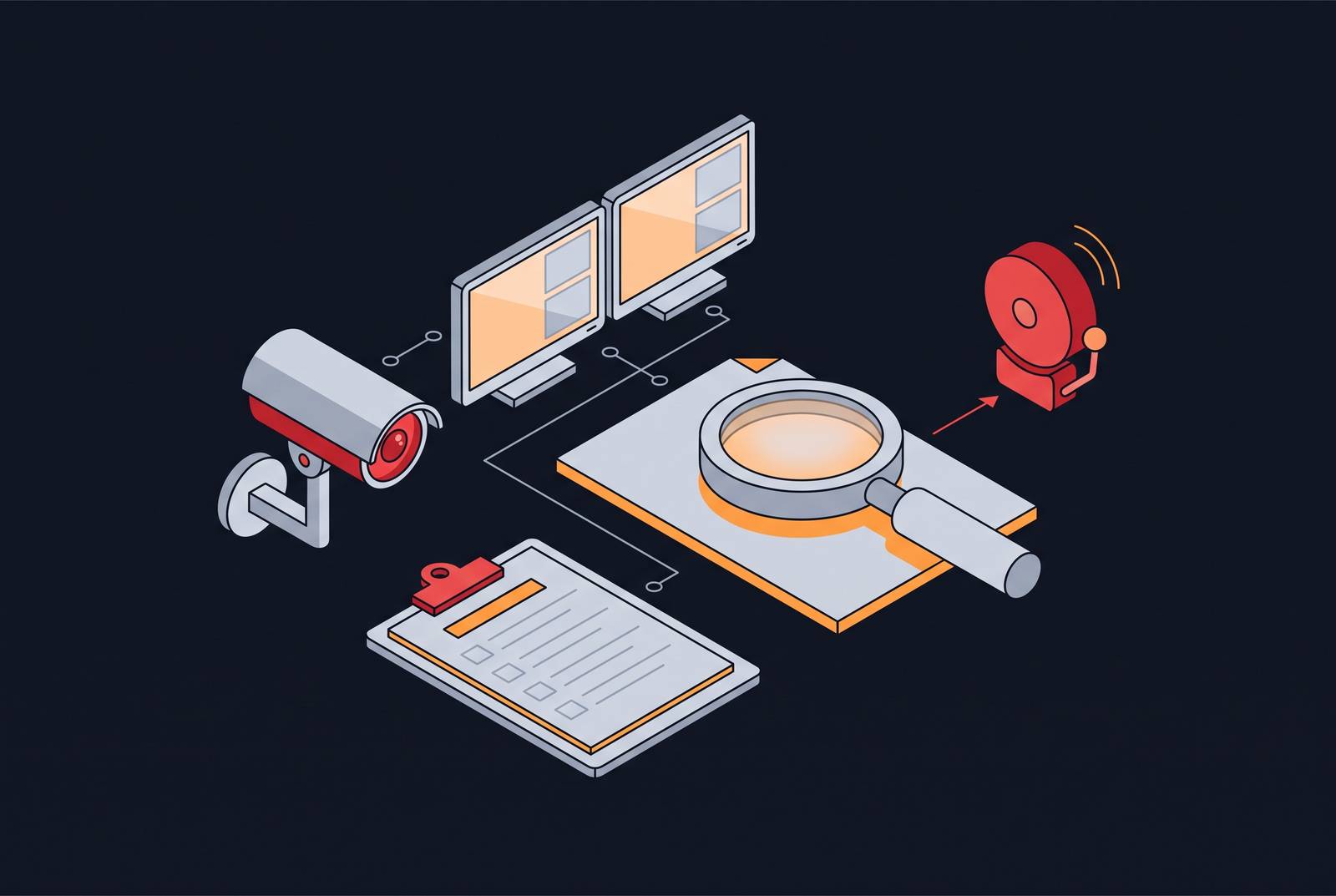
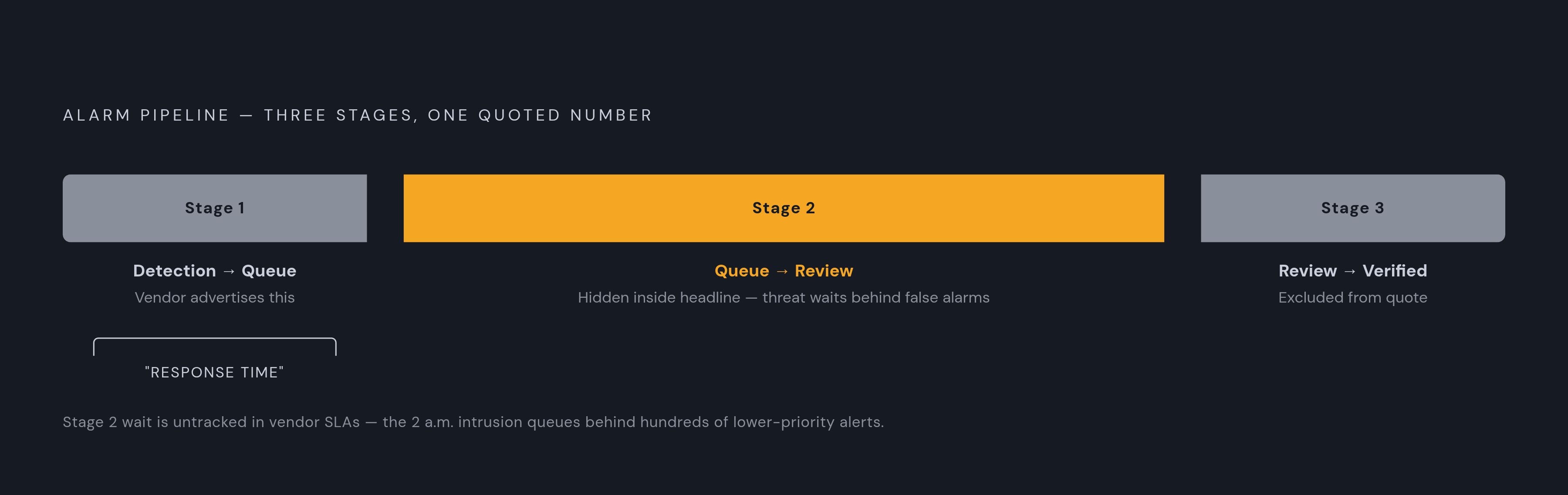
A vendor quotes a number. The buyer hears "real-time surveillance." A pipeline with at least three separate stages, detection-to-queue, queue-to-review, and review-to-verification, produces that number, and a vendor can post a fast headline figure while the dangerous stage, queue-to-review, stays hidden inside it. A buyer evaluating monitoring vendors on a single average or median review time is often reading a number that describes only the fastest or easiest part of the process, not the part where risk accumulates. The gap between those two things matters most at the hour nobody is watching the dashboard: a genuine threat at 2 a.m. can sit behind hundreds of false alarms while the clock keeps running, and the vendor's headline metric never captures that wait. Getting specific about which stage a number actually measures is the first step toward evaluating a monitoring contract honestly, and the rest of this piece builds the case for why.
The arithmetic that makes fast alarm review structurally impossible for legacy monitoring centers
The queue problem in legacy monitoring centers comes from volume, not from lazy or undertrained operators. It is a story about volume that exceeds what any human team can process with real attention, no matter how skilled or diligent that team is. A false-positive rate in that range, multiplied across a monitoring center's full site portfolio, pushes the nightly alarm count to a level no human team can meaningfully evaluate alarm by alarm, no matter how the shifts are staffed. Analysis of SOC operations identifies three converging forces making 2026 a critical point: labor costs rising sharply in major metros, policing and compliance pressure intensifying, and enterprise clients now demanding verified alarms with evidence packages and SLA transparency rather than motion alerts.
The obvious defense of the incumbent platforms deserves a direct answer rather than a dismissal. Systems like SureView and Immix were built primarily for alarm management and operator-guided response, with limited native reasoning about whether an alarm deserves attention in the first place, and they do what they were designed to do. The fair criticism is that an entire industry built its business model around routing alarms to humans rather than around reducing the number of alarms that need routing at all. A system that shuttles a genuine threat into a 20-minute queue behind a stack of false alarms has failed the buyer's actual purpose in hiring a monitoring vendor, even if it has technically met every line item in its product spec. Functioning as designed and functioning adequately are not the same claim, and buyers evaluating vendors need to ask which one they are actually being sold.
How alarm fatigue turns queue depth into missed threats
Queue depth does not simply make review slower. It changes how operators review at all, and that change is the real danger. When the overwhelming majority of alerts an operator sees are false, human attention adapts by tuning out repeated stimuli rather than evaluating each one on its own terms, and that adaptation, not the raw volume by itself, is what makes alarm fatigue a threat to accurate detection. Response times slow, real threats get lost inside noise, and experienced operators leave the job, with alarm fatigue standing as a leading driver of turnover across the monitoring industry. Replacing a trained operator is not a paperwork exercise. It carries real costs in recruiting, training time, and the lost productivity of running a shift understaffed or staffed by someone still learning the job.
The costs of high false alarm volume extend past the monitoring center floor and into municipal budgets and law enforcement policy. Cities including Dallas, Atlanta, Edmonton, and Calgary now levy fines for unverified dispatches, and those fine structures are not static: some jurisdictions have raised them in response to dispatch burden, while Atlanta has actually cut its false alarm fines rather than raise them. The pattern across jurisdictions is inconsistent, which is itself a reason buyers should not assume municipal fine exposure is fixed or predictable. Law enforcement response has moved in a firmer direction. The Los Angeles Police Department and Sheriff's Department have moved to policies that deprioritize unverified commercial alarms, so a sensor trip at 3 a.m. will not prompt dispatch unless a human can confirm a crime is in progress, while verified alarms are treated as high priority. That policy shift puts the weight of the outcome back on the monitoring vendor's verification process. A vendor's quoted alarm review time means very little if the review at the end of that clock is a fatigued operator pattern-matching against noise rather than actually evaluating what the camera shows.
What a vendor's SLA covers
Most vendor service agreements are written to protect uptime guarantees around cameras and connectivity, not to guarantee any particular outcome for a real threat. A contract can be satisfied in full, every clause honored, while an actual threat sits unreviewed for a dangerous stretch of time, because uptime and threat outcomes are not the same commitment. Buyers evaluating a contract need to know what a complete SLA actually covers: system and connection availability, the time from event generation to review, the time from review to intervention, the accuracy of alert classification, compliance with escalation instructions, completion of documentation, and resolution of system-health issues. Most vendor contracts address only a portion of that list, and the portion missing is usually the one that matters most to outcomes rather than infrastructure.
Language matters as much as scope. An effective SLA specifies a maximum alarm response time with an actual number attached to it, backup staffing coverage for when a primary operator is unavailable, on-call supervisor availability, and clear escalation protocols to police, fire, or medical services. Vague phrasing such as "as soon as possible" in place of a hard ceiling is a sign the contract was written to avoid commitment rather than to make one. Regulatory infrastructure is tightening around this exact question. Early in 2026, the Security Industry Association released the ANSI/SIA DC-09-2026 standard, an update meant to improve the security, reliability, and interoperability of alarm communication over IP networks, and a vendor unable to demonstrate compliance with it is likely still running alarm transmission on legacy infrastructure. The most useful test a buyer can run costs nothing and requires no technical background: ask the vendor to walk through, step by step, what happens to an alarm generated at 2 a.m. on a Saturday.
The architectural question that separates AI filtering from AI marketing
Nearly every vendor in this market now advertises AI-driven false alarm reduction. AI that sits downstream, receiving events already generated by legacy motion detection and passing a smaller set forward to a human, still creates load at the point where the alarm first fires. AI that intercepts and eliminates false alarms before they enter the queue produces a different outcome for the operator and for the threat behind it.
The distinction maps onto two different technical approaches. Snapshot-based analytics process a still image or a short clip triggered by conventional motion detection, and because they're reasoning from an incomplete slice of what actually happened, they reduce false alarms without eliminating them. Streaming-first systems process video continuously, which lets them evaluate context, direction of movement, and behavior over time rather than reacting to a single triggered frame. Systems built on presence detection rather than behavioral understanding tend to collapse under exactly those conditions, because they were built to notice that something moved, not to judge whether that movement means anything.
Every AI vendor in this space claims a strong false-alarm reduction rate, and those numbers, taken on their own, are close to impossible for a buyer to tell apart. The question that actually distinguishes vendors is not the percentage claimed but the stage of the pipeline at which that reduction happens. A vendor who cannot answer precisely where in their architecture the filtering occurs has likely not thought that architecture through. There is also a real risk in getting this wrong in the other direction: an AI system that is poorly calibrated but still passes a meaningful volume of false alarms through to operators can make human performance worse, not better, because operators start assuming the AI has already done the filtering and bring less vigilance to whatever reaches them. A filter that works badly is arguably more dangerous than no filter at all, because it manufactures false confidence in exactly the queue that most needs scrutiny.
Questions to ask about operator load and escalation triggers
Buyers who understand the arithmetic and the architecture behind alarm review time need a concrete set of questions to bring into a vendor conversation, starting with the load on individual operators. How many sites and cameras does a single operator monitor at once, simultaneously, during a normal shift? A number that runs into dozens of sites and hundreds of cameras per person is itself a warning sign, because that workload cannot support genuine per-alarm review no matter how the vendor describes its process.
Buyers should ask for the current false alarm rate and insist on an actual number rather than a general description. A vendor who cannot produce a rate does not track one. Industry baselines put the share of false or non-actionable alarms in the large majority of total volume, so a vendor claiming a rate dramatically better than that baseline, without a clear explanation of how, deserves closer questioning rather than quick acceptance. It also matters whether that rate is measured before or after any AI filtering runs, because a rate measured after filtering is far easier to make look favorable and says nothing about the actual volume operators receive.
Queue depth at peak hours is the next area to probe. Operators in legacy systems cannot scale up on demand when volume spikes, so peak periods without architectural support behind them produce longer queues and worse review quality rather than more staff appearing to absorb the load. Ask specifically what happens to queue time at 2 a.m. on a weekend compared to a Tuesday afternoon, because the gap between those two answers reveals whether the system has any real capacity buffer built in.
The handoff moment deserves its own question: what does an operator actually receive at the point of escalation, and what triggers that escalation in the first place? A vendor unable to describe the specific context package, the video clip, a severity score, prior incident history at that site, the protocol for that property, handed to the operator at the moment of decision is still running a legacy queue dressed in newer language. That handoff is where AI-augmented monitoring either earns its claim to being different or quietly fails to deliver on it. Last, ask about backup staffing: what happens when the assigned operator is unavailable? Meaningful SLAs specify backup coverage for staff absence and on-call supervisor availability, and a vendor without a concrete answer has a single point of human failure.
Questions to ask about site-specific protocols and verification
A vendor applying the same default escalation template to every property it monitors is processing alarms, not verifying them, and that gap costs the most at the exact moment a real threat shows up. A genuinely human-verified alert is one a trained specialist reviews against that specific property's established procedures, and the operative question for any buyer is whether those procedures were actually coded for that site or simply inherited from a generic template applied across the vendor's client base.
Ask how site-specific schedules, lists of authorized personnel, and after-hours rules get built into a vendor's verification logic. A system whose AI is meant to reason about whether activity is authorized needs those site-specific rules to make that reasoning worth anything at all. Without them, a delivery driver arriving at 6 a.m. and an intruder arriving at 2 a.m. can trigger the exact same response from the system. Ask whether escalation rules are written per site or shared uniformly across a client roster, since that answer reveals how seriously the vendor treats the specificity of each property.
Ask, too, how escalation logic differs across property types: a retail storefront, a multifamily residential building, an industrial yard. Each of those has distinct monitoring zones, distinct profiles for what counts as authorized activity, and distinct escalation requirements, and a vendor running one protocol across all three is not monitoring any of them with the precision the situation calls for. Multifamily residential carries its own layer of complexity on top of that baseline: tenant rights, ADA compliance obligations, and the practical distinction between a resident who has every right to be on the property at an unusual hour and an unauthorized person who does not. A generic protocol applied to that setting risks getting both directions wrong, either escalating a resident's ordinary movement as a threat or failing to flag an intruder because the system never learned the difference. The vendor able to answer these questions with specifics, rather than general assurances, is the one that has actually built verification into its process rather than simply renamed its queue.