Monitoring Vendor Certifications That Actually Matter
Certifications confirm compliance, not whether vendors actually catch threats under real alarm load.

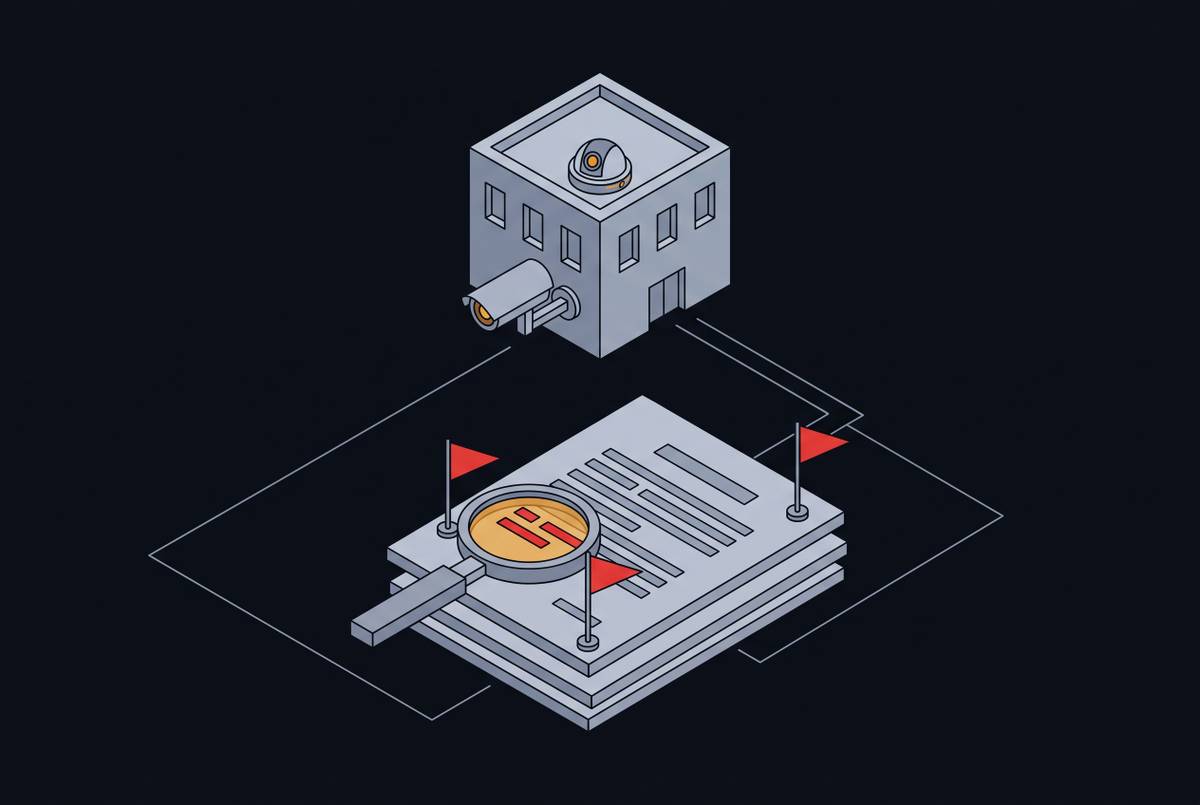
You're told to check for certifications when you evaluate monitoring vendors, but the market offers no shared standard for which credentials actually predict performance. A facility can hold a stack of logos on its sales sheet and still fail the one test that matters to a buyer: will this vendor catch a real threat and respond before it becomes an incident? Most certification audits never ask that question. They ask whether a building meets code, whether equipment has redundancy, and whether you can document administrative processes. Those are reasonable things to audit, but they are not the same as auditing speed, accuracy, or judgment under real alarm load. Treating certification as a proxy for competence, when it is frequently only a proxy for compliance with process-level minimums, leaves buyers exposed to a specific and costly failure: a verified threat sitting in a queue behind dozens of unreviewed routine alarms, a structural failure that a facility-compliance credential was never built to catch.
What a certification needs to test
The failure mode at the center of traditional monitoring is a queue problem. When alarm volume outpaces what a human operator can process, genuine threats wait in line behind routine noise, and no facility-compliance credential detects that gap, because none of them measure queue behavior. Operators have a hard ceiling on how many simultaneous feeds they can watch with real attention, and once that ceiling is crossed, the dynamic known as alert fatigue sets in: operators flooded with low-quality signals stop trusting their own queues, and critical events become easy to miss. A 2025 industry analysis found that 76% of cybersecurity professionals, including SOC leaders, named alert fatigue a top operational challenge, and the same dynamic governs physical video monitoring queues even though the context differs.
This is a structural problem, not a staffing problem. Adding more operators or muting noisy cameras trades away coverage or signal quality without shrinking the queue at its source. Alert fatigue produces two costly failure modes in surveillance operations: overreaction, where resources get dispatched to benign events, and underreaction, where unverified alerts get filed and a breach surfaces days later during a compliance review. Neither failure belongs to the operator. Both belong to the system that put more signal in front of a human than a human can reasonably judge.
A certification worth taking seriously has to test whether the monitoring architecture can get a verified threat in front of a qualified human within a defined, auditable window. Facility size and equipment inventory say nothing about that. Only a standard built around the queue itself can.
UL 827 and the limits of the central station baseline
UL 827 is the standard most buyers encounter first, and for good reason: it is the necessary baseline for any credible central station. Formally titled the UL Standard for Safety Central-Station Alarm Services, it audits physical infrastructure, redundancy, communications systems, and operational process. It confirms that a monitoring center is built and run to a defensible minimum. It does not confirm that the operators inside that building are fast or accurate once a real alarm load hits them.
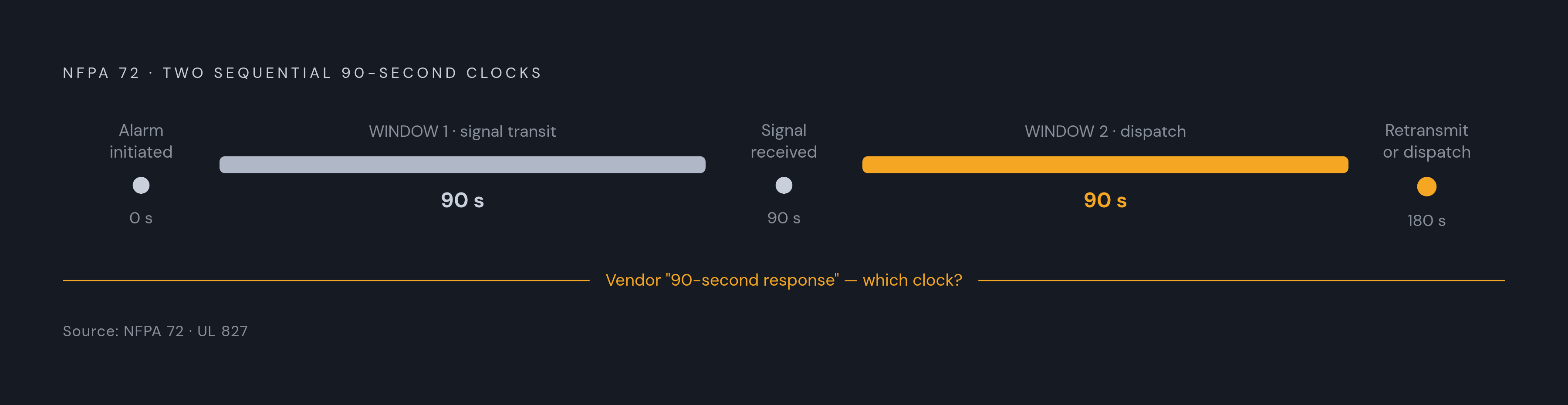
The standard's most operationally relevant feature is its dispatch clock, and the clock is more specific than it first appears. NFPA 72, which underlies this portion of UL 827, sets two sequential 90-second windows. The first runs from alarm initiation at the protected site to the signal's receipt at the supervising station. The second runs from that receipt to retransmission or dispatch. A buyer reading service-level language that promises "90-second response" needs to know which of these two clocks is being quoted, because a vendor can satisfy one without satisfying the other, and burglary signals in particular carry longer, separately defined windows than fire alarms do.
Compliance does not end at certification. UL conducts annual audits of every certified monitoring company to confirm it still meets the standard, and certification lapses if a center falls below the bar between those audits. What the standard does not do is test whether operators correctly separate genuine threats from environmental noise. It does not audit false-alarm rates or escalation accuracy, and it does not require any particular AI-assisted filtering or alarm validation workflow. UL 827 sets a floor. A vendor without it should be disqualified. A vendor with only it has cleared the minimum bar and nothing more.
TMA Five Diamond: what the operator credentialing layer adds and leaves open
Where UL 827 certifies a building and a process, TMA Five Diamond certifies the people running it. The Monitoring Association, known as CSAA before a 2017 rename, operates the Five Diamond Central Station program, and it requires operator certification training at Level 1, with Level 2 available, covering central station monitoring, technology, effective communication, emergency preparedness, and false-alarm prevention. Certified operators must recertify every three years, building a minimum recurrency standard into the credential and treating training as an ongoing requirement.
This is a genuinely meaningful addition, not a weak one. It shifts the requirement from a trained facility to trained staff, giving buyers a way to confirm that the people answering alarms have passed a structured competency evaluation rather than simply occupying a code-compliant building. Five Diamond narrows the vendor field to those willing to invest in operator development over time, and that investment is worth something concrete in a market where many vendors treat training as an afterthought.
What Five Diamond does not do is measure performance. It certifies that training happened. It does not audit response times under load, false-negative rates, or escalation accuracy on live deployments. A vendor can hold Five Diamond certification and still run a queue that buries real threats under routine noise, because the credential only operates at the training layer. Buyers need both UL 827 and Five Diamond, but those only clear the basic hiring and infrastructure bar. Neither one answers the question of whether the system, under actual alarm volume, gets the right event to the right person in time.
ANSI/TMA-AVS-01: the alarm validation standard that most directly tests what buyers need
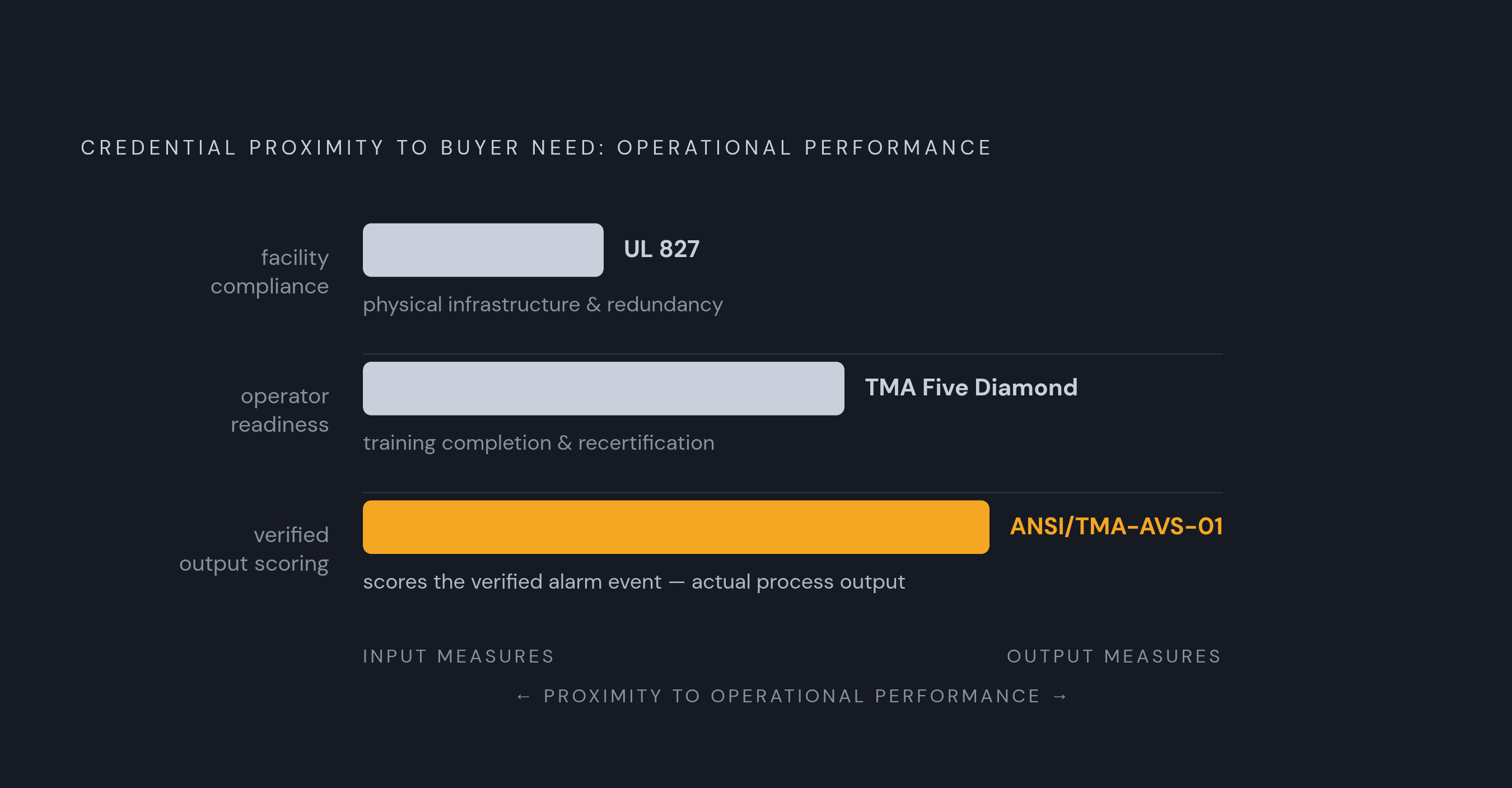
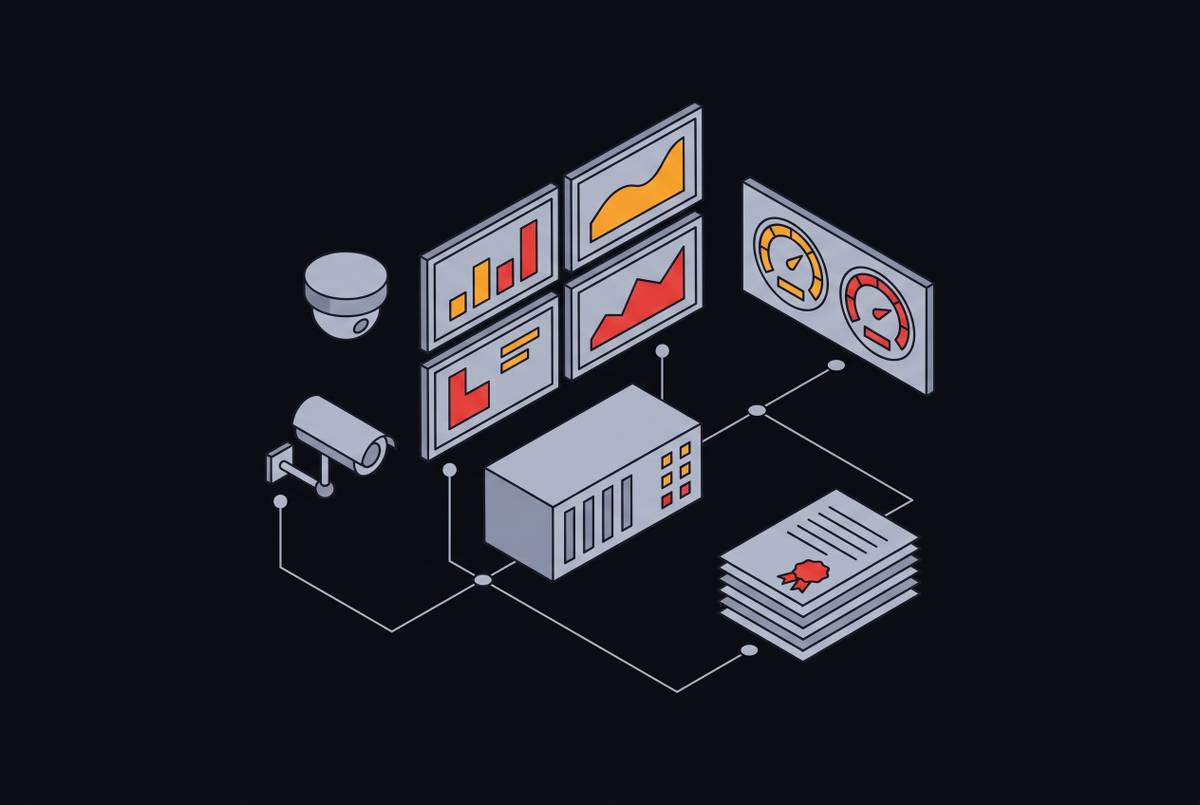
The credential that comes closest to measuring what buyers actually care about is ANSI/TMA-AVS-01, the Alarm Validation Scoring Standard. The current version received ANSI approval as a revision in December 2024, building on the original standard that first achieved ANSI approval in January 2023. What distinguishes it from UL 827 and Five Diamond is the target of measurement: AVS-01 scores the output of the monitoring process, the verified event itself, rather than the facility or the training that produced it.
AVS-01 establishes a scoring methodology for alarm validation events, creating a standardized classification metric meant to help law enforcement prioritize calls for service and allocate resources accordingly. In late October 2024, the executive committee of the International Association of Chiefs of Police ratified a resolution at its Annual Meeting in Boston encouraging public-safety answering points and emergency communications centers to use the standard. That endorsement matters because it comes from the end recipient of dispatched responses: law enforcement agencies formally recognizing that verification quality should be measurable.
The standard addresses a problem with real weight behind it. Research compiled by one industry group found that between 94 and 99 percent of police responses to burglar alarm activations turn out to be false alarms, and the cumulative cost of that false-alarm rate in wasted law enforcement time runs into the billions of dollars annually. AVS-01 is the framework built to replace that noise with a measurable, scored standard for what counts as a verified event. The standard also connects to a structured digital dispatch protocol that links monitoring centers directly to public-safety answering points. Centers that score well under AVS-01 are better positioned to operate inside that infrastructure, because the protocol depends on the same premise AVS-01 formalizes: that a verified alarm can be trusted enough to route automatically.
For a buyer, the practical move is to ask a prospective vendor whether its alarm validation workflow is documented and scored in a format compatible with AVS-01. A vendor that cannot answer that question is not yet operating at the level where verified output gets measured.
How site-specific protocol encoding shapes a certified vendor's performance
Holding every meaningful credential does not guarantee performance at a specific site, because alarm verification depends on context that no certification can encode in advance. A person climbing a fence at midnight is a criminal intrusion at one property and an authorized overnight contractor at another. Generic detection logic cannot tell the difference without that site's specific schedules, authorized activity, and response protocols built into the workflow from the start.
A security operations center's first job is converting an incomplete signal into a decision backed by evidence, and that requires knowing whether after-hours access was scheduled, what the corroborating camera footage shows, and what response threshold the site has defined for that type of event. Combining audio and video verification sharpens that decision further: the reviewing operator can confirm the number of individuals present, whether a weapon is visible, a vehicle description, and whether a crime is actively underway, all of which improves dispatch accuracy and gives arriving officers better situational awareness.
An AI-assisted filtering layer is worth something only under the same condition. If an AI agent knows a site's authorized activity windows, entry points, and access schedules, it can dismiss authorized events immediately and surface genuine anomalies for human review. An AI agent without that context flags both at the same rate, defeating the purpose of filtering. If you evaluate a vendor's performance at a specific property, ask for documented onboarding of site-specific parameters, a defined cadence for reviewing and updating those protocols, and evidence that the verification workflow distinguishes between sites.
What the AI filtering layer changes about certification weight
As AI agents take over the first pass of alarm review, the questions worth asking a vendor shift. Whether operators are trained no longer settles the matter; what matters now is how the system decides what reaches a human at all, and whether that decision process can be audited.
AI-first filtering attacks the queue problem at its root instead of leaving it for operators to manage around. AI agents review every alarm, dismiss environmental noise and authorized activity, and surface only verified threats to human operators. That differs fundamentally from raising detection thresholds to cut down on noise, which only converts false positives into false negatives and trades one failure mode for another. Agentic AI systems built for physical security can reason about what they observe, distinguishing people from vehicles from animals from ordinary environmental movement, without requiring a human to intervene at each step. That capability is what makes sub-90-second verified-threat escalation an operational reality.
This changes how the existing certifications should be read. UL 827's 90-second dispatch window becomes both more achievable and more meaningful once AI pre-screening clears the noise before the human clock even starts. A vendor that claims UL 827 compliance while still routing every alarm into a human queue first is running the standard the way it was designed for a pre-AI architecture, not the way current technology allows. AVS-01 grows more important rather than less in this environment, because its scoring methodology is the mechanism that documents whether AI-assisted filtering is actually improving verified-response rates or simply shifting the false-negative burden from a human queue to an algorithmic one.
None of this eliminates the human operator. It sharpens the operator's role. Trained, credentialed staff under Five Diamond become the judgment layer for alarms that AI has already verified and escalated, instead of the first-pass triage layer that absorbs raw alarm volume. That is the function TMA credentialing was always best suited to test, and AI filtering finally lets operators perform it under conditions where their judgment can be trusted.
The questions to ask a monitoring vendor after reviewing their certifications
Certifications establish a floor; a buyer must ask further questions after reviewing them to find out whether a given vendor performs above that floor at the sites and threat scenarios that actually matter. On UL 827 compliance, ask what the verified elapsed time is from alarm receipt to human operator review, not dispatch but review, and how that figure is tracked across the vendor's highest-volume periods. On Five Diamond, ask what the operator recertification schedule looks like and how coverage is handled during recertification cycles without degrading response time. On alarm validation, ask whether the workflow is documented and scored in a format compatible with ANSI/TMA-AVS-01, and request aggregate verification accuracy metrics from deployments comparable to the buyer's own site. On site-specific protocols, ask how the vendor encodes a given site's authorized-activity schedule into its verification decision process, and how often it reviews and updates that encoding. On AI-assisted filtering, ask what role the AI agent plays in the alarm review workflow and what the documented escalation path looks like from AI detection to human operator decision, including time benchmarks. On accountability, ask what a sample incident report actually contains, specifically whether it shows event time, operator actions, dispatch details, and resolution, so performance can be evaluated against evidence. A vendor that cannot answer the AVS-01 and site-protocol questions with real specificity is operating at the credential-compliance layer rather than the performance layer, and no number of logos on a sales sheet changes that distinction.