Sensor Fusion and AI Triage for Unmanned Freight Yard Cargo Theft Detection
Sensor fusion and AI triage cut through false alarms to catch cargo theft as it happens.
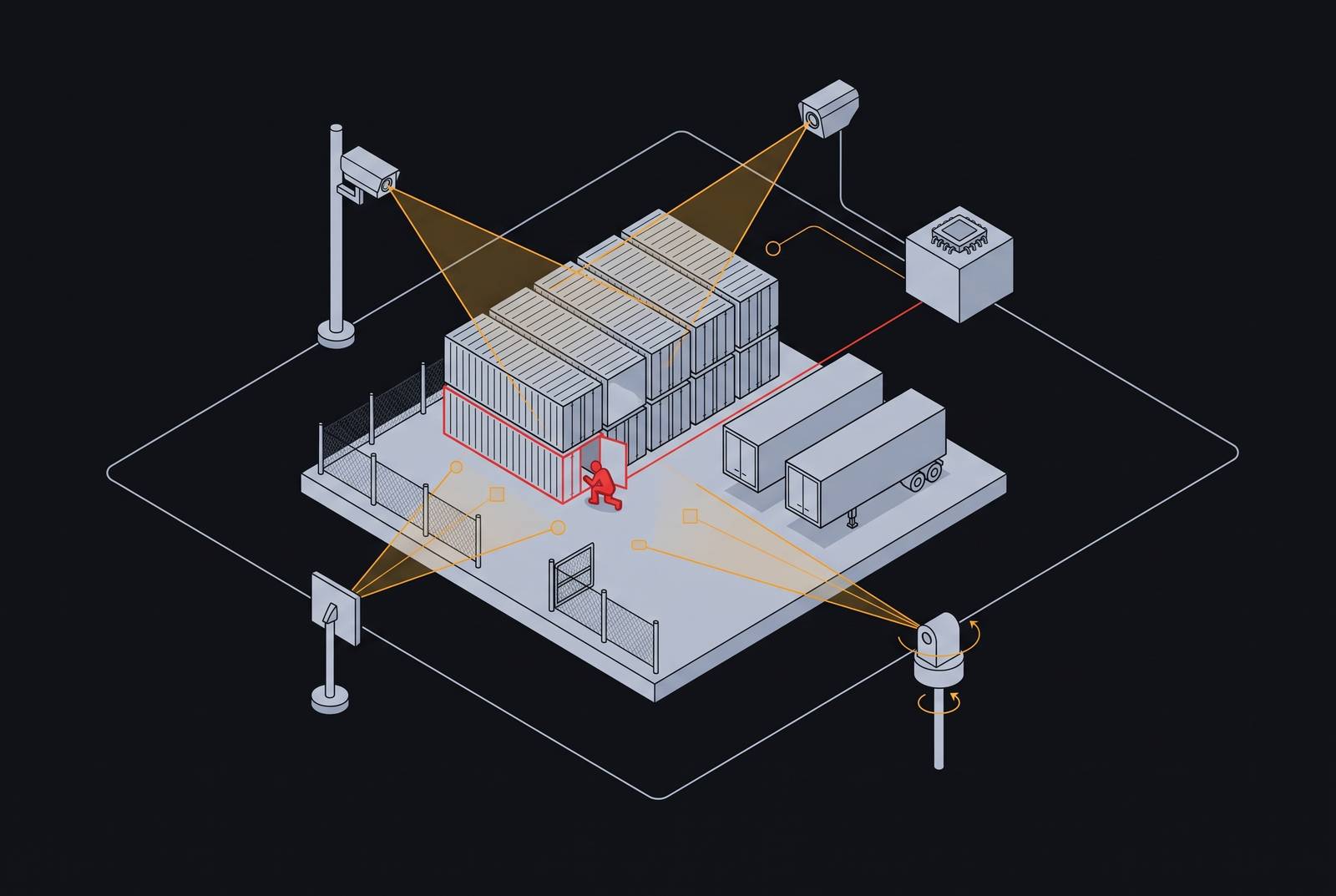
AI-augmented remote video monitoring for truck yards and freight facilities needs sensor fusion and AI triage as well as video alarms. Combining video, on-cargo telemetry, location integrity, access data, and behavioral signals allows the system to corroborate suspicious activity before alerting an operator. For unmanned yards, the decisive improvement is filtering environmental noise before it enters a human review queue, so trained operators can act on verified anomalies while a theft is still unfolding.
Why unmanned freight yards are the dominant target for organized cargo theft today
Organized cargo theft has moved from highway hijackings toward stationary freight yards, cross-docks, and distribution hubs because goods that sit still are easier to take than goods on the move. Unmanned yards make that strategy easier to carry out. Theft rings study delivery schedules, employee shift rotations, and camera blind spots before they act, and plan around the lack of anyone who would challenge them right away. The threat is therefore not limited to an intruder crossing a fence after hours.
A fraudulent pickup can instead begin with cloned credentials, spoofed emails, or a false carrier identity that makes the transaction look authorized. Cargo then leaves through the front door. GPS spoofing, cyber-enabled rerouting, and insider leaks give thieves more ways to make a cargo movement look authorized when it is not. These tactics can produce yard breaches without broken seals or visible perimeter failures, so a quiet fence line does not establish that freight is secure. Detection must account for both entry into the yard and what happens to cargo within it.
Why the perimeter-alarm model fails unmanned yards on two simultaneous fronts
The first failure is a mismatch between what individual sensors report and what security teams need to know. A trailer-level GPS tracker’s report is limited to the trailer’s position when freight is moved, misrouted, or handled inside a facility. Access records have a similar limitation. A valid badge or cloned carrier identity can pass the access check without giving a perimeter alarm any reason to trigger.
The second failure occurs downstream, where operators must interpret more footage and alerts than their attention can sustain. Watching many live feeds wears down attention, and most CCTV footage is never watched. That noise consumes the same review capacity needed for genuine threats, and repeated false alarms erode trust in the system. The resulting backlog reflects an architectural failure.
Muting alerts, ignoring certain cameras, and delaying reviews are predictable responses to a system that cannot filter its own output. Adding cameras can deepen that burden without resolving the original visibility gaps. More inputs do not necessarily produce better decisions. Because many freight-yard thefts execute in minutes, an unreviewed alert’s time in the queue may be the interval in which the cargo disappears.
What sensor fusion actually means in a freight yard context
Sensor fusion combines observations from different sensing layers so that no single device bears the full detection burden. Video shows what happened, while on-cargo telemetry records changes that a trailer location or gate record cannot explain. Door-state monitoring combines magnetic position with light intrusion detection to establish whether a door has opened and ambient light supports evidence of physical access. Movement and tilt sensors capture handling that departs from expected loading or unloading patterns. Each layer contributes a different kind of evidence.
Vibration analysis adds a distinction between normal motion and cutting or prying activity on seals, locks, or container walls. Environmental sensors supply another source of context. Temperature, humidity, light, and CO2 readings can flag conditions inconsistent with the shipment manifest, particularly for regulated or high-value cargo. Together, these inputs make the cargo’s condition observable during yard dwell rather than leaving the facility as a gap between pickup and delivery.
Location integrity complements this sensing. Multi-band GNSS reduces dependence on a single satellite system, while assisted GPS and cellular triangulation corroborate position. Dead-reckoning maintains continuity during degraded signals or jamming, and jammer and spoofing detection identifies deliberate interference. Route corridor enforcement adds a behavioral constraint by testing movement against approved corridors as well as a geofence. A truck idling just inside a boundary can satisfy the latter without establishing that its behavior is appropriate.
Access and identity data connect those physical observations to authorization. RFID access logs with timestamps establish an auditable event sequence, while license plate and tractor VIN matching test whether the vehicle matches the registered carrier identity. Yard management integration supplies pre-approved entries within the operating workflow. Devices evaluate conditions locally and generate alerts without depending on delayed cloud analysis, giving the AI layer timely evidence to interpret.
How AI triage converts fused sensor data into verified, actionable alerts
AI triage evaluates the relationship between signals rather than treating each sensor event as an independent alarm. It is not simply faster motion detection. A rule-based system triggers when an event matches a prescribed condition, but organized theft rings can deviate from the patterns those rules anticipate. Behavioral analysis instead evaluates sequences, including dwell-time anomalies, irregular stop timing, repeated short stops consistent with pilferage, and inconsistencies between tractor and trailer identity.
Driver patterns evaluated across trips can reveal cumulative drift that a normal-looking stop would not expose on its own. Temporal sequence models track how behavior changes over time, while graph-based identity-behavior correlation links who someone is with what they do. Unsupervised clustering can find unfamiliar patterns without needing a template from a past incident, and multi-signal threat fusion weighs sensor abnormality scores together.
Confidence scoring then determines which detections become alerts. A detection must exceed a defined threshold, and confirmation across consecutive readings or frames helps suppress transient noise. Verification precedes the operator’s review. This is the operational distinction between first-generation analytics and agentic systems. The former still need a person to check each flagged detection, while the latter make validated detections ready for action by default and bring confirmed, high-confidence events to a person’s attention.
The intended output replaces the alarm backlog with a short set of verified anomalies. That difference must be visible in response measurement. “MTTR” can obscure whether a vendor means time-to-acknowledge or time-to-contain, which are not interchangeable. When theft can complete in under five minutes, triage latency can delay a usable alert until after the theft, while containment records whether the threat was actually stopped.
Why site-specific context determines whether AI detections translate into useful responses
A verified observation is not automatically a useful security alert. The same loading pattern can be normal at one facility and suspicious at another because schedules, authorized carriers, and gate workflows differ. Authorization must be defined locally. Firearms detection at access points, perimeter intrusion at fence lines and loading docks, unauthorized-person detection, loitering, abandoned objects, and access-pattern anomalies all need site context to guide the appropriate response. The system must distinguish what it can observe from what that observation means here.
An off-window truck arrival illustrates the dependency. To recognize a schedule violation, the AI needs a reliable truck detection, the facility’s receiving schedule, and the relevant carrier authorization. Pallets moving in the wrong direction similarly require knowledge of expected cargo flows. A loading pattern that contradicts a scheduled inbound shipment becomes meaningful only when the operational plan is available for comparison. Yard management integration belongs in detection logic from deployment, where it does more than help with paperwork.
Automated access based on truck numbers and authorized personnel also depends on an up-to-date registry, with human verification available when necessary. Maintaining that context imposes a configuration burden. However, a generic behavioral baseline avoids that work only by generating false positives at a higher level, where the observation may be correct but the inferred threat is not. Site-specific configuration helps the AI filter out anomalies that pose no threat at that site. It also gives human operators the context needed to resolve the ambiguous cases that remain.
Where human operators fit when AI handles the filtering
A centralized security operations center can cover a large portfolio of facilities when AI pre-filters feeds and presents verified events through cross-site dashboards. Edge nodes keep bandwidth use in check without needing a person at each yard. The operating model changes with the information flow. Operators receive a concentrated set of situations requiring action rather than an uninterrupted demand to distinguish ordinary activity from threats.
People still need to use their judgment when a flagged event is unclear or involves a site-specific exception they have not seen before. Operators also supply the authority and communication needed to escalate a response to on-site security, shift supervisors, or emergency workflows such as RapidSOS. Integrated routing can alert the on-duty security officer, the shift supervisor, and emergency response workflows at the same time, where those resources are available. That permits lockdown or interception to begin while the threat remains on site. Detection has value because it enables action.
Voice-down deterrence is one such intervention, with a remote operator addressing a detected intruder directly. The decision requires real-time judgment about escalation or de-escalation. AI detection makes the opportunity visible, while the operator decides how to use it. This division of work allows a smaller monitoring team to support more facilities without reproducing the legacy queue at each additional site. The gain depends on removing routine filtering from the human workload.
How can buyers tell whether AI video monitoring actually solves the queue problem?
Security buyers should evaluate where filtering occurs before comparing systems described as “AI-powered.” Does it combine video with on-cargo telemetry, location integrity, and access control data, or does it analyze video alone?
Buyers should also check whether a human must still review every detection the AI flags. If so, the queue persists at the human review stage. Buyers should ask for the measured interval from alarm trigger to a verified, human-reviewed alert and whether that interval is documented in an SLA. They should also require the vendor to distinguish time-to-acknowledge from time-to-contain. Those definitions expose whether the promised response measures the start of a process or an action against the threat.
Does the system ingest schedules, authorized carrier lists, and expected cargo flows, and can its confidence threshold be adjusted for each facility? A useful evaluation asks whether it can distinguish a loading pattern that contradicts a scheduled inbound shipment from ordinary yard activity.
The relevant distinction is not how quickly a system can announce that something happened, but how quickly it can present a corroborated event for an appropriate decision. That is the test of the upgrade. A system that still requires people to clear raw detections preserves the bottleneck that makes unmanned yards vulnerable, regardless of the label attached to its analytics.