Video Monitoring Contract Red Flags for Commercial Properties
Vague contract language masks a system that cannot reliably deliver fast response.
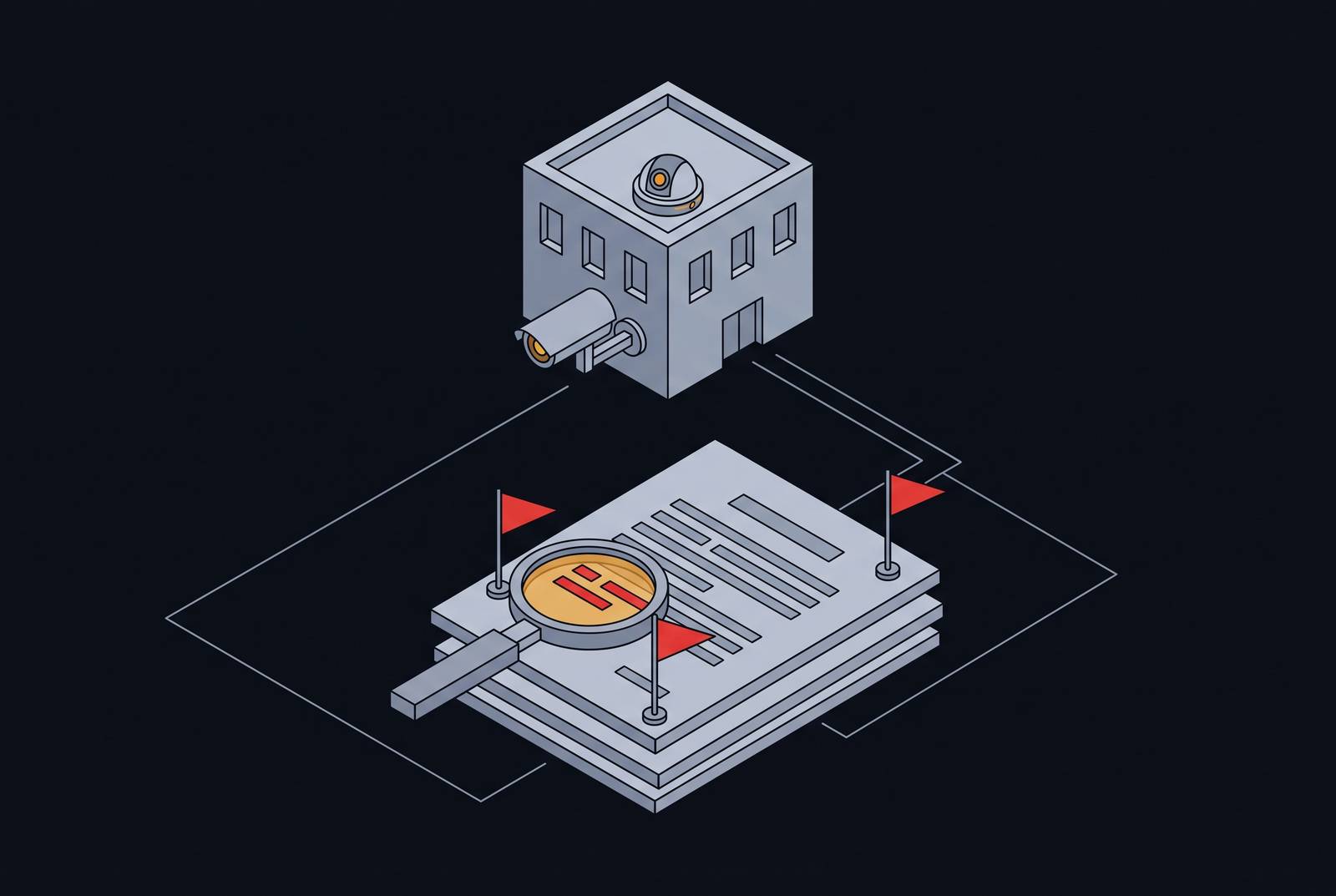
A commercial property buyer signs a video monitoring contract expecting a simple thing: someone watching the cameras, ready to act when something goes wrong. The contract itself rarely says that. Phrases like "around-the-clock monitoring" and "best effort response" read as guarantees of attentive coverage, but they commit the vendor to nothing a court or an auditor could measure: no defined start time for the response clock, no named person accountable for the next step, no penalty if the vendor misses the mark. The distance between what the marketing language implies and what the contract actually binds the vendor to is not a drafting accident. It reflects a monitoring model whose operational core cannot reliably deliver fast, verified response at scale, and the contract language is written to avoid promising what the system underneath it cannot do. A buyer who stops at the service description and never reads the SLA, the escalation terms, and the protocol language has no way of knowing which version of "monitoring" landed on the invoice.
The physics problem that legacy monitoring contracts are written around
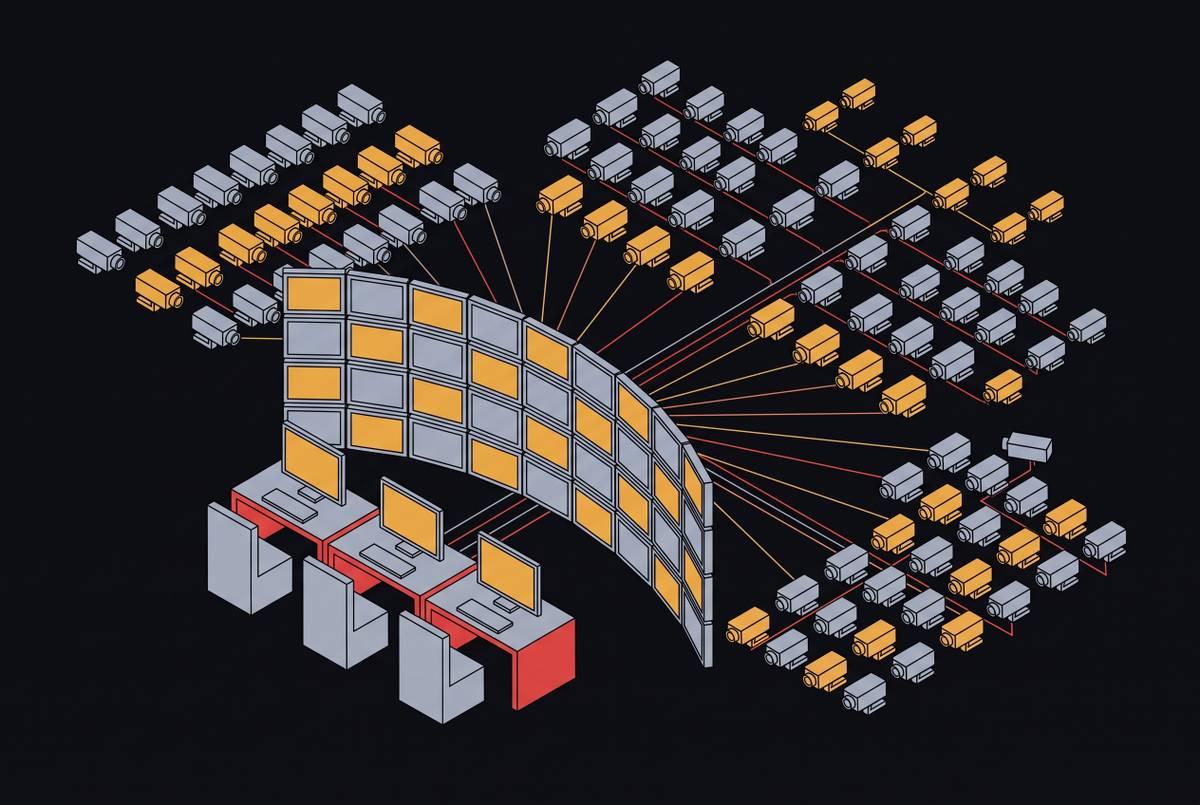
The alarm queue at the center of legacy monitoring cannot be fixed by hiring more staff. It is a capacity limit built into how a human operator processes incoming alerts, and no clause in a service agreement changes that limit. A person watching multiple low-signal video feeds for a full shift will lose sharpness well before the shift ends; research on sustained visual attention shows that even trained professionals hit that wall, and experience narrows the gap only slightly. Motion-based triggers make it worse rather than better: a shadow moving across a parking lot, a tree branch in the wind, a delivery truck idling near a fence line each throw an alert into the queue, and across dozens or hundreds of cameras that queue never actually empties. Once most of what lands in the queue turns out to be nothing, operators adjust the only way a person can: they slow down, they treat incoming alerts as lower priority by default, and a genuine threat sits indistinguishable from the noise around it.
The behavior that follows is predictable rather than careless. Alerts get cleared in batches without individual review, a sensor that fires too often gets muted outright, and a signal that looks like a hundred others before it gets pushed to the bottom of the list. The brain stops treating repetition as information once repetition stops carrying consequences. And because legacy systems route everything through a single human checkpoint, that checkpoint becomes the single point of failure: when the operator assigned to a site is overloaded, stepped away, or simply buried under volume, there is no second path for a real threat to take. It waits in the same line as everything else.
This is the architecture that legacy contracts are actually written for. The vague response language, the silence on who owns escalation after the first alert, the absence of any defined resolution target: these are not oversights that a better lawyer would have caught. They are the contract form that fits a system that cannot credibly promise anything firmer.
What "response time" clauses measure, and what they leave out
Response-time language in a legacy monitoring contract tends to measure whatever is easiest to put a timestamp on, not the outcome a buyer actually cares about, which is whether a threat got stopped.
The first gap appears in how "response" gets defined. A contract may report Mean Time to Acknowledge as if it were Mean Time to Respond, and the two are not the same thing: an operator clicking to acknowledge an alert is a timestamp, not evidence that anyone did anything about the alarm itself. A second gap sits beside it. Many contracts set a target for how fast an alert gets acknowledged but say nothing about how fast it gets resolved, which leaves the buyer with a clock on the least meaningful step in the chain and no enforceable standard for the step that matters.
A third gap hides inside the uptime guarantee. An uptime SLA usually covers whether the platform or API is technically available, not whether an operator is paying attention or whether the alarm queue is backed up by hours. A system can report a high uptime percentage while the humans watching it are buried and slow, and the SLA will never register the difference.
The last gap is financial. A contract that sets a response target but attaches no service credit or penalty to a missed one is making a promise with no cost to breaking it. That kind of clause reads like a commitment on the page and functions like a marketing statement in practice, because nothing changes for the vendor if the target is missed.
The absence of site-specific protocol language is a more consequential gap than a missing SLA
An SLA that is slow or loosely worded is a problem. A contract that never defines what a correct response looks like for a given event, at a given site, is a deeper one, because it leaves the vendor with no standard to meet and the buyer with no way to check what actually happened. Speed without context produces a response that looks verified on paper and means nothing in practice.
Take a door alarm. An operator sees it fire and goes to investigate, but if the contract doesn't specify that this particular door has an authorized contractor access window on Tuesday mornings, the operator has nothing to work from. There's no way to tell an intruder apart from a vendor who left a service entrance unlocked, and the buyer may never find out afterward whether the response was fast, correctly classified, or wrong in a way that matters. A dozen variations on this gap show up across most legacy contracts: language that promises to respond "promptly" or "as needed" without naming the event type it covers, who owns the next step, or how that response gets measured; silence on escalation ownership past the first notification, so a disputed incident has no accountable party once it moves beyond the initial alert; incident reports thin enough that they skip location, sequence of events, actions taken, or outcome, leaving the buyer no record to spot a pattern or fix a recurring access problem; and patrol requirements with no checkpoint or timestamp attached, so a patrol that happened and a patrol that didn't look identical on paper.
Site-specific detail is the baseline condition that makes an alarm review meaningful at all: the schedules, the authorized activity windows, the approved vehicle routes, the access permissions, the post orders that let an operator, or an AI system doing the same job, tell a real threat apart from routine activity. This matters most at industrial sites, where meaningful monitoring depends on knowing which vehicle routes are normal, which pedestrian zones should stay empty after hours, where loading activity is expected, and what equipment status looks like on an ordinary day. A contract silent on that detail cannot support the judgment it is asking someone, or something, to make.
How headcount-linear pricing reveals the monitoring model underneath
The way a monitoring contract prices coverage tells a buyer more about the underlying system than almost anything else on the page, because pricing structure exposes whether the vendor has actually solved the queue backlog described earlier or just built a bigger staff around it. A contract that prices coverage in a straight line with hours watched or operators assigned has done the latter.
A staffed on-site guard post, and a headcount-scaled remote monitoring contract built the same way, both price roughly in line with hours covered: double the coverage, and the cost roughly doubles with it. Every added hour of coverage under that model gets exposed to wage inflation and to turnover in a labor market that stays tight for this kind of work. Remote video monitoring changes the delivery method, swapping an on-site guard for a watch floor and adding video verification, but it still scales with how many operators are on staff, and it inherits the same queue dynamics as the model it replaced: more cameras assigned to each operator means more noise reaching that operator, not better coverage of the site.
Two pricing patterns are worth checking for directly. One is a rate card that scales with hours watched or headcount, with no mention of an AI layer filtering alerts before they reach a person. Under that structure, the operator queue backing up is not a risk to manage; it's the default outcome as camera counts grow. The other is overage pricing tied to alarm volume, where the vendor charges more as alarms spike, which quietly rewards muting a noisy camera rather than reviewing it, the opposite of what the buyer is paying for.
A different model has software review every alarm before a human ever sees it, reserving operator attention for alerts that have already been verified instead of the full raw volume coming off every camera. Under that structure, cost doesn't need to climb in a straight line with coverage hours, because the thing driving cost in the legacy model, human attention spent per alert, has been reduced at the source.
What AI-augmented monitoring contracts should specify instead
A monitoring system where software reviews every alarm before it reaches a person changes what the contract can honestly promise, so you should expect the contract language to reflect that change rather than repeat the legacy template with a new label on it. Software-based pre-filtering shortens the time between an alarm firing and a human confirming it, because the gain comes from a change in the underlying architecture rather than a better staffing ratio layered onto the old one. A genuine threat that would otherwise sit in a legacy queue reaches a trained operator far faster once software has already done the first pass of filtering.
A contract built around that architecture should specify several things the legacy template leaves out. It should set separate, measurable targets for time-to-verify, covering the software review stage, and time-to-human-escalation, covering how fast a verified threat reaches an operator, because these are two distinct steps and each deserves its own standard. It should require notice when the underlying AI model changes, since a silent update carries real risk: agentic AI systems can fail through goal misalignment, flawed planning, and conflicts between competing objectives, and a buyer with no notice of model changes has no way to check whether the system reviewing their alarms is still the one they contracted for. It should treat site-specific protocol documentation as a deliverable rather than a reference to a generic post order: a written procedure for each event type at each site, naming who owns escalation and how performance gets measured. It should require incident reports that include location, sequence of events, actions taken, and outcome, since that's the minimum record a buyer needs to audit response quality or fix a recurring access problem. It should attach service credits to verified SLA breaches, because a financial consequence is what turns a stated commitment into an actual obligation. It should also keep video and incident data in the buyer's custody rather than the vendor's, which avoids both lock-in and the custody questions that arise if an incident ends up in a legal dispute.
None of this removes the human operator from the process. It restructures the role around the judgment calls that still require a person: final confirmation and the decision to dispatch on a verified threat, while software absorbs the repetitive, high-volume filtering that wears down human attention under the older model. Software can tell a person apart from an animal, or a vehicle on its usual route from someone loitering near a restricted area, and once that filtering happens automatically, operator attention is saved for the events that actually require a human to weigh in. The most serious escalations, calling law enforcement, responding to a life-safety incident, acting in a use-of-force situation, should require human review and sign-off by contract, not autonomous action by software.
When a contract's SLA terms, protocol language, pricing structure, and data custody terms all line up with this kind of architecture, it does more than read better on the page. It's evidence that the system behind it can actually deliver the response that legacy contracts only gesture toward.