Converting Passive Camera Infrastructure Into Active After-Hours Response for Multifamily Parking
AI triage lets operators respond to verified parking threats before the intrusion completes.
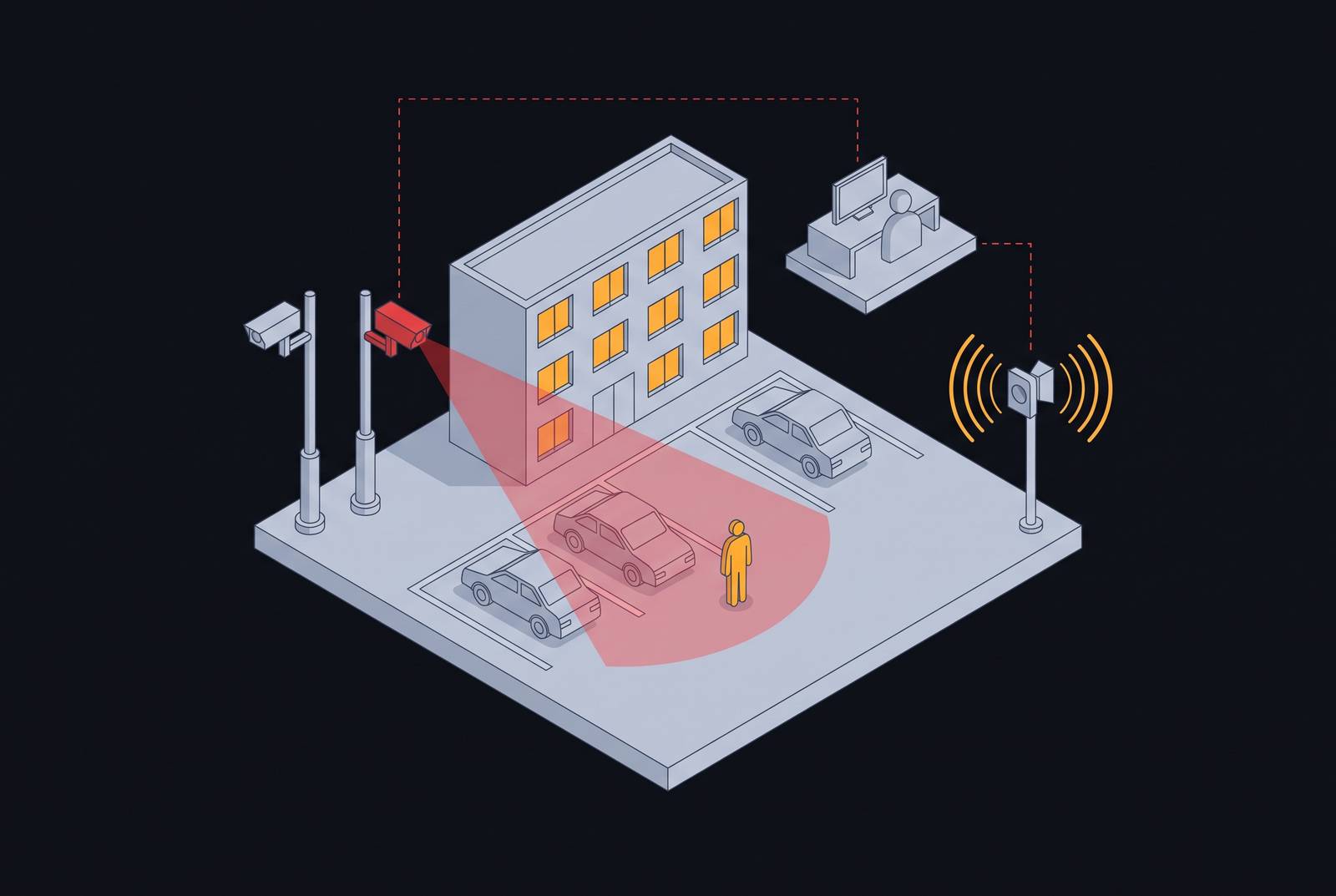
Turning passive cameras into an active after-hours response takes a triage layer that sorts environmental noise from genuine threats before alerts reach a trained human operator. For multifamily and employee parking lots, remote video monitoring protects the site only when someone acts on verified events in time. The decisive measure is verified-threat response time.
Why multifamily parking cameras are forensic tools, not security tools
At 7 a.m., a maintenance crew enters a multifamily parking lot and finds evidence of overnight break-ins. The cameras recorded the activity, and the footage is available for review. But nobody saw the threat in time. The property has evidence for an investigation rather than a response that could have interrupted the event. That distinction exposes the structural flaw in passive surveillance.
Passive CCTV was designed around retrieving footage after an incident. Recording can establish what happened within a camera’s view, but it does not assign anyone responsibility for acting while the event unfolds. An overnight intrusion can therefore be captured without producing an intervention. The missing component is the operational link between captured activity, a verified threat, and a person authorized to respond.
A property can have extensive recorded coverage while leaving the interval between detection and action entirely unmanaged. After hours, surveillance supports an immediate response when that interval is short enough, or only the next morning’s investigation when it is too long. Converting the system means changing what happens after footage is captured.
How the legacy monitoring queue turns a real threat into a waiting problem
Paying for monitoring does not by itself close that gap. In a legacy workflow, a genuine threat may enter the same queue as environmental movement and routine activity. Someone must look at each alert before they know what it means. Security Operations Centers can receive thousands of alerts every day, with a majority going unaddressed.
Fragmented systems make each queued alarm more expensive to assess. Video may appear on one screen, access control on another, and environmental sensors elsewhere. The operator becomes the integration layer, assembling context across systems before deciding what happened. Without clear priorities, a life-safety event takes the same sorting work at the start as a routine signal. Notifications, logs, callbacks, and escalations then repeat throughout the shift, creating more opportunities for errors as fatigue builds.
Adding staff increases capacity without removing this repetitive work. As alert volume grows, the strain returns, while operator turnover erodes the accumulated site knowledge that helps distinguish an anomaly from normal activity. Retention is therefore part of response quality. Muting cameras takes the opposite approach, reducing the workload by withdrawing coverage. Both approaches still leave the operator to make sense of an ambiguous signal, so the fix must come before the queue forms.
What raising thresholds or muting cameras actually costs a multifamily site
Raising an alert threshold can quiet the queue by leaving out events that used to trigger review. It can also exclude a genuine threat. A longer loitering threshold, for example, may stop alerts for harmless waiting but also let suspicious activity that lasts less time pass without an alert. Lower volume alone cannot show whether the change improved discrimination or merely converted false positives into false negatives.
Muting a noisy camera makes the trade more explicit. The camera still records, but it no longer contributes to active monitoring of that parking area. An overnight breach returns to the original forensic-only workflow, discovered after the opportunity to respond has passed. The infrastructure remains in place, which can obscure the operational loss.
Existing AI analytics do not resolve this objection. An overly sensitive configuration can fire repeatedly on shadows, headlights, and environmental movement, teaching operators to distrust its output. Conversely, an unexplained “possible” event can invite unnecessary escalation or dismissal as unverified. Both outcomes reflect missing context. AI analytics need better discrimination before human review.
How a triage layer separates environmental noise from genuine parking threats before the queue forms
Detection identifies activity, while reasoning evaluates what that activity means. A parking camera can trigger when a person remains stationary or paces within a defined zone for a threshold period overnight. During the evening peak, a longer window can account for residents legitimately waiting in parking areas. Time changes the interpretation of the same behavior. The reasoning layer combines that timing with the zone and the activity sequence before deciding whether the event warrants human attention.
This distinction extends beyond loitering. Approaching multiple vehicles in suspicious patterns, entering a restricted area after hours, and lingering in a low-traffic zone require different interpretations from resident, pet, or delivery activity. Defined-zone intrusion detection adds a precise boundary condition, distinguishing a crossing from movement nearby. Cross-system correlation then brings in evidence that video alone may not have. A perimeter alert assessed against access logs and camera status is more informative than an isolated sensor signal.
CORTEX research demonstrates how specialized collaborative agents can support this kind of triage. One agent examines behavior sequences, others gather evidence from external systems, and a reasoning agent synthesizes the findings into an auditable decision. The research reports reduced false positives compared with single-agent approaches, though it is not a parking-specific performance guarantee. In the parking workflow, the resulting verified event reaches the operator with a short video clip, location tag, and exact timestamp. The operator can assess the threat rather than first locating the camera and reconstructing the event.
Why site-specific context is what makes AI triage meaningful rather than mechanical
A person in a parking structure at 11 p.m. may be a resident returning home or someone entering without authorization. The time alone cannot distinguish them. Resident schedules, contractor access windows, parking zone boundaries, and access permissions tell the system what is allowed at the site. Opening and closing schedules and holiday hours can further change which activities are expected in each area. A site-wide rule loses these distinctions.
Video verification becomes more useful when paired with access-control activity. A camera view and credential activity can help distinguish a delivery truck, an employee with valid access, and a forced entry. Continuous AI attention can also build a baseline of normal behavior for the specific facility over time. Activity that is normal during business hours may need review off-hours or within a restricted zone.
The response rules need equally specific grounding. The monitoring center must know who may cancel an alarm, request guard dispatch, approve contractor access, or authorize police notification before an event occurs. Lin and Zhang’s failure-mode framework identifies insufficient environmental grounding as a source of goal misalignment and flawed planning in agentic systems. For parking operations, the practical implication is individual configuration of the parking structure, perimeter, breezeways, and restricted access areas. Those settings establish which decisions the system can make reliably and spare an operator from having to piece together permissions under pressure.
What response speed actually means when a threat is verified and a human acts on it
A 90-second benchmark for getting a verified threat in front of a trained operator provides a concrete response target. It is not a guarantee of interception. Operationally, speed falls into different categories, including action before the event ends, staff interception, and response useful only for investigation. The last category does little more than passive recording.
Alert delivery is a separate, shorter interval within that chain. A clip, location tag, and timestamp that arrive in under three seconds give the operator evidence to act on right away, but a wait beyond five seconds can already be too long for an active threat. Fast delivery removes retrieval work from the operator’s first moments with the event. Verification must then lead to an authorized response.
In a multifamily case, three days after proactive monitoring went live, at approximately 1:30 a.m., two individuals entered the back perimeter of the parking lot with backpacks and flashlights. The system detected the activity and issued an alert during the event. The documented account does not establish a subsequent interception or arrest. Its value here is the contrast with discovering the activity the following morning.
Verification can also improve the next handoff. Video-verified alarms get priority dispatch and a much faster average police response than unverified alarms because they confirm what happened, while unverified alarms leave the signal unexplained. That advantage extends beyond the monitoring center. Deterrence depends on this capacity for intervention.
The economics of active monitoring against the true cost of passive infrastructure
Treating active monitoring as just another cost on top of passive cameras starts the buying decision with the wrong comparison. Passive recording does not provide the response function being purchased. The relevant alternatives include a staffed guard post and the full cost of maintaining that coverage. An existing monitoring fee also says little unless someone can act on the alerts. A fragmented, high-volume queue can preserve the same delay under a paid contract.
Round-the-clock coverage at a single guard post requires three overlapping shifts plus relief coverage. That costs substantially more per month than remote video monitoring with live intervention capabilities. The difference extends beyond the initial quote. The cost of staffed coverage rises roughly with hours worked, and higher wages, turnover, and retraining add to the cost of running it. High turnover can also repeatedly remove the site knowledge that response quality depends on.
AI-augmented monitoring costs more than basic alarm-triggered review. Its economic case rests on reducing false alarms so that trained operators can concentrate on verified threats, making remote monitoring viable as a guard replacement. Once analytics are running, the marginal detection cost of another camera or coverage hour can approach zero. That does not make human response free. The property owner’s decision therefore turns on the coverage hours, verification quality, response authority, and staffing burden included in each alternative.
How do multifamily property managers secure parking lots after hours beyond cameras?
A layered configuration coordinates AI filtering and human response. The AI layer reviews alarms, dismisses environmental noise and authorized activity, and surfaces verified threats. The human operator receives the event with its video clip, location, timestamp, and site context. Each layer has a distinct job to perform. The operator’s responsibility begins with an actionable event.
For a property manager, the configuration work starts before the first alarm. Parking boundaries, resident schedules, contractor access windows, and emergency dispatch permissions must be encoded for the areas they govern. These details establish what counts as unauthorized activity and who can approve the next action. They also give the monitoring center a shared basis for escalation. Without them, fast triage can still end in a stalled decision.
Non-life-safety alarms require verification before dispatch, while panic, holdup, fire, and CO alarms require immediate dispatch with no verification delay. Filtering must not become a universal waiting step. This protocol provides an accountability layer for both the monitoring center and the property, defining when evidence is required and when immediate action takes precedence.
The expected service is continuous AI attention paired with trained, site-informed human judgment. Performance is judged by verified-threat response time and whether the operator has the evidence and authority needed to act. The decisive test occurs after hours. A real event in the parking structure at 2 a.m. must reach a trained human while intervention is still possible, rather than become another recording awaiting morning review.